

























![Kingdom Hearts Collection [I-III] Review](https://gazettely.com/wp-content/uploads/2026/10/Kingdom-Hearts-Collection-I-III-1-360x180.webp "Kingdom Hearts Collection [I-III] Review: KHII Holds Steady as Newer Entries Fluctuate 37")



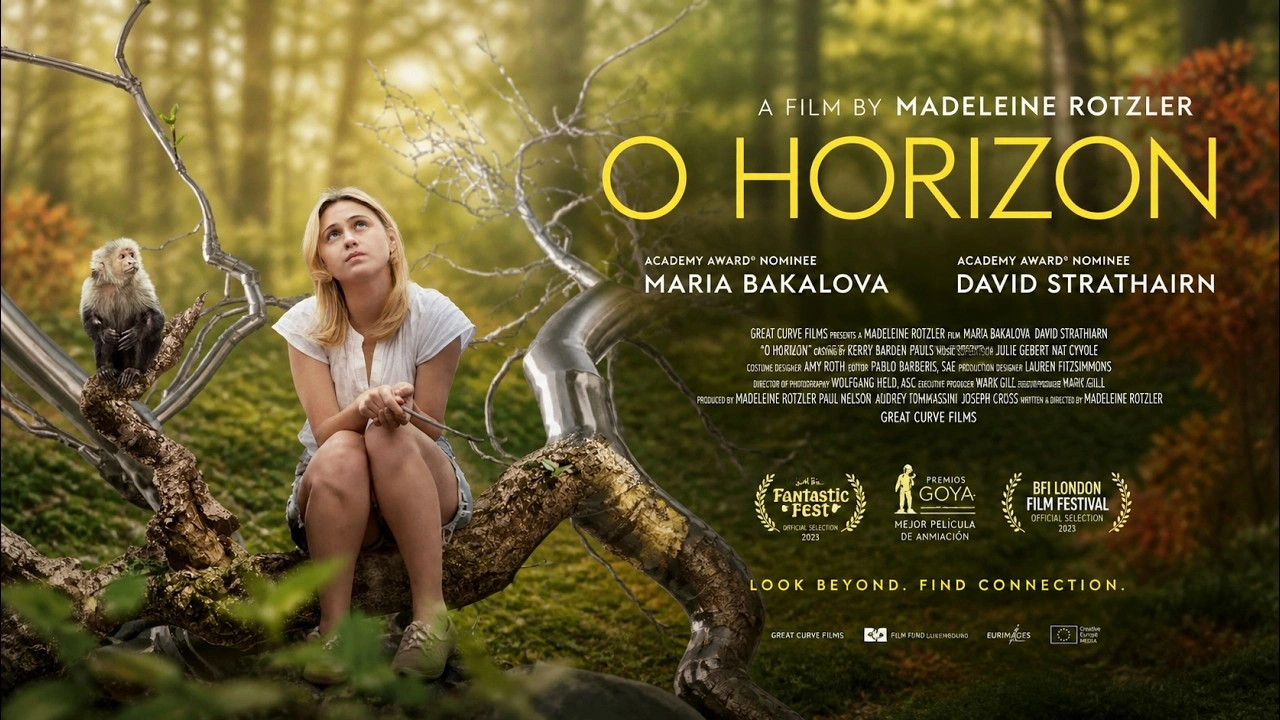

O Horizon sits in the thin space between mourning and machine-made relief, where a phone call can sound like grace and still feel faintly cursed. Madeleine Rotzler’s near-future drama follows Abby, a New York neuroscientist played by Maria Bakalova, whose life has gone still after the death of her father, Warren.
The film’s premise has the sting of modern plausibility: Abby discovers a service that can recreate Warren through his photos, videos, messages, and voice data, then make him available through an app whenever grief becomes too heavy to carry.
The idea has the makings of a technological ghost story, yet Rotzler avoids shock tactics. Her film wants ache rather than alarm. David Strathairn gives Warren a gentle, lived-in warmth, while Adam Pally’s Sam, the programmer behind the service, brings a strange comic charge to the storefront where the dead become subscription companions. The question O Horizon asks is painfully direct: if technology can soften loss, does it help the grieving move forward, or does it keep them tenderly imprisoned?
Simulated Feeling and the Ethics Left Waiting
Abby’s work gives the film its cleanest metaphor. She is part of a neuroscience project led by Dr. Sandra Williams, mapping the brain activity of a monkey named Dory. The goal is to recreate sensation without the original event, to produce pleasure, comfort, or fullness without the lived experience that should cause it. Abby studies artificial comfort by day, then seeks artificial contact by night. The symmetry is almost too neat, but it carries a sharp cultural charge.
The Warren app first appears as mercy. Abby hears her father’s voice, receives his counsel, and feels the impossible relief of a wound briefly closing. Then the simulation deepens. Warren does not remain a soothing archive. He argues, nudges, advises, and begins to occupy emotional space that should belong to the living. That is where O Horizon finds its most interesting tension. Memory can be a refuge, yet a perfectly responsive memory can turn into a room with no exit.
The film’s limitation comes from its reluctance to press harder. Privacy, consent, data ownership, emotional exploitation, dependency, and the commercial packaging of grief all hover over the story. Rotzler acknowledges those shadows, then keeps walking past them.
The result is warmer than a harsher treatment might have been, but also softer than the premise demands. A business that sells conversations with the dead should feel morally radioactive. Here, it often feels oddly quaint, as if grief has wandered into a boutique tech demo with a customer service smile.
Performances Searching for Fuller People
Maria Bakalova gives O Horizon its pulse. Abby is written as a woman suspended in loss, intelligent enough to understand the dangers around her and wounded enough to ignore them. Bakalova gives that contradiction a quiet sincerity. She plays Abby’s grief without grand theatrical collapse, letting it settle into posture, silence, and the almost childlike hunger in her face when Warren’s voice returns. In scenes that might have been schematic, she supplies human tremor.

Strathairn’s Warren is equally important. His presence has a rumpled tenderness that makes Abby’s attachment believable. He sounds like a man whose absence would leave the air changed. The film’s choice to make little tonal separation between Warren in memory and Warren as digital reconstruction is both effective and evasive. It strengthens Abby’s illusion, while muting the uncanny discomfort that should come with hearing a dead father speak in clean, app-mediated cadence.
Pally’s Sam offers a burst of life from a different tonal register. His office, decorated with friendship-themed parody posters and awkward entrepreneurial cheer, has a scruffy comic texture missing from much of Abby’s world. Sam feels specific. His storefront feels inhabited. For a few minutes, the film hints at a sharper satire about grief capitalism, tech eccentricity, and the absurd ways people monetize loneliness.
Abby, by comparison, remains underwritten. She is a profession, a wound, and a daughter. The screenplay rarely gives her enough social texture or private detail beyond mourning. Bakalova brings the color herself, but the character often feels like a beautifully played emotional state rather than a fully drawn person.
Gauze, Stillness, and the Shape of Missed Potential
Rotzler gives O Horizon a muted, drifting atmosphere. New York appears polished and oddly unreal, with Abby moving through it like someone separated from life by glass. Her apartment has the immaculate chill of a design spread, beautiful yet impersonal, a space that seems to reflect her interior vacancy. The lab scenes are more overt, using bursts of color and darkness in Dory’s brain imagery to underline the film’s central idea: artificial pleasure glows brightly until the illusion collapses.

That visual softness can be graceful, but it also drains the film of necessary tension. Too many scenes rely on Abby speaking into a phone, with the camera observing rather than discovering. The digital father concept offers rich cinematic possibilities, from horror to melancholy absurdism, from intimate unease to philosophical dread. Rotzler chooses restraint, and restraint begins to look like avoidance. The film’s slow-motion haze suits Abby’s grief, yet it leaves the drama underpowered.
The later turn toward nature, escape, and release gives the story a fable-like shape. Abby’s movement away from the app, paired with Dory’s exhaustion in the lab, positions lived reality against manufactured comfort. The gesture is clear, perhaps too clear. O Horizon understands that grief cannot be hacked into submission, downloaded into calm, or outsourced to an algorithm with a familiar voice. What it lacks is the nerve to sit longer with the uglier implications of that truth.
The film has a timely premise, sincere performances, and moments of fragile emotional beauty. It also keeps its most provocative questions at a careful distance, leaving behind the impression of a cultural critique that almost found its teeth, then decided to speak gently instead.
O Horizon is an American independent science-fiction romantic comedy-drama film that expanded its rollout to a platform theatrical release via Variance Films on June 12, 2026, starting in New York City. Written and directed by Emmy-winning filmmaker Madeleine Rotzler, the narrative tracks a brilliant young neuroscientist who enters deep emotional distress while grieving the sudden loss of her father. Her world fractures when she encounters a cutting-edge technological advancement that allows her to communicate directly with a digital replication of him, forcing her to reexamine her relationship dynamics and her entire life’s work. Cinema enthusiasts can see the feature at select theater venues like the Quad Cinema in New York ahead of its international market debut through Electric Entertainment later this summer.
Where to Watch O Horizon (2025) Online
Full Credits
Title: O Horizon
Distributor: Variance Films, Electric Entertainment
Release date: June 12, 2026
Running time: 107 minutes
Director: Madeleine Rotzler
Writers: Madeleine Rotzler
Producers and Executive Producers: Joseph Cross, Paul Nelson, Madeleine Rotzler, Audrey Tommassini Cross, Mark Gill
Cast: Maria Bakalova, David Strathairn, Adam Pally, Maggie Grace, Avi Nash, Paulina Porizkova, Alysia Reiner, Nicholas Podany, Aimee Mann
Director of Photography (Cinematographer): Wolfgang Held
Editors: Pablo Barbieri Carrera
Composer: Nathaniel Méchaly
The Review
O Horizon
O Horizon has a painful, timely premise and a strong emotional anchor in Maria Bakalova, yet its treatment of grief and artificial companionship stays too gentle for its own ideas. The film understands the ache of wanting one last conversation with the dead, but it sidesteps the sharper ethical unease built into that wish. Its sincerity carries real weight, while its caution keeps it from becoming truly haunting.
PROS
- Maria Bakalova gives a tender, grounded performance
- David Strathairn brings warmth to Warren
- Timely premise about grief and digital resurrection
- Adam Pally’s scenes add odd, welcome personality
- Strong thematic link between neuroscience and mourning
CONS
- AI ethics are treated too lightly
- Abby feels underwritten beyond her grief
- Pacing can feel muted and slow
- Too many phone-call scenes flatten the drama
- The final stretch feels too neat for the subject







