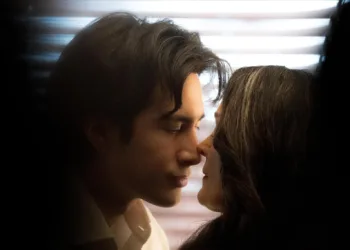
















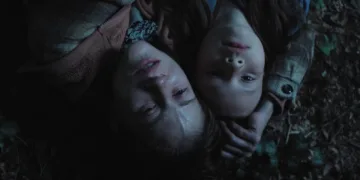











Sometimes reality feels like a poorly rendered simulation, full of uncanny valleys and moments where the physics just seems… off. Miguel Llansó’s Infinite Summer operates entirely within that glitch. It boots up with a familiar scenario: a summer trip to a lakeside cabin in Tallinn, Estonia. We meet Mia, a quiet intellectual on the cusp of adulthood, reconnecting with her childhood friend Grete, who has brought along a new, more confident friend, Sarah.
The initial scenes establish a palpable awkwardness. There is a weight to the silences between Mia and Grete, a shared history that now feels like a chasm. This is the fertile ground of a thousand coming-of-age films, but Llansó quickly corrupts the source code. The film’s inciting incident arrives not through a dramatic confrontation, but through a login screen.
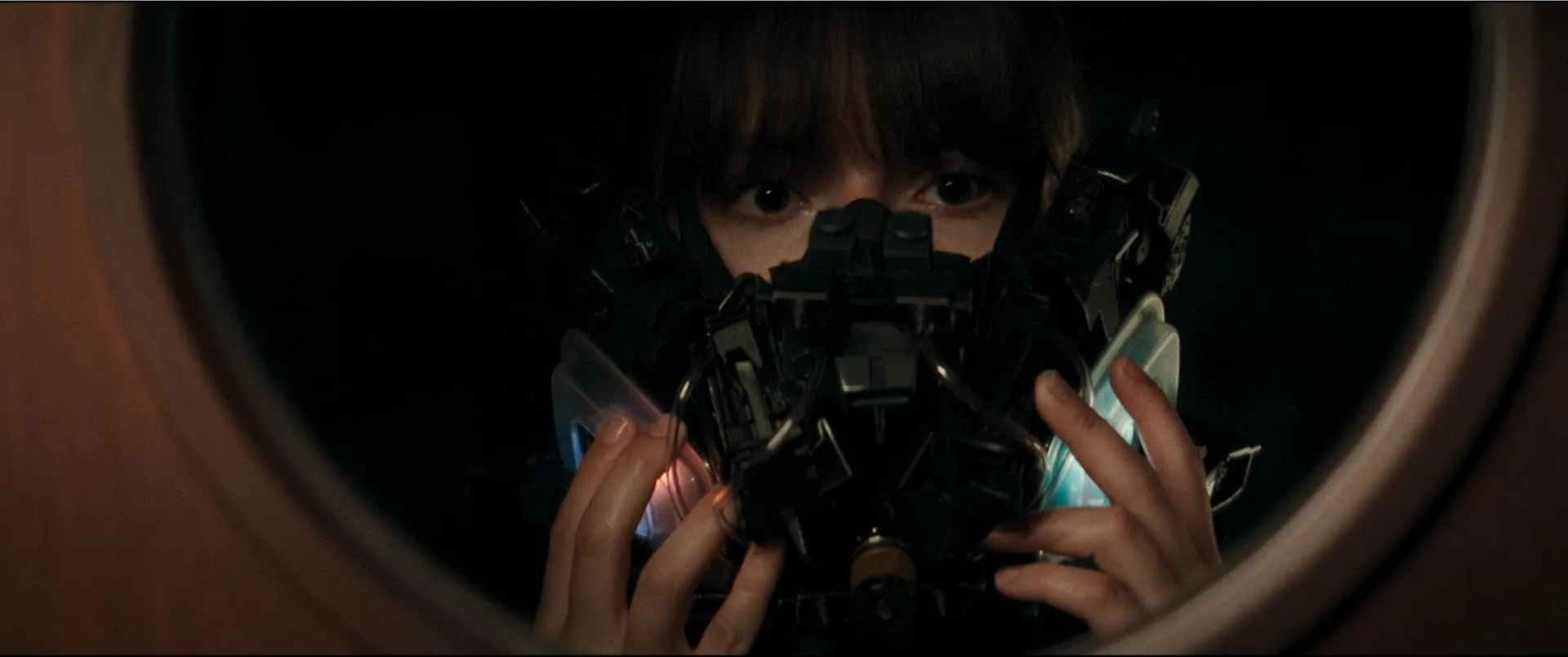
An augmented reality dating app introduces the girls to a bizarre avatar, Dr. Mindfulness, a guru who promises a higher state of being via a strange, gas mask-like respirator. This piece of speculative hardware becomes the portal into the film’s true nature: a psychedelic and deeply unsettling journey into digital escapism and the loneliness it fails to cure.
Logging In to Loneliness
The film’s emotional resonance is anchored entirely by Mia’s journey, which explores the anxieties of being left behind. Teele Kaljuvee-O’Brock’s performance is a study in quiet desperation; her character is an open circuit, waiting for a current. The growing bond between Grete and Sarah pushes Mia to the periphery, and Kaljuvee-O’Brock conveys this isolation with subtle, pained expressions that speak volumes.
The camera often catches her observing the other two, her face a mask of longing. When Dr. Mindfulness offers his technological shortcut to bliss, her decision to accept feels less like a reckless choice and more like a logical, desperate next step. The device itself functions as a compelling narrative mechanic. It promises connection but delivers a solitary, internal experience, a perfect metaphor for the false promises of social media.
The film presents a sharp critique of a world where apps are marketed as solutions for profound human problems. It understands that the allure of these digital fixes is strongest when our real-world connections are failing. The screenplay also delicately weaves in a thread of Mia’s unspoken attraction to another woman, Sisi, presenting another potential path to genuine connection that Mia is too hesitant to follow, making her retreat into the machine all the more poignant.
The Aesthetics of Disconnection
Visually, Infinite Summer is a meticulously designed fever dream. Llansó and cinematographer Israel Seoane use the cinematic language to amplify Mia’s psychological state. The ultrawidescreen aspect ratio is a key tool, often used to push Mia to the far edges of the screen, creating vast empty spaces in the frame that mirror her internal emptiness.

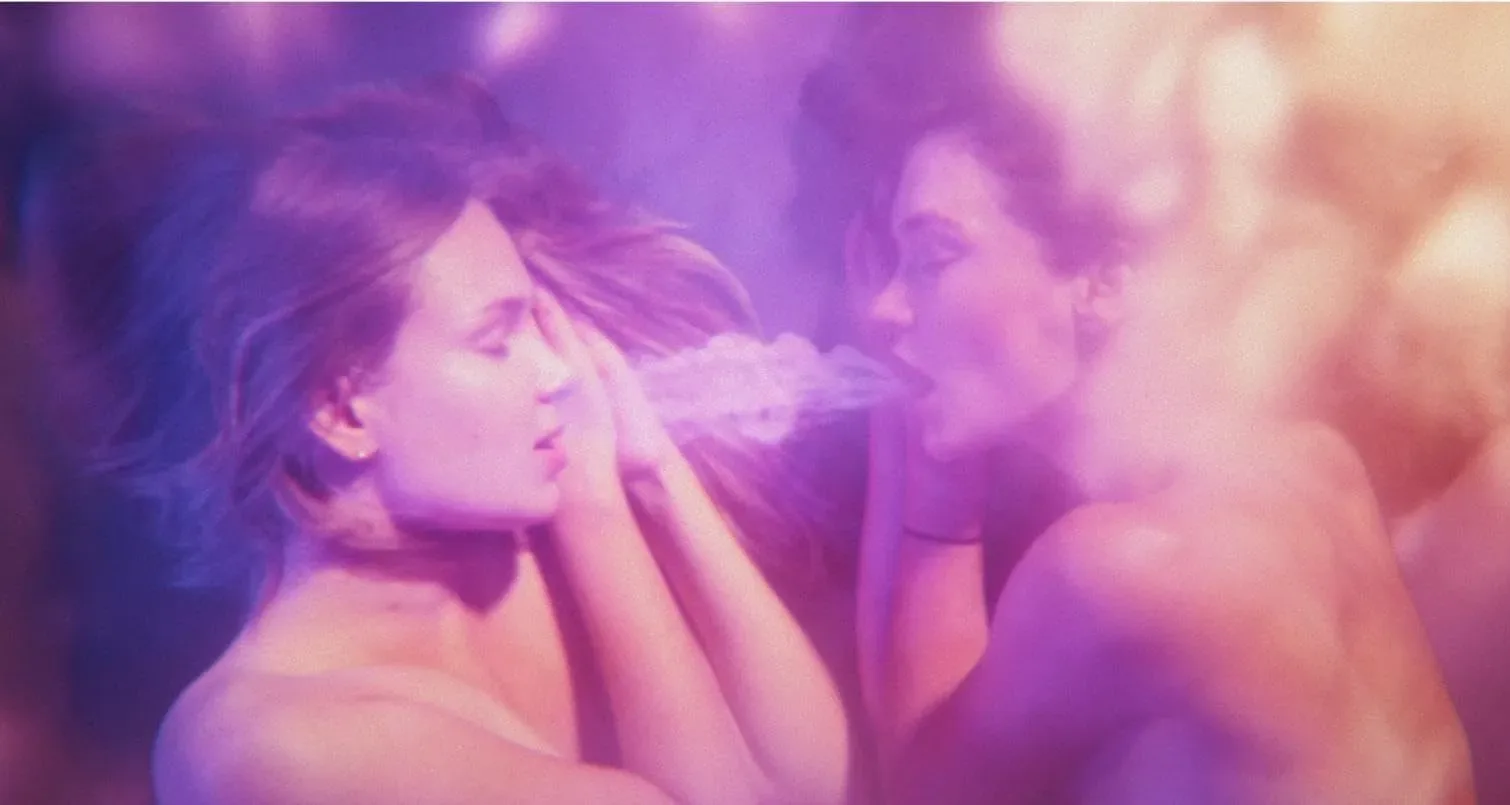
The film’s color palette functions almost like a UI element, clearly signaling the character’s state. Reality is rendered in muted, washed-out tones, giving the beautiful Estonian landscape a sense of melancholy. When a character puts on the respirator, the screen floods with a riot of artificial pinks, purples, and blues. The visual effects in these sequences have a deliberate, low-fi texture, recalling the glitchy, surreal aesthetic of early 2000s video games or the vaporwave art movement.
This is not a film striving for photorealism. Instead, it embraces its artifice, suggesting the “higher plane” is just a mess of beautiful, meaningless pixels. The electronic score from Laurie Spiegel is the final, crucial layer, a soundscape of unsettling drones and hypnotic arpeggios that feels like the machine’s own strange breathing, pulling the viewer deeper into its disorienting logic.
When the Plot Breaks
Just as you acclimate to the film’s psychedelic rhythm, Llansó intentionally crashes the program. The narrative abandons Mia’s perspective and abruptly reboots as a quirky, off-kilter police procedural. Two deadpan Interpol agents begin investigating Dr. Mindfulness, and their stilted line deliveries and bizarre behavior feel like they belong to a completely different movie.
This jarring shift is bound to alienate anyone expecting a conventional story structure. Yet, the choice feels purposeful. It forces the viewer into a state of confusion that mirrors Mia’s own dissociation. By sidelining its protagonist, the film challenges our very expectation of what a story should be. It suggests that perhaps the central narrative was never the point.
Like an experimental game that subverts player expectations, Infinite Summer asks us to find meaning not in the plot, but in the atmosphere and the experience of disorientation itself. The film is an ambitious, singular work that offers no easy catharsis. It is a cinematic trip for those who appreciate bold, challenging art that lingers in the mind, a beautiful system error you won’t forget.
Infinite Summer is a 2024 science fiction thriller adventure film, co-produced by companies in Estonia, the United States, and Spain. The plot follows three young women whose week at the beach transforms into a transhumanist mystery romp during one Estonian summer. The film, directed and written by Miguel Llansó, had its world premiere at the 28th Fantasia International Film Festival on July 27, 2024, and had a commercial release in Estonian theaters on April 11, 2025. It is distributed by Tallifornia.
Full Credits
Director: Miguel Llansó
Writers: Miguel Llansó
Producers and Executive Producers: Allison Rose Carter, Tõnu Hiielaid, Miguel Llansó, Rain Rannu, Jon Read
Cast: Hannah Gross, Johanna Aurelia Rosin, Teele Kaljuvee-O’Brock, Ciaron Davies, Denise Moreno, Steve Vanoni, Katariina Unt, Ivo Uukkivi
Director of Photography (Cinematographer): Israel Seoane
Editors: Velasco Broca
Composer: Laurie Spiegel
The Review
Infinite Summer
Infinite Summer is a challenging and hypnotic piece of cinema that prioritizes atmosphere over a conventional plot. It functions as a stunning, sensory experience, using its bizarre sci-fi premise to explore profound loneliness in the digital age. While its fractured narrative and deliberate ambiguity will prove frustrating for some, those willing to embrace its strange, fever-dream logic will be rewarded with a uniquely memorable and visually inventive film that lingers long after the credits roll. It is a bold, uncompromising vision for adventurous viewers.
PROS
- Visually striking cinematography with a distinct and effective color palette.
- A compelling and relatable lead performance from Teele Kaljuvee-O’Brock.
- Successfully creates a potent, psychedelic, and unsettling mood.
- Thought-provoking exploration of technology, isolation, and human connection.
- A bold and artistically ambitious approach to storytelling.
CONS
- The abrupt shift in narrative structure can be jarring and disorienting.
- Key emotional threads are sidelined in the second half.
- Its unconventional style and ambiguous plot will not appeal to all audiences.
- The deliberately stilted dialogue in some scenes can feel alienating.