














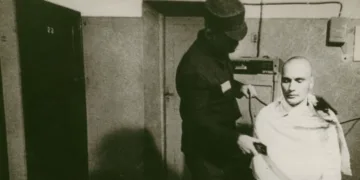





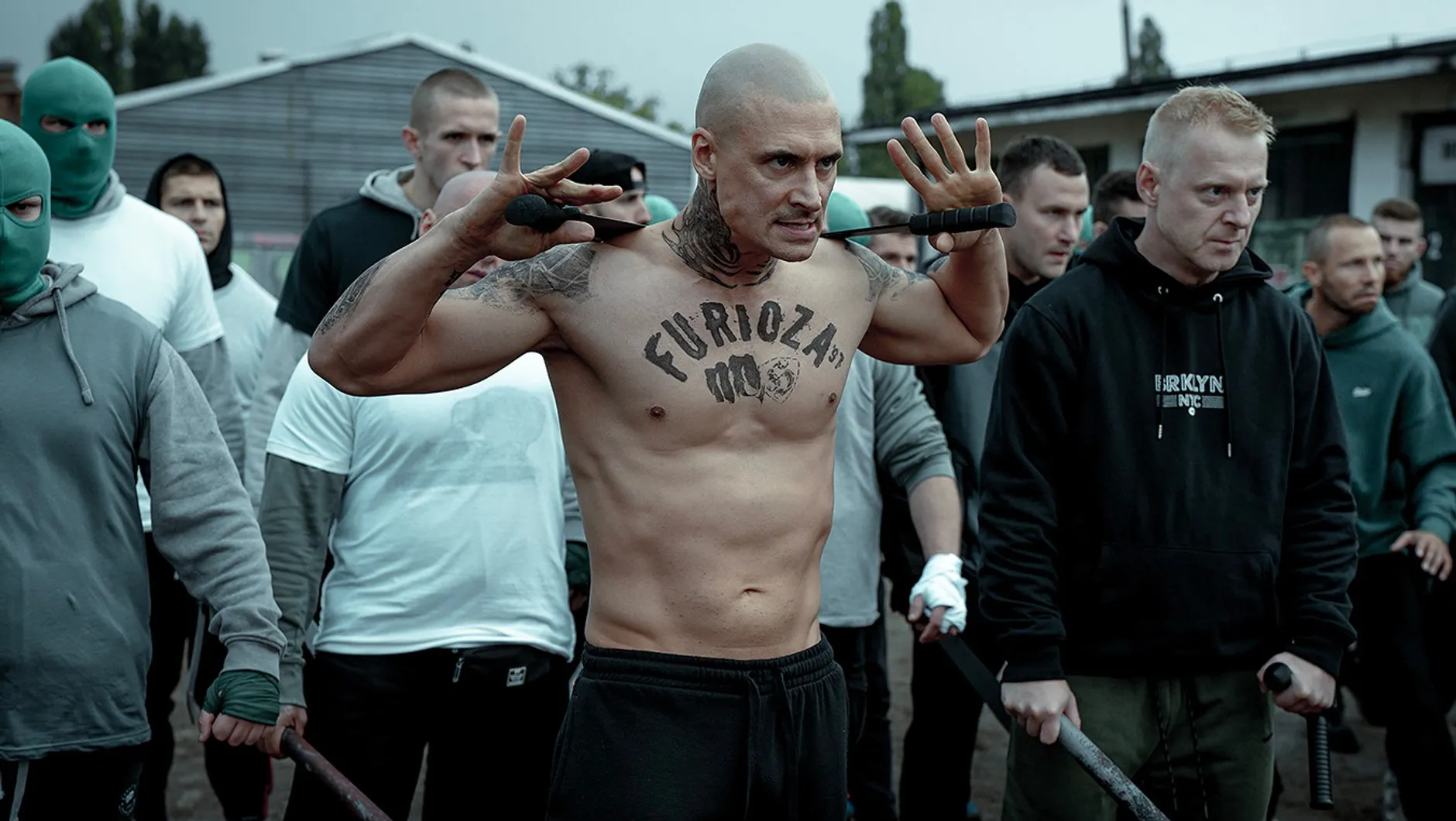

Cyprian T. Olencki’s Furioza Again (Druga Furioza) returns to Poland’s volatile criminal underworld and shifts the series from street brawls to a full gangster chronicle. The film concentrates on Golden (Mateusz Damięcki), a charismatic and reckless figure who leads the Furioza ultra gang. This chapter tracks his rapid, desperate rise and fall as he moves from local hooligan to international drug trafficker, ambition burning like a self-lit pyre.
Its most striking choice concerns placement in time. The story works as a midquel, a strategic side quest within the broader series that unfolds between the first film’s early movements and its bloody finale. The same raw, brutal energy remains and the scale grows to a sprawling, nearly three-hour crime saga. The effect aligns with the way sagas in European history often expand around a single conflict until the edges blur and only consequence remains.
The Midquel as a Fateful Parable
Revisiting events that precede a known, bloody endpoint invites a perception of “zero stakes.” Viewers who already know several destinies look less for surprise and more for procedure, the step-by-step march toward what cannot be dodged. That frame recasts the film from a crime thriller into a parable of fate, a morality engine that keeps turning even when the characters insist otherwise.
Golden’s trajectory plays like a “Scarface-on-steroids” ascent, a track-suited riff on classical tragedy. He expands to Dublin and sets up a pan-European route for the trade, a project powered by hunger that consumes rather than nourishes. The rise begins with the secret of a dead teammate, which seeds an original-sin narrative. What follows is an anatomy of decline that studies the legacy of violence.
A man tries to outrun an accidental killing and chooses criminal growth as his vehicle. The script maps an interior tug-of-war: gang loyalty against a fragile wish for normal life, embodied by the dancer Eli. That conflict defines the drama, larger than the logistical drug war with rival Mrówka (Szymon Bobrowski). The rivalry tracks toward an unconventional alliance that behaves like a political ceasefire, temporary and tactical, the kind urban histories remember for its brief calm before the next fire.
The film keeps circulating one question: how much power can cover guilt. It suggests that authority amplifies remorse rather than dissolving it. Golden moves, recruits, and negotiates, yet every gain carries a shadow ledger. The theme fits a Polish crime canvas marked by scars from earlier eras. The past sits on the present like heavy weather.
Cinematics of Excess and Endlessness
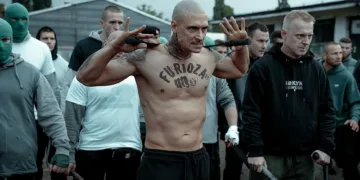
Olencki stages the material with flourish and panache, building a self-declared “hooligan epic.” The film stays intense, vulgar, and ferociously brutal, with machetes, heavy gunfire, and hectoliters of blood. Action sequences maintain velocity. A high-energy street shootout stands out, cars serving as barely sufficient shelter while the frame jitters with impact. The momentum creates a kind of raw naturalism, the camera registering shock as a physical fact.
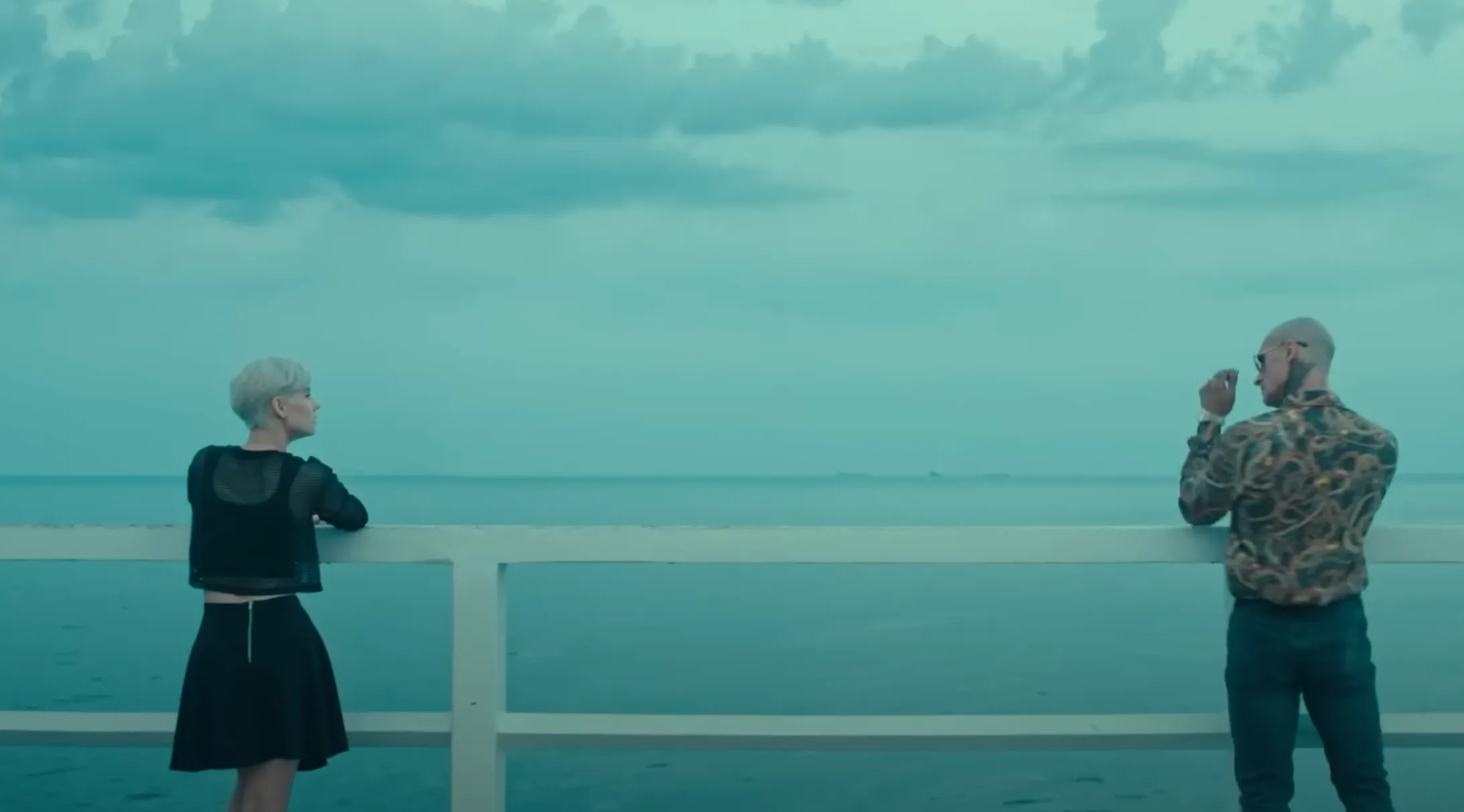
Scale brings a tax. The 165-minute duration drags the narrative spine. The first half feels bloated and unfocused, a long inhale that risks boredom before the final hour gathers needed motion. Explicit content matches the world portrayed, yet several scenes read as gratuitous jolts that pull attention away from psychology. The technique remains sharp, especially the visual design by cinematographer Jeremi Prokopowicz. The Polish Tricity of Gdańsk, Gdynia, and Sopot is not backdrop; it behaves like a hard-edged chorus, present in the salt of the air and the geometry of docks and streets. Place operates as witness.
Olencki favors accumulation. Repetition of violence and spectacle becomes an aesthetic stance. Call it hooligan baroque. The approach studies ugliness until it turns stylized, a choice that courts argument yet fits a story about appetite that refuses limits.
The Weight of a Singular Performance
Mateusz Damięcki anchors the film as Golden. The physical and psychological shift he undertakes lands with charge; the presence carries scenes and gives the plot a pulse. He shapes a complex anti-hero whose ambition and trauma read as credible impulses rather than slogans. This turn provides the scaffolding that holds a very long narrative.
The structure leans hard on that scaffolding. Golden fills frame after frame, which creates a severe imbalance. The ensemble power that helped the first film dissipates. Mrówka and Łukasz Simlat offer strong work, yet several recurring figures from the series serve mostly as plot motors. The focus clarifies motive and guilt, then narrows the world until everything echoes one man’s remorse.
A pocket of dark humor slips through, especially in the Irish subplot, with a moment of physical comedy that lands odd and sharp at once (an actor flinging arms while prone, a sight gag that deflates menace for a beat). The tonal shift hints at a truth inside crime myths: brutality and absurdity keep each other’s company. Culture absorbs both. The film suggests a cost ledger where ambition purchases status at the price of doubt. Golden’s internal life supplies the interest payments.
As a cultural artifact, the film extends a Polish screen tradition that treats crime as social weather and individual will as a local forecast. The piece imagines power as a brief season. It studies how a secret birthmark on a career, the kind carried by the dead teammate’s memory, stains every later victory. The parable closes its circle, and the city keeps breathing.
Furioza Again, a Polish action crime thriller, is a midquel to the 2021 film Furioza. With a lengthy runtime of approximately 167 minutes (2 hours and 47 minutes), this follow-up focuses on the ruthless rise of Golden, the leader of the ‘Furioza’ ultra gang. The movie, which bears the original title Druga Furioza, is set to premiere on the streaming platform Netflix on or around October 15, 2025.
Credits
Director: Cyprian T. Olencki
Writers: Cyprian T. Olencki, Dawid Kornaga
Producers and Executive Producers: Marcin Zarębski, Magdalena Szwedkowicz
Cast: Mateusz Damięcki, Szymon Bobrowski, Pola Gonciarz, Weronika Książkiewicz, Łukasz Simlat, Mateusz Banasiuk, Wojciech Zieliński, Cezary Łukaszewicz, Konrad Eleryk, Sebastian Stankiewicz, David Masterson
Director of Photography (Cinematographer): Jeremi Prokopowicz
Composer: Miro Kępiński
The Review
Furioza Again
Furioza Again is a brutally energetic, well-acted crime epic that suffers from its chosen structure. By setting the plot as a known midquel, it drains the narrative of meaningful suspense. Mateusz Damięcki's magnetic performance as Golden successfully anchors the bloated runtime, portraying a modern tragic figure consumed by ambition. While the film delivers dynamic action and a raw style, its excessive length and reliance on shock value mean that the second punch lacks the devastating impact of the first. It is an uneven, compelling tragedy.
PROS
- Mateusz Damięcki’s powerful, magnetic lead performance as Golden.
- Highly kinetic and raw action sequences (e.g., the street shootout).
- Sharp visual style and cinematography.
- Deep exploration of the themes of destructive ambition and the tragic cost of violence.
- Effective, visceral use of the Tricity (Polish coastal) locations.
CONS
- Excessive 165-minute runtime leads to periods of boredom and sluggish pacing.
- The midquel structure significantly lessens narrative surprise and suspense.
- Gratuitous or excessive explicit content that often detracts from the plot.
- Imbalanced character focus, relying too heavily on the protagonist.
- Repetitive plotting and familiar beats from the first installment.