




















Forget the sterile efficiency of incremental design; Tingus Goose arrives as an aesthetic and mechanical rupture inside the idle game tradition. It takes the compulsive satisfaction of watching numbers multiply and sinks that familiar loop into a surreal, deeply strange spectacle, creating an experience that feels both gripping and deeply unsettling.
The player’s central task is to nurture the growth of a “ground goose” until it can complete a bizarre, ritual-style mating with a “sky goose.” This happens through the simple act of buying water for the goose, a pastoral mechanic that causes its neck to stretch upward like a fleshy plant. The money that fuels this cycle emerges from the goose itself, which periodically spits out tiny humanoid beings called Tingis. Players click or collect these figures, convert them into cash, and feed that income back into the watering process that keeps the ritual alive.
From the outset, the game sets out a distinctive, disturbing visual and narrative language. The opening image of a goose bursting from the abdomen of a pregnant person signals a full commitment to goose-centered body horror and the grotesque. That shock establishes an early ceiling for absurdity. While the structure remains that of an idle/clicker game, Tingus Goose behaves like a chaotic audiovisual spectacle that constantly pulls at the player’s attention and delivers a kind of brain-frying astonishment. The result feels like distilled madness.
The Grotesque Art of Psychological Unsettlement
Tingus Goose draws much of its impact from an aesthetic that stays minimal while provoking strong reactions. Its visuals rely on a hand-drawn, stripped-down style, with black linework set against a stark white background. Occasional color accents guide the eye to elements with mechanical or narrative weight, often marking zones of biological distortion. This deliberate simplicity strengthens the psychological grotesque effect. The absence of high-fidelity detail leaves space for the player’s mind to complete the image, which heightens the discomfort inside each scenario.
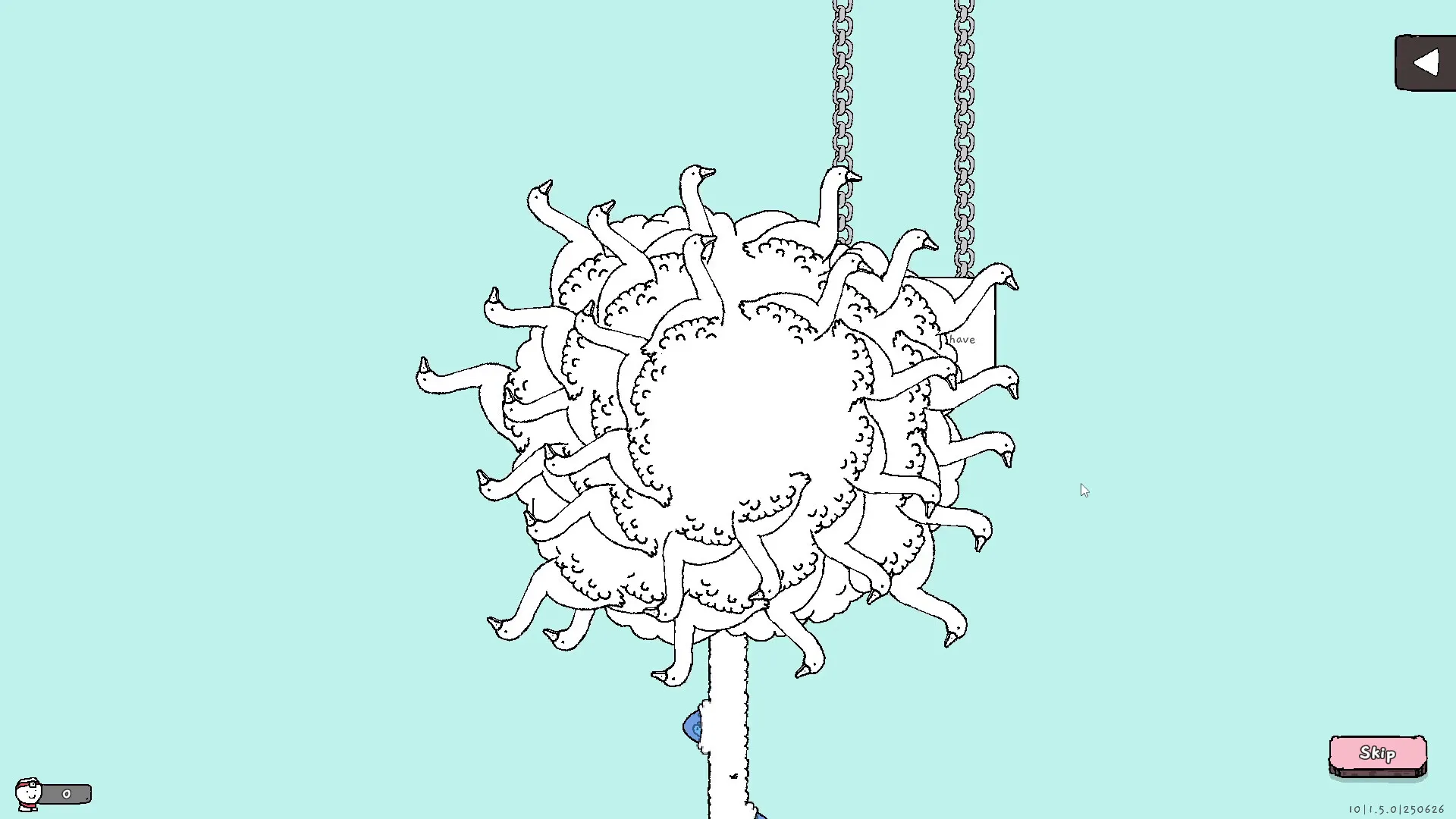
Narrative animations function as key rewards for sustained engagement. After a successful mating and the completion of a stage, players receive wild, unforgettable cutscenes that expand the mythology of this goose-dominated world. These hand-drawn sequences trace the climb in absurdity. They depict events such as a goose’s violent metamorphosis into a tree, or a parasitic invasion in which a goose seizes full control of a human host. The imagery unsettles through implication; the horror grows from bizarre biological and conceptual distortions, with explicit violence kept at a distance.
Also Read





The game’s themes circle around a warped, shifting idea of “love.” This appears in uneasy mating rituals, for instance the sky goose’s beak passing into the ground goose’s throat. Ongoing bodily transformation frames the experience as an exploration of physical and romantic mutation, where affection and violation sit inside the same image.
Sound design receives careful attention even with its imperfections. The instrumental score suits the play loop yet can grow repetitive during long sessions, which often leads players to mute it. The sound effects, including the cries, pops, and bounces of the Tingis, remain vital. They emphasize the on-screen chaos and add a tactile, visceral layer that completes the grotesque mood.
The game’s visual language recalls visceral sketch work associated with early 20th-century journalistic horror or certain strands of contemporary low-fi internet art, which makes the images difficult to shake off. The sparse style builds sticky mental impressions. Scenes such as a goose sprouting from a human body linger well after the play session ends. The result feels like a lesson in using visual simplicity to generate psychological density.
Mechanical Synergy and the Optimization of Chaos
The mechanics of Tingus Goose reshape expectations of the passive clicker genre by foregrounding spatial strategy. The central loop remains clear: cash buys water, water stretches the goose’s neck. As the neck extends, the game procedurally generates new interactive objects called Blossoms or Branches along that vertical space.

These Blossoms form the strategic engine of play. They interact with falling Tingis in varied ways, from bouncing them, to consuming and later ejecting them, to producing entirely new Tingi. The player works to construct a system that increases the number of interactions each Tingus undergoes before reaching the cash-out point at the bottom. This goal demands deliberate placement and tests the player’s skill at arranging components for maximum income.
This approach reshapes the game’s economic rhythm. Progress moves quickly from simple early clicking to a focus on intricate automation. Over time, complex, chaotic arrays of Branches handle most of the income generation on their own. Later stages increase this complexity, adding elements such as animated teeth, obstacles, or farm animals that interfere with the flow of Tingis in unpredictable ways.
The mechanics demand more engagement than the genre average and invite active observation and experimentation with layouts. Poorly placed or misused branches can drag down efficiency, which creates a rare strategic hazard inside a clicker framework. The game offers a tutorial, yet true competence emerges through practice with the game’s strange physics and placement rules, which pushes players to confront the impact of each design decision.
Recursive Growth and Persistent Investment
Long-term investment receives strong reinforcement through a two-path progression system tuned for repeated resets. The first path revolves around Calcium and the Roots. After a successful mating and a stage reset, the player receives Calcium, often represented as tiny bones. This resource flows into a sprawling skill tree that sits in the goose’s underground roots. Upgrades purchased here persist across runs and provide enduring advantages in later stages. These upgrades can shift Tingi evolutions, raise click efficiency, or supply broad bonuses, which turns early investment into a steady advantage throughout the game’s life.

The second path functions within each individual stage and revolves around Gems and the Medical Center. Players earn Gems during a stage by meeting tasks or reaching specific milestones. These Gems can be spent at the Medical Center or on the Doctor/Pharmacist, who appears from time to time with limited-time upgrades. These purchases offer temporary changes or extra Branches tied only to the current attempt.
This structure enforces a constant trade-off, since players must decide between pushing immediate growth and buying short-term upgrades for sharper optimization. The game also opens creative options through achievements across both progression paths, which steadily unlock new branches for the player’s strange machine. Finally, key quality-of-life tools, such as idle progress while the game is closed, arrive through player level growth and reinforce the sense of a long, ongoing relationship with this grotesque goose ecosystem.
The Review
Tingus Goose
Tingus Goose is a successful experiment in psychological horror and incremental design, transforming the often-passive clicker genre into a bizarre, strategic, and unforgettable spectacle. Its power lies in the synergistic interplay between its unnervingly minimal hand-drawn aesthetic and its deep, recursive gameplay loop. The game successfully uses grotesque imagery to incentivize player progression and mechanical optimization, resulting in a strangely compelling experience that is challenging to put down and impossible to forget. It is highly recommended for players who appreciate strategic depth and highly strange narrative concepts.
PROS
- Unforgettable, grotesque art style
- Complex, strategic Rube Goldberg gameplay
- Deep, persistent upgrade systems
- High-impact, bizarre narrative animations
CONS
- Repetitive instrumental background music
- Initial psychological shock may deter some players
- Requires active attention, less pure "idle"
- Learning curve is steeper than typical clickers