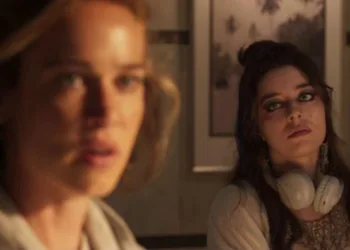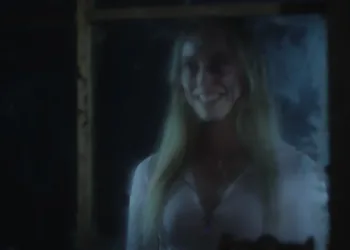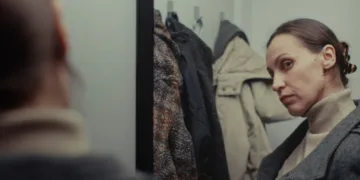














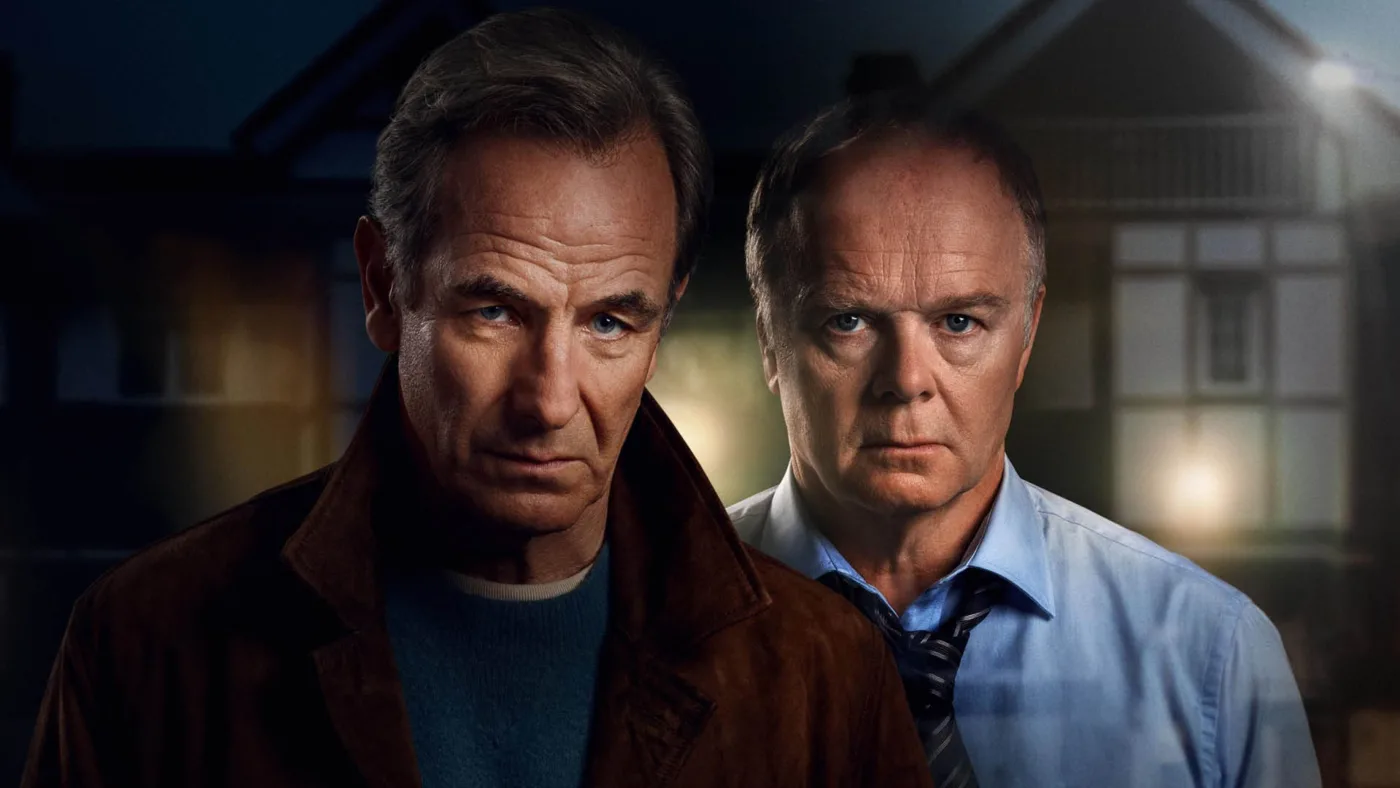

Huw Miller exits the police force under heavy public opprobrium. His early retirement follows a career-defining failure to take the Ripton Stalker into custody, a killer who treated homicide as a grim psychological experiment. The two last met in a warehouse; Huw left wounded and the perpetrator at liberty (a humiliation preserved in the amber of true crime podcasts). He now lives in a quiet suburb where days stretch and silence presses. He tries to orient himself with domestic tasks and cycling. These activities do not silence his thoughts.
A neighbor’s sudden death and the arrival of Patrick Harbottle interrupt that uneasy calm. Patrick moves into the empty house nearby and presents himself as a polished antiques fixer. He greets Huw with a phrase the Stalker used years earlier. That small slip functions like a spark. Huw becomes convinced his old adversary has returned to finish an unfinished account. The series establishes a duel between an aging investigator and a revenant from his past.
The Antagonistic Mirror
Jason Watkins builds Huw’s character around what I label Status-leakage. Watkins shows a man whose authority has bled away, leaving a brittle nervousness beneath a thin skin. He avoids the clichéd picture of a stoic, grizzled lawman. The performance favors a flustered presence, someone who watches from behind curtains that twitch with anxiety.
Huw’s identity remains knotted to his former rank; retirement functions as erasure. He listens to a podcast that ridicules his greatest failure, a form of public self-punishment uncommon in mainstream crime protagonists. Watkins communicates discomfort through small gestures—hands, eyes, posture—so that the body supplies the biography.
Robson Green serves as a calibrating contrast as Patrick Harbottle. He carries what can only be described as predator-grace: poised, fit, charismatic, unnervingly calm. Huw unravels while Patrick assembles a public face. The clothing choices—dark polo necks—signal a controlled sharpness. Patrick treats the streets and front gardens like a lab for social experiments; charm is his instrument. Green plays the part with a smirk that functions as menace. He weaponizes ordinary politeness and communal rituals to make Huw appear troublesome to neighbors and friends.
The women around Huw act as stabilizing forces. Sunetra Sarker’s Alice mixes patience with an ever-increasing dread. She embodies the domestic steadiness that Huw seems ready to sacrifice. Her sorrow registers when she realizes he prefers specters to company. Amber James, as DS Jenny Atkins, performs the role of institutional memory. She remembers Huw as he once was. Her presence keeps the stakes intimate. Any misstep by Huw threatens the few relationships that still vouch for him.
The Existential Weight of Leisure
Retirement appears here as a Sociospecter state. Huw is a kind of ghost within his own life. The series turns golf into a sign of this existential emptiness. Middle-aged men tapping small white balls across grass become an image of wasted ritual and quiet despair. The sport serves as a time-killing device that also marks what has been lost. Huw’s wife purchases golf equipment in the hope of anchoring him. The gear arrives as an emblem of purposelessness. He revisits the Stalker case because the chase supplies the only sustained rush left in his life.
The narrative links Huw’s trauma to the contemporary appetite for true crime. The podcast Freddie’s Forensic Fails stands in for how real suffering becomes serialized digital content. The public shaming forces Huw into repeated exposure to his worst moment. The pillory is now an algorithmic loop. That public loop turns his compulsion into a seeming mission; the watching world functions as an accusatory audience. He breaks rules and invades private spaces because he feels observed, and that sense of observation shapes his choices.
Suburban life is presented as brittle. Neighbors welcome Patrick because he matches an accepted aesthetic of success. They view Huw with suspicion because his behavior is visibly frayed. This disjunction reveals a social truth about perception: a pleasant façade often outbids a harder truth. The script asks whether Huw is trustworthy. He might be projecting inner chaos onto a newcomer. Tension arises from the possibility that the true antagonist could be a construction of Huw’s unraveling mind. The series stages that ambiguity so the viewer must weigh fear against evidence.
The Artifice of Domesticity
Formally, the production adheres to the conventions of a contemporary television thriller. It compresses time to maintain urgency. Dialogue usually runs plain and sometimes veers toward the heightened cadences of soap opera. That plainness makes psychological complexity legible to a broad audience. An odd product placement for a delivery service momentarily strips away mood and reminds the viewer of the commercial scaffolding that supports drama. That reminder grounds the piece in media reality.
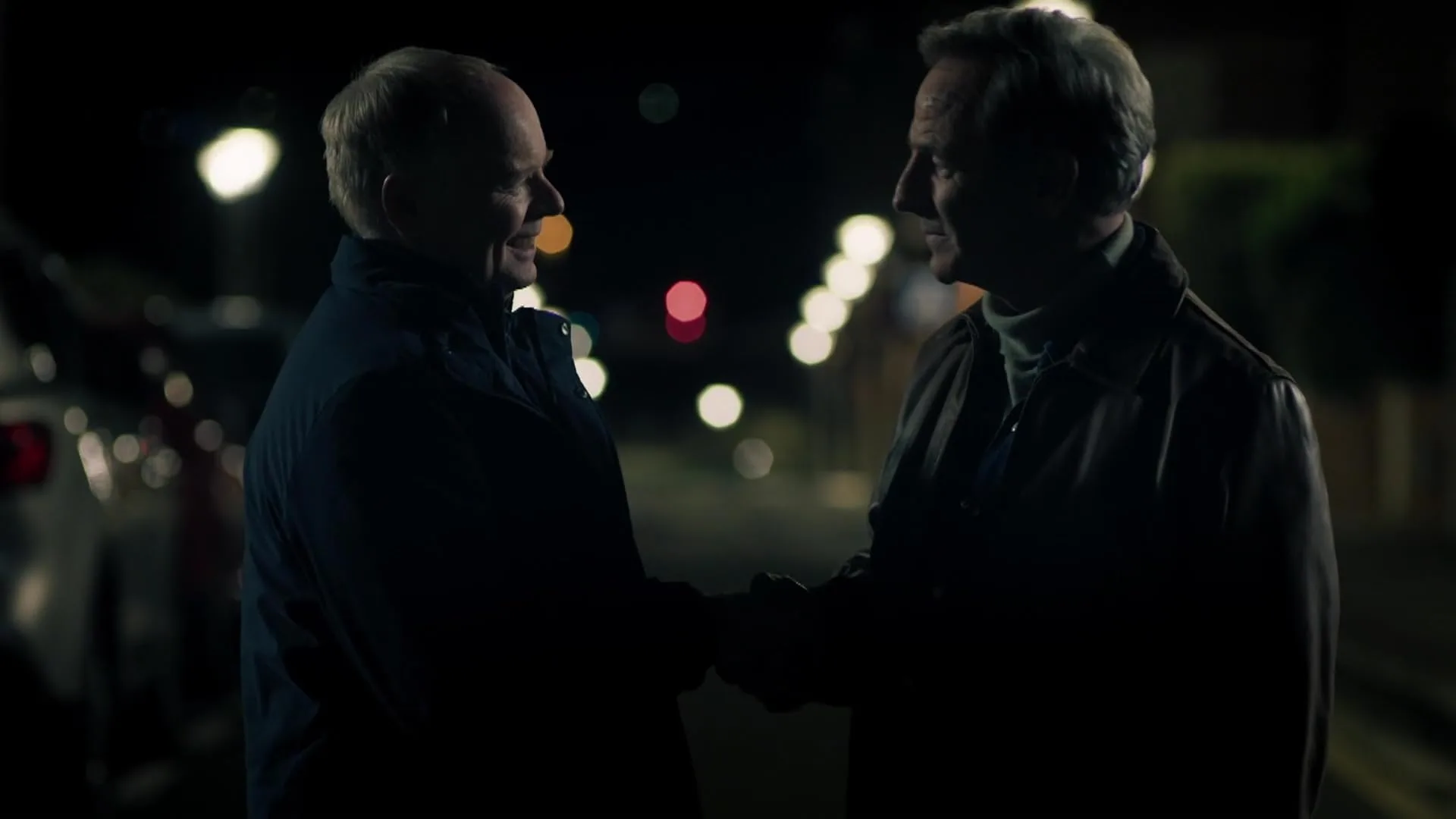
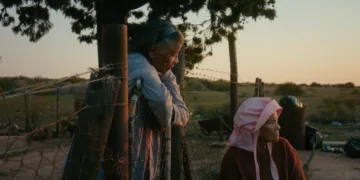
Shooting in Spain to impersonate English suburbs creates a deliberate visual friction. Basque light reads sharper than the softer tones generally expected in British crime work. That geographic mismatch produces an un-homely quality; the architecture looks slightly out of step with expectation, matching Huw’s displacement. Sunny exteriors feel like painted masks over rot. Location choices operate as a kind of scenic character, signaling misalignment between surface and interior.
Sound design functions as a psychological primer. Punctuated musical cues accompany Patrick’s entrances, conditioning the viewer’s response. The phrase Catch you later repeats until it ceases to be casual and starts to function as a linguistic incision. Pacing opens with the heavy slow rhythm of a bored retiree and then accelerates into the stammering tempo of pursuit. That modulation mirrors Huw’s move from dulled resignation into tense fixation. The audio world keeps the spectator physically attuned to Huw’s constriction.
The Architecture of Paranoia
At the core, the series stages a cat-and-mouse exchange between Huw and Patrick that is really an exchange over social capital. Patrick trades small repairs and visible usefulness for neighborly trust while Huw’s erratic behavior bleeds that trust away. Patrick’s visits to Huw’s house function as intrusions; his presence signals that private boundaries have dissolved. Without a badge, Huw’s defensive maneuvers register as personal aggression. Social sanction reshapes the protagonist into an outsider inside his own community.
Escalation arrives as Huw shifts from watchfulness into active sabotage. He plants listening devices and riffless through personal effects. Those measures are self-destructive; each discovery widens the gap between him and his loved ones. His isolation becomes a mechanism that advances Patrick’s advantage. The death of Frank supplies the tangible evidence Huw needs to justify his suspicions. At that moment the story pivots from a character study toward a more urgent investigation. Huw’s compulsion becomes the engine of the plot.
The denouement assembles meaning from small domestic traces rather than spectacle. The series resists pyrotechnics in favor of claustrophobic pressure. It tracks how a violent person might inhabit an ordinary life. The question of why the Stalker resurfaces remains the central puzzle.
The final confrontation tests Huw’s sanity and his capacity to marshal the methods of detection while the community reads him as a patient. The outcome hinges on whether he can act with the logic of a detective in a context that wants to confine him. Patrick’s motives remain partly veiled, which keeps the suspense active and forces the audience to choose between pattern and paranoia.
The Game is a gripping four-part psychological thriller that premiered on Channel 5 in the United Kingdom on May 12, 2025. The series follows Huw Miller, a recently retired detective who becomes dangerously obsessed with his new neighbor, Patrick Harbottle, believing him to be the notorious “Ripton Stalker” from an unsolved case that ruined his career. As of January 2026, the series is available for streaming on My5 in the UK and premiered for North American audiences on BritBox on January 8, 2026.
Full Credits
Title: The Game
Distributor: Channel 5, BritBox, Paramount+
Release date: May 12, 2025
Rating: TV-MA
Running time: 60 minutes
Director: Toby Frow
Writers: Tom Grieves
Producers and Executive Producers: Mike Benson, Paul Testar, Sebastian Cardwell
Cast: Jason Watkins, Robson Green, Sunetra Sarker, Indy Lewis, Amber James, Joshua Hill, Jenny Rainsford, Scott Karim
Director of Photography (Cinematographer): Michael Timney
Editors: John Phillipson
Composer: Damian Moloney
The Review
The Game
The Game functions as a "Boredom-Noir" where the primary antagonist is the silence of an empty house. Jason Watkins masterfully portrays the twitchy disintegration of the retired ego. While the Spanish filming locations create a slight geographic mismatch (an accidental surrealism), the central psychological duel remains sharp. It avoids the bloat of longer series by focusing on a singular, suffocating fixation. The result is a lean, unsettling study of a man trying to arrest his own irrelevance.
PROS
- Sharp friction between lead actors.
- Brief, focused episode count.
- Effective portrayal of post-career identity crisis.
- Subversion of the traditional investigator role.
CONS
- Obvious product placement.
- Small logic gaps in the investigation.
- Spanish filming looks distinctly un-British.