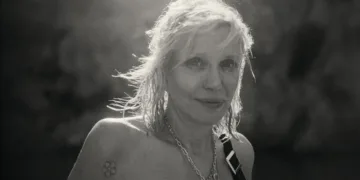

















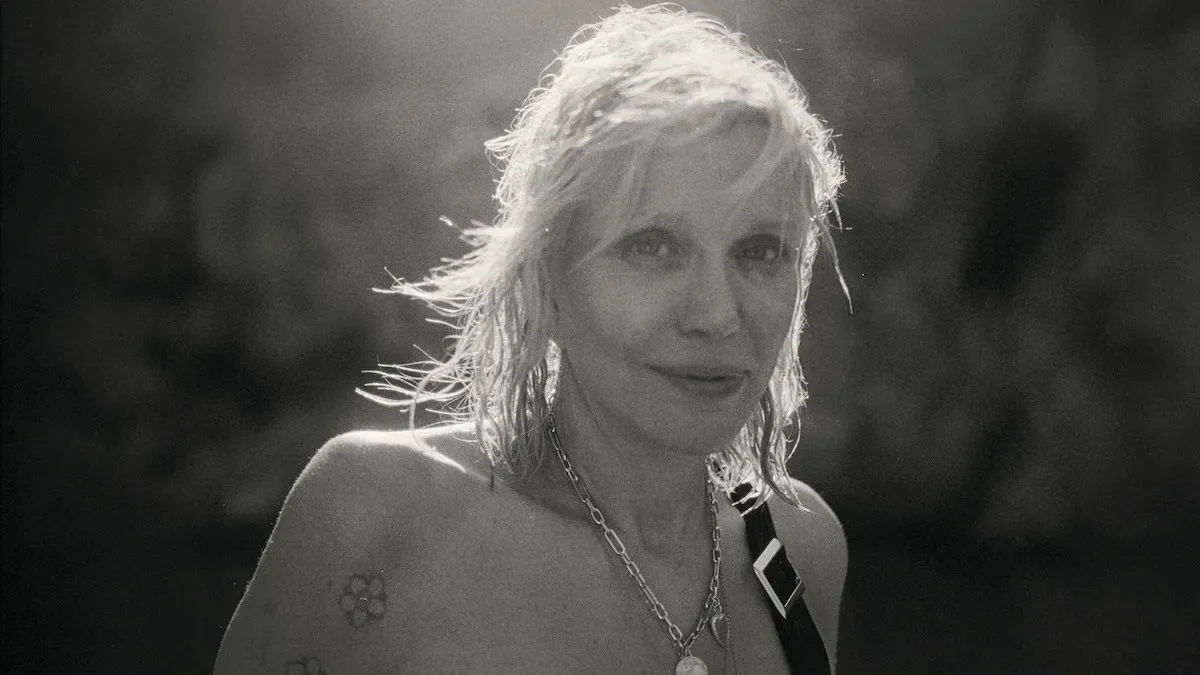

The camera settles on Courtney Love in the stillness of her London home. She is sixty-one now, her face marked by time, her presence still sharp enough to steer the frame. Directors Edward Lovelace and James Hall meet her in a period of creative restart as she prepares her first album in more than a decade. The documentary commits to a fly-on-the-wall approach and lets Love carry the narration through private journals and plainspoken reflection. What emerges is a self-authored account of a public figure shaped by rock stardom and years of tabloid hostility.
The structure resists a neat timeline. The filmmakers build the story from fragments: grainy home movies, raw archival footage, and close, unglamorous studio scenes. That collage method mirrors the subject, a life that reads as memory first and chronology second.
The tone is heavy, full of the wear that comes from trying to keep making things after the world has watched you fall apart in public. Love is shown working, tracking vocals and staring down the past that keeps insisting on a return engagement. The film’s restraint becomes its argument. It watches her survive her own legend, then speaks in her voice.
Foundations of Defiance
The biography the film assembles begins in chaos and stays honest about how early it starts. Love recalls a childhood marked by profound instability, including her father giving her LSD at age four. She describes drinking alcohol by age ten. Those experiences frame the defiance that follows, a posture that becomes a tool long before it becomes an image.
A stay in juvenile hall becomes a turning point, less through institutional reform than through art landing like a strike. Love connects a copy of Patti Smith’s Horses to a sudden recognition of what a woman could claim in creative life. The documentary treats that moment as a seed that later grows into Hole and the release of Live Through This. Love speaks about the persona she built early on, a deliberate announcement of poetic ability paired with an abrasive public self that refused to ask permission.
Her songwriting is presented as raw and feminist, grounded in a refusal to soften. The film ties that stance to specific histories that carry violence, sexual politics, and exploitation. Songs such as “Retard Girl” and “Doll Parts” are linked to that personal material, with Love describing music as both shield and weapon.
Also Read





The narrative keeps returning to ambition as survival logic. Love rejects the role of victim while describing dire circumstances, and she frames fame as a choice made for escape from a life with little stability. The stage persona becomes flamboyant and confrontational, designed to demand attention and force an audience to look at what it prefers to ignore.
The Public Marriage and Private Grief
A major spine of the film is Love’s marriage to Kurt Cobain. Private home movies offer a view of the relationship that public coverage rarely allowed, showing tenderness and a connection built on shared talent and shared experience of rejection. The documentary then tracks how quickly that private world turned into a battleground. A notorious Vanity Fair profile triggers a legal fight over custody of their daughter, and the film lingers on the era’s appetite for moral theater. One pointed example lands hard: the airbrushing of a cigarette from a magazine cover to manufacture an image of neglect.
Cobain’s death is approached through a single, haunting detail: a missed phone call that Love describes as a lasting regret. She attributes the missed connection to a mechanical failure at a hotel desk. The story widens from there into the cold machinery of the music business. The film notes that Love was sent on tour for Live Through This one week after the suicide. It shows the hostility that followed, including threats from fans and the practice of leaving shotgun shells onstage during performances.
Those details do more than decorate the timeline. They form the documentary’s rebuttal to a familiar caricature, using evidence to dispute the “villainous widow” story. The portrait that replaces it is harsh and human: a woman trying to keep her mind intact while being pursued by the press and by a grieving fanbase that turns sorrow into punishment. The Seattle years register as a brief pocket of domestic calm, then the outside world breaks in and tears it apart.
The London Renaissance
The later chapters lean into recovery and reinvention, with the film treating both as ongoing work rather than a clean transformation. Miloš Forman appears as a meaningful intervention when he casts Love in The People vs. Larry Flynt. The documentary frames the role as a lifeline, one that reveals her range as an actor and coincides with a period of sobriety during a professional high. Her continued film work, including Man on the Moon, suggests a viable path away from the stage, even as the film keeps her relationship with fame unsettled and combustible.
From there, the documentary moves into her present-day life in London. Love describes a calmer routine shaped by Buddhism and quiet living, and the camera reflects that shift with patience. A small loss carries surprising force: the death of her dog, Bell, becomes an unguarded moment of vulnerability, intimate in a film filled with larger tragedies.
The studio returns as the film’s engine, and we watch Love work with Michael Stipe and Melissa Auf der Maur on new material. She speaks candidly about how her voice has changed. The signature scream from earlier years is gone. She leans on a lower, controlled delivery that carries its own authority. The sessions play as a study in endurance and craft, less romantic than persistent.
The film uses a recurring image of her breaking the surface of water as a visual metaphor for return. Love describes this period as an invitation back to the party after a long exile, and the documentary holds that idea without forcing a tidy redemption arc. It presents an artist negotiating her past and her present in the same room, searching for a voice that fits the person she is now.
Antiheroine is an intimate and raw biographical documentary that premiered at the Sundance Film Festival on January 27, 2026. Directed by Edward Lovelace and James Hall, the film offers a rare, unfiltered look into the life of rock icon Courtney Love as she records new music in London for the first time in over a decade. It blends never-before-seen home movies and personal journals with candid present-day interviews to explore her childhood trauma, her marriage to Kurt Cobain, and her survival through years of public vilification. While the film is currently making its way through the festival circuit, it is expected to be available for streaming later this year; music fans should keep an eye on platforms like MUBI or specialized documentary channels for its wide release.
Full Credits
Title: Antiheroine
Distributor: Dorothy St. Pictures (Production), MUBI (Select Regions)
Release date: January 27, 2026 (Sundance Film Festival World Premiere)
Running time: 98 minutes
Director: Edward Lovelace, James Hall
Writers: Jacq Sharples (Story Producer), Edward Lovelace, James Hall
Producers and Executive Producers: Julia Nottingham, Melanie Archer, Hattie Bridges Webb, Jon Lullo, Jonathan Daniel, Elisabeth Murdoch, Chris Fry
Cast: Courtney Love, Michael Stipe, Melissa Auf der Maur, Eric Erlandson, Patty Schemel, Billie Joe Armstrong, Butch Walker
Director of Photography (Cinematographer): Magda Kowalczyk
Editors: Jinx Godfrey, Dan Setford, Daniel Lapira
Composer: Nikky French
The Review
Antiheroine
The documentary succeeds as a restorative portrait that replaces tabloid caricature with a complex human narrative. By allowing Courtney Love to pilot her own history, the film avoids the trap of easy hagiography, instead offering a methodical look at the toll of fame and the mechanics of survival. It is a dense, emotionally resonant study of an artist reclaiming her voice when the world assumed she had none left.
PROS
- Unfiltered access to private journals and rare home movies.
- Deeply narrative-focused exploration of the 1990s grunge era.
- Avoids standard documentary tropes in favor of raw, on-the-fly intimacy.
- Strong focus on Love's specific creative process and songwriting.
CONS
- Leaves a significant twenty-year gap in the middle of her career.
- Some symbolic visual metaphors feel slightly heavy-handed.