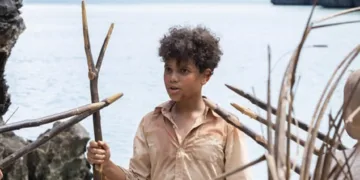


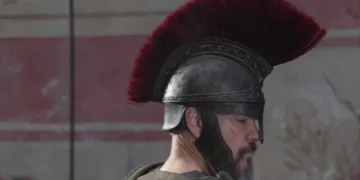
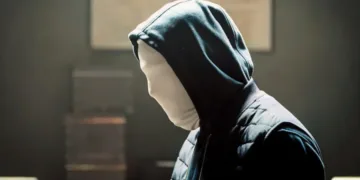
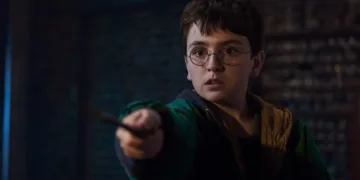
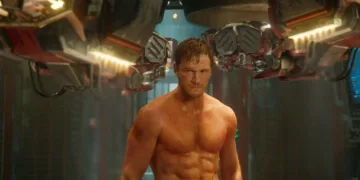






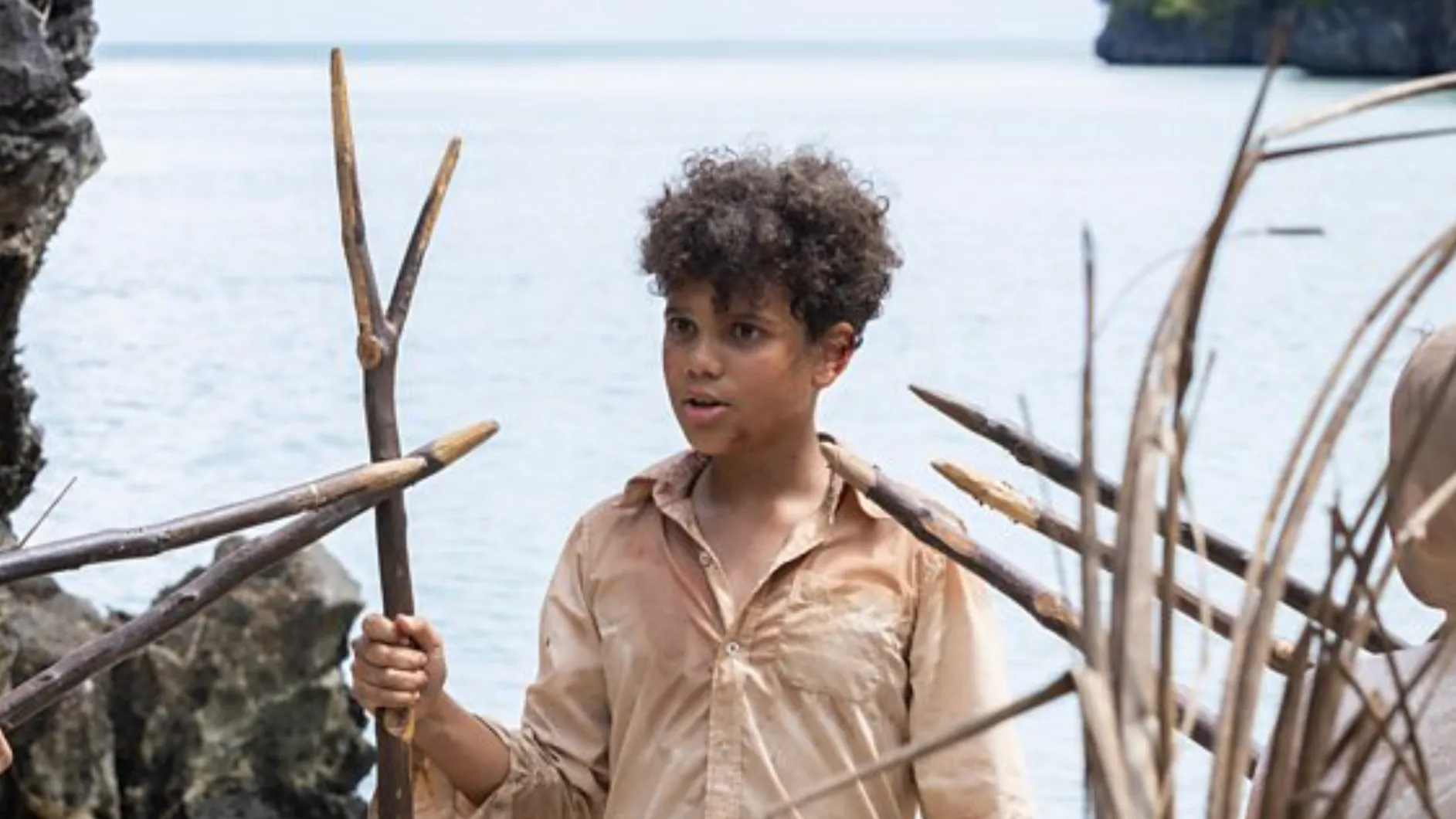

The 2026 BBC adaptation of Lord of the Flies brings William Golding’s 1954 novel to the screen as a four-part series. Set against a mid-century conflict, it opens with a plane crash that strands a group of British schoolboys on a remote tropical island in Malaysia. No adults survive the wreck, so the boys build a society from the ground up. They choose a leader, agree on rules, and try to keep a signal fire burning for rescue.
This production is the first time the story has been adapted for television, and the format matters. The series has the room to track the familiar slide from schoolboy order into primal violence with a patience that a feature-length version cannot match. Director Marc Munden emphasizes the island’s physical demands and the children’s shifting inner lives as their early civility frays.
The adaptation stays close to the source material while enlarging the psychological space around the central characters. Spread across four hours, the story becomes an extended study of power, how it gets performed, and how quickly it stops sounding like a civic duty and starts sounding like permission.
Structural Subjectivity and the Lens of the Individual
Screenwriter Jack Thorne uses a structural device that remakes the linear survival narrative into something more intimate and more accusatory. Each episode centers on a single character, moving through Piggy, Jack, Simon, and Ralph. The result brings the boys’ private logic into sharper focus, the small rationalizations that turn into rules, then rituals. The series frames the breakdown as a set of personal catastrophes that happen in parallel, each shaped by temperament and longing. We experience the island first through Piggy’s rational, often frustrated perspective, then through Jack’s intensifying appetite for dominance.
Pacing follows a slow-burn approach. Scenes often play without dialogue, leaning on lingering images to build a sense of claustrophobia inside an enormous landscape. Munden folds in nature footage with the polish of high-end documentaries. Stick insects and hermit crabs register the wilderness as indifferent, a living system that keeps moving while the boys argue about order and meaning.
That stillness sits beside Thorne’s pointed dialogue. The boys cling to “proper” British speech as if grammar can function as a perimeter fence. Their formality becomes a kind of representation in itself, a performance of who they believe they are supposed to be, even as their conditions make that performance harder to sustain. The show stretches the space between Golding’s literal events and the expanded psychological dimension the series occupies, letting dread collect in the pauses.
By giving each boy a dedicated hour, the narrative rejects a single, stable viewpoint and replaces it with competing versions of the same crisis. Power looks different depending on who holds it, who resents it, and who needs it to feel safe. The “Beast” reads as a personal shadow that changes shape from child to child, a fear that adapts to its host. This perspective-based architecture points to a television trend that treats plot as an outcome of subjectivity, with character focus driving momentum and meaning.
The Faces of Fragility: A Masterclass in Youth Performance
This adaptation stands on the young cast’s ability to carry the story’s moral pressure without softening it. David McKenna’s Piggy lands as the group’s intellectual and moral anchor. McKenna builds the character through physical details, including the “suet pudding cheeks” and the wheezing “ass-mar,” and he plays Piggy’s need to be heard as both stubbornness and pleading. He holds tight to the conch shell as a democratic symbol even as its authority drains away, and the performance makes that loss feel like a public humiliation staged in slow motion.
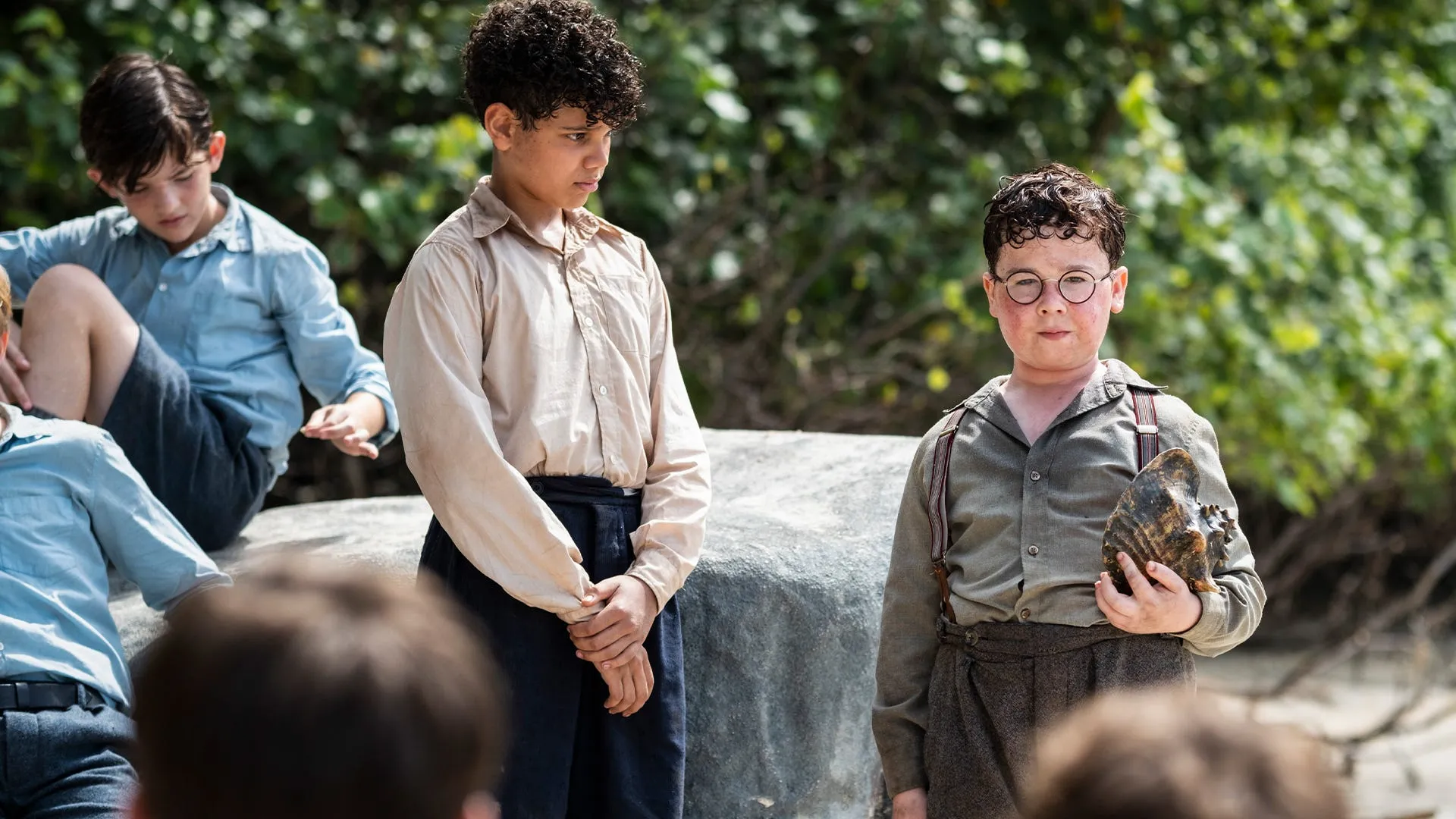
Lox Pratt plays Jack with a chill that arrives early and keeps sharpening. His background as a head chorister lends an eerie composure to his first scenes, a tidy discipline that reads like training for command. Pratt reveals an “internal hollowness” and loneliness inside Jack’s aggression, and he charts the shift from choir leader to spear-carrying dictator with cold efficiency. The transformation feels like a lesson in how authority can rebrand itself, swapping one uniform for another while keeping the same hunger.
Winston Sawyers’s Ralph begins as an amiable leader with a military background, and his struggle is the daily grind of governance. He tries to mediate between Piggy’s logic and Jack’s raw force, and the series uses that effort to show how quickly leadership gets defined by fatigue. Ralph’s authority erodes as the group grows bored with the unglamorous work of shelters.
Ike Talbut’s Simon offers a gentler register. He moves between factions, watching more than speaking, and his quiet observations provide a steady counterpoint to the noise of the “hunters.” The “littluns” appear as truly small children, and that scale matters. Their presence keeps pulling the viewer back to the fact that these survivors are kids performing adulthood under impossible conditions.
Thomas Connor’s Roger completes the picture as the figure who embodies the tribe’s most sadistic impulses. The casting choices push for naturalism. These children look and behave with a feral credibility, not the polish of child stardom. The ensemble underlines a shift in what television asks of young performers, demanding sustained dramatic intensity and moral complexity across hours, not scenes.
Technical Hypnosis: The Sensory Jungle
The series’ technical craft locks the viewer into its unease. The Malaysian location operates like an active force, pressing in on the boys and reshaping them. Cinematography leans into saturated, luminous color that can feel almost too rich, turning the jungle into a lush, suffocating paradise. Mark Wolf uses clear visual strategies to chart the boys’ changes. Close-up headshots track the move from combed hair and clean skin to grime and war paint, and the tight framing creates an intimacy that makes later violence feel personal and near, with no safe distance.
At points, the visual language slips into surrealism. Fisheye photography and color shifts generate a hallucinatory quality during ritual scenes. Foliage turns blood-red. The boys glow with unnatural light. This visual experimentation pairs with the collaborative score from Cristobal Tapia de Veer, Hans Zimmer, and Kara Talve. Music begins with orchestral and choral elements that echo the boys’ disciplined upbringing, then fractures as their society fractures. Voices grow discordant and haunting, turning childhood sound into something that feels accusatory.
Sound design intensifies the dread around the “Beast.” Forest rustles become cues for constant surveillance, as if the island itself listens. The result creates sensory overload that pushes the viewer toward the same paranoia as the castaways. The production uses its high-end craft to reframe the “prestige” survival drama as a mood engine first, with action beats serving the atmosphere, not the other way around. It is the kind of polish television loves to congratulate itself for, right up until it forces you to sit with what that polish is amplifying.
The Anatomy of a Fallen Society
This version reframes Golding’s “inherent evil” through a psychological lens shaped by lived damage. Thorne gives the boys domestic backstories: Jack comes from a loveless household, Simon has an abusive father, and Ralph’s mother is ill. These additions shift the argument about cruelty toward trauma and its aftershocks. Violence becomes “inflicted trauma” that gets carried onto the island and reenacted there, as if the boys reproduce the adult failures that raised them.
The show tracks collapse through physical symbols that mark time. Buckled leather shoes and school robes disappear. Face paint and sharpened spears take their place. The change signals a rising anti-intellectualism that the series makes painfully literal through the bullying of Piggy, a targeted assault on reason and deliberation. Governance becomes a debate about basic infrastructure.
“Toilets and shelters” represent the slow, unglamorous labor of communal life. “Feasts and fun” represent immediate reward, spectacle, and belonging. Jack’s ascent reads as populism built from appetite and fatigue. He offers meat and excitement to boys worn down by Ralph’s rules, and the promise lands because it asks nothing of them except loyalty.
The “Beast” emerges as the psychological form of collective fear, reflecting their capacity for violence back at them until the reflection starts to feel like permission. The final episode treats the horror of what they do with sobering weight, keeping the fact of childhood in frame even as murder enters the story. The adaptation presses on a contemporary anxiety: social structures can evaporate fast, and the language that props them up can turn into theatre at the exact moment it is needed most. It asks if the darkness belongs to the island, or to the world that sent the boys there.
The four-part television series premiered on February 8, 2026. This production marks the first time the novel by William Golding has been adapted for the small screen. Viewers can watch the entire series on BBC iPlayer or tune in to BBC One for weekly broadcasts. Filmed on location in Malaysia, the story follows a group of schoolboys stranded on a remote island as they attempt to build a society without adult guidance.
Full Credits
Title: Lord of the Flies
Distributor: BBC One, BBC iPlayer, Stan, Sony Pictures Television
Release date: February 8, 2026
Rating: TV-MA
Running time: 60 minutes
Director: Marc Munden
Writers: Jack Thorne
Producers and Executive Producers: Callum Devrell-Cameron, Joel Wilson, Jamie Campbell, Jack Thorne, Marc Munden, Nawfal Faizullah, Cailah Scobie, Amanda Duthie
Cast: David McKenna, Lox Pratt, Winston Sawyers, Ike Talbut, Thomas Connor, Noah Flemyng, Cassius Flemyng, Cornelius Brandreth, Tom Page-Turner
Director of Photography (Cinematographer): Mark Wolf
Composer: Cristobal Tapia de Veer, Hans Zimmer, Kara Talve
The Review
Lord of the Flies
This adaptation transforms a classroom classic into a disturbing mirror of modern social decay. By grounding the boys’ savagery in psychological trauma rather than mystical evil, the production creates a grounded and terrifying critique of authority. The visual beauty of the Malaysian jungle creates a jarring contrast with the brutality of the playground politics. While the pacing occasionally falters in the final hour, the performances are haunting. It is a bold reimagining for an era defined by fractured truths.
PROS
- Strong naturalistic acting from the lead children.
- Cinematography that utilizes the location as a central character.
- A structure that prioritizes individual psychological interiority.
CONS
- Final episode contains segments that drag.
- Certain scripted exchanges feel unconvincing or modern.