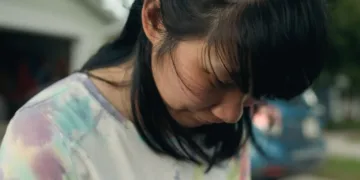

























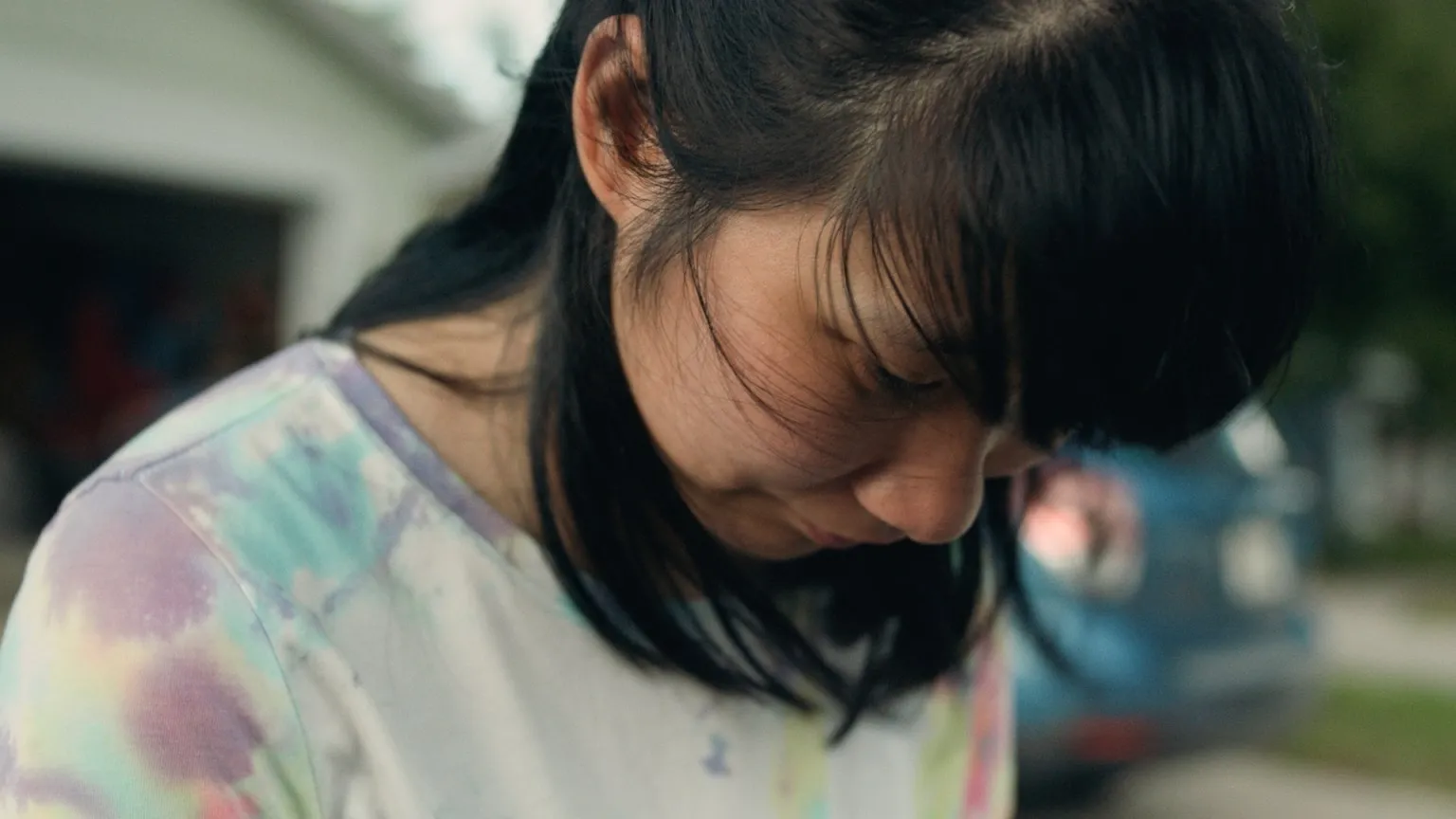

Take Me Home builds its drama on precarious routines that repeat until they break. The film introduces Anna, a 38-year-old Korean adoptee with cognitive disabilities living in a swampy, humid pocket of suburban Florida. Her days stay small, shaped by the care of her aging white parents, Bob and Joan. Director Liz Sargent frames their household as a quiet mutual aid society where roles keep shifting, where care moves in more than one direction.
A shower shared by Anna and Joan becomes a ritual of total trust, hands moving through hair with a gentleness that feels practiced and deeply known. Outside that domestic calm, massive cruise ships glide past at a distance, monuments to a moving world Anna watches more than she enters.
The household’s steadiness reads as a thin surface. Joan’s sudden death from heat stroke lands with a particular kind of devastation because it arrives through the ordinary. With her gone, the person who held the family’s routines together disappears, leaving Anna and a struggling Bob facing a future they have no language for, and no preparation to manage.
The Burden of Presence and the Guilt of Absence
Emily’s arrival, as Anna’s sister, injects sharp urban momentum into Florida’s slow heat. She has built a successful career in Brooklyn, and that life carries the unspoken weight of being the one who left. Ali Ahn plays Emily with a persuasive mix of professional competence and buried panic, a person trying to solve a problem designed to resist solutions.
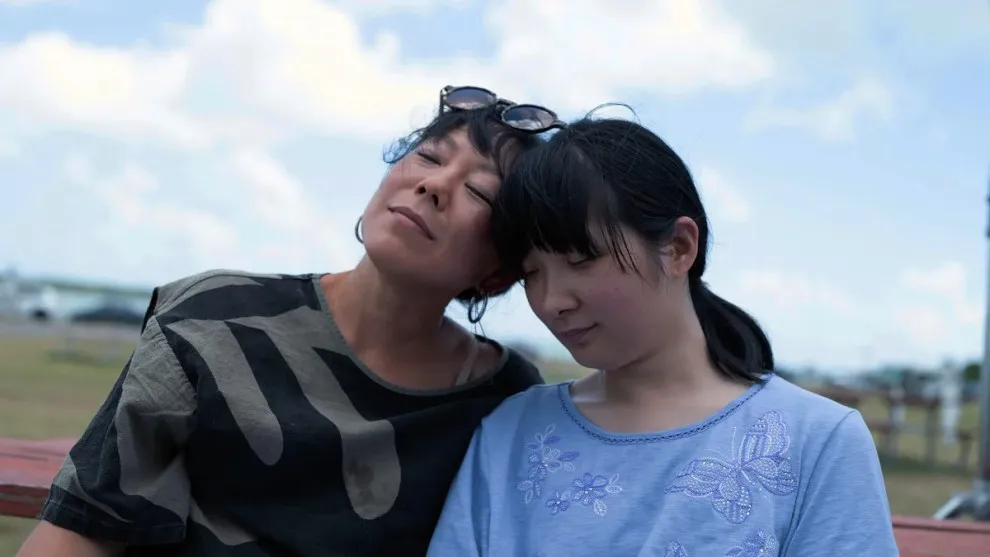
The strain between the sisters stays close to the skin. It crests in a brutal argument when Anna screams that her love for Emily has vanished, a line that hits with the force of something withheld for years. The film gives that rupture the space it needs, so the anger feels lived-in. A later moment finds the sisters rediscovering a thread of closeness while stealing ice pops from a supermarket, a small transgression that briefly restores a shared rhythm.
Also Read






Emily’s questions reach further than sibling resentment. When she asks Bob why they chose to adopt a child with a disability, his response arrives with blunt simplicity: he admits they had extra love to give. That exchange sits as the film’s emotional center, refusing easy villain roles.
Emily does not read as a detached interloper. The film keeps attention on the collision between modern career demands and the visceral, time-consuming needs of a family in crisis, and it treats that collision as structural rather than moral. Responsibility here becomes a pressure that reshapes identities, especially for the person who built a life elsewhere and returns to find the old life collapsing.
Systemic Failures and Personal Defiance
As the narrative moves forward, it widens toward the cold machinery of the American healthcare system. Emily and Bob get swallowed by insurance paperwork and Medicare restrictions, a bureaucratic terrain that offers little clarity and even less mercy.
A care manager states, without softness, that the system is intentionally complicated, and the line lands like a verdict for a middle-class family already leaning over the edge. Bob’s own mental state frays in plain, heartbreaking images: paper towels placed in the refrigerator, the blank paralysis of a grocery aisle, the look of someone losing access to his own continuity.
Against that decline, Anna’s agency emerges with insistence. She is shown as a person with desires and private momentum, someone who visits a neighbor to play basketball or to spend time with his friends. These choices matter because they refuse the story’s gravitational pull toward reduction. Anna remains a daughter and a dependent within the family structure, and she also remains herself, with a life that extends past the walls of the house. The tension spikes when Bob grasps the exorbitant cost of professional care.
The possibility of staying together becomes a financial threat, and the fear is practical, immediate, and humiliating in its arithmetic. The film puts a hard truth on the table: one medical setback can dismantle a lifetime of carefully maintained independence, and the dismantling can happen through forms, phone calls, and policy language that treats crisis as routine.
Visual Intimacy and the Tonal Departure
The film’s visual approach leans on closeness. Cinematographer Farhad Ahmed Dehlvi uses tight close-ups to hold the physical reality of these lives, from bathroom steam to the tired lines on Bob’s face. That intimate camera language anchors the story in social realism through most of its runtime, insisting on bodies, spaces, and the labor of care. Anna Sargent gives a remarkable performance, moving through childlike frustration into sharp, guarded sensitivity, with shifts that feel responsive to the changing temperature of every room.
The final act takes a sudden radical turn. After a moment of total despair, the film leaps into a brightly lit, utopian dreamscape where the characters reach a peace the real world denied them. The change can feel jarring, as if the film steps into a different register without warning.
It can read as catharsis for characters who have endured enough damage for one lifetime. It can also read as a step away from the difficult questions the script has spent so long constructing. By choosing a fantasy ending instead of a realistic resolution, the film places a challenge in the audience’s hands: decide if hope can stand as a valid response to a broken system.
Take Me Home is a poignant drama that premiered at the Sundance Film Festival on January 26, 2026, where it received the Waldo Salt Screenwriting Award. Based on a critically acclaimed 2023 short film of the same name, the feature-length production follows Anna, a woman with a cognitive disability, as she navigates the sudden loss of her mother and the complexities of the American healthcare system in suburban Florida. The film is scheduled for its international premiere at the 76th Berlin International Film Festival on February 17, 2026. As of now, it is primarily available through the festival circuit, with wider streaming or theatrical distribution details expected following its international debut.
Where to Watch Take Me Home
Full Credits
Title: Take Me Home
Distributor: All Caps, Caring Across Generations, Cinereach, Cyprian Films New York, River Road Entertainment
Release date: January 26, 2026 (Sundance Film Festival Premiere), February 17, 2026 (International Premiere at Berlinale)
Running time: 91 minutes
Director: Liz Sargent
Writers: Liz Sargent
Producers and Executive Producers: Apoorva Guru Charan, Minos Papas, Liz Sargent, Philipp Engelhorn, Michelle Hamada, Andrew W. Kim, Kelly Martin, Bryce Norbitz, Jane Shin Park, Bill Pohlad, Ai-Jen Poo, Candice Sanchez McFarlane, Lydia Storie, Janet Yang
Cast: Anna Sargent, Victor Slezak, Ali Ahn, Marceline Hugot, Shane Harper, Jeena Yi, Lisa Panagopoulos, Danielle J. Bowman
Director of Photography (Cinematographer): Farhad Ahmed Dehlvi
Editors: Ian Holden
Composer: Nathan Halpern, Chris Ruggiero
The Review
Take Me Home
The film succeeds as a heartbreakingly honest observation of the fragility of caregiving. While the abrupt shift into a dreamlike finale might feel like a narrative escape for some, the power of Anna Sargent’s performance and the authentic portrayal of a family under pressure remain undeniable. It is a vital, albeit difficult, look at the gaps in our social safety net and the enduring strength of familial bonds.
PROS
- Authentic and unguarded lead performance.
- Avoids common "inspiration" tropes.
- Nuanced portrayal of systemic healthcare failures.
CONS
- Final act tonal shift feels jarring.
- Some scenes feel repetitive.
- Unresolved narrative threads in the realism arc.