

























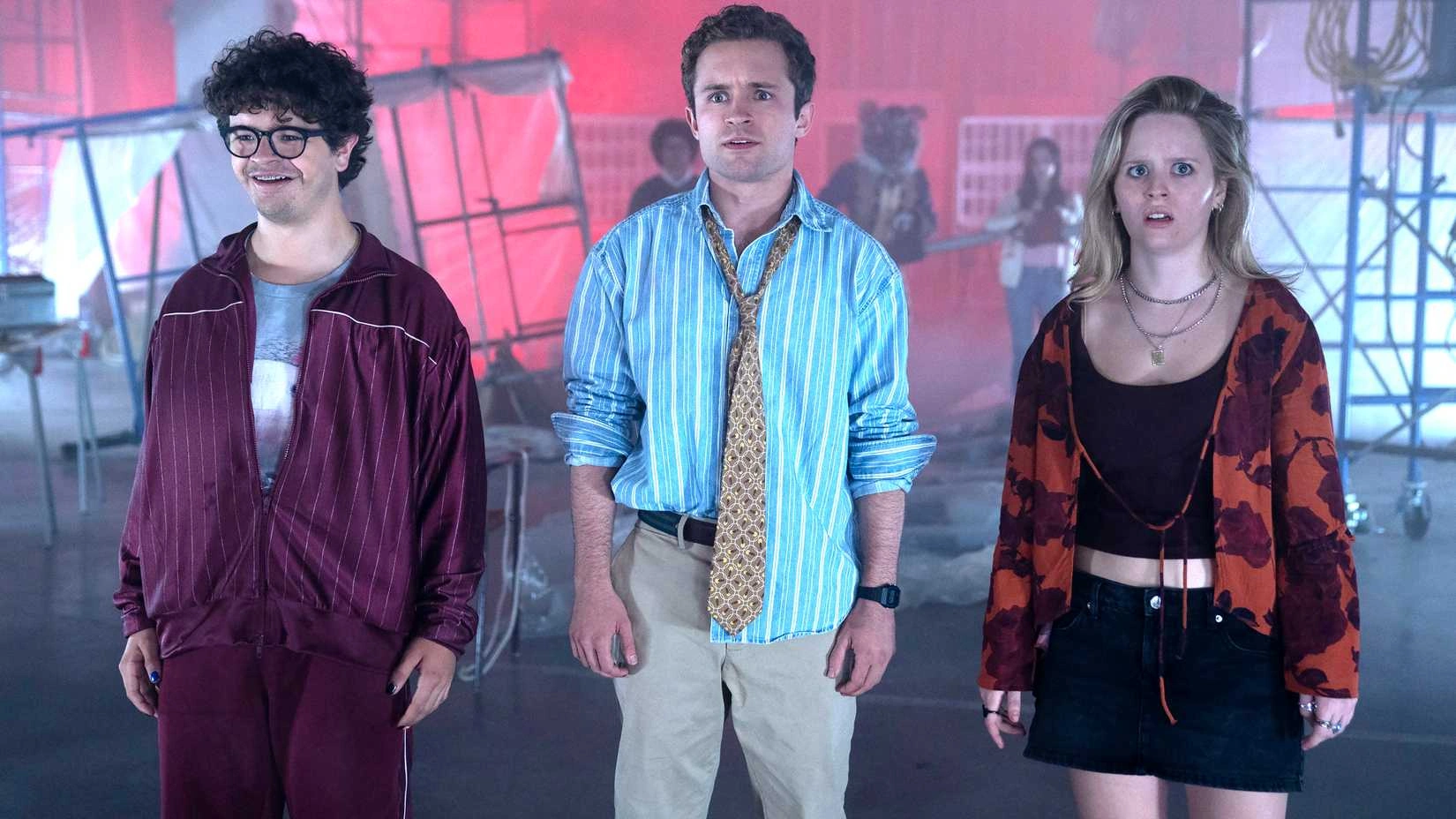

Caldwell College stands as a wasteland of academic artifice, a purgatory built from red brick, hierarchy, and social Darwinism. Jack and Montgomery occupy the campus fringe, studying its rituals from the shelter of their shared room. Jack is the loud pariah who crippled the local athletic religion by helping bring the football program to a halt. Montgomery is quiet, nervous, and still reaching for some fantasy of alpha status.
Their night of low-grade despair changes when a tin of M.I.N.T.S. drops from the ceiling like a cheap plastic omen. These decade-old neuro-stimulants set off six phases of reality-warping madness. Frankie, a digital creator with the cadence of a prophet raised on junk media, gives them their doctrine: eat pizza or suffer complete psychological collapse.
From there, the film transforms a trip down two flights of stairs into a survival epic scaled to dorm-room absurdity. Pizza becomes a secular relic, the sole barrier between the characters and a horrifying end. The task is plain. The feeling around it is apocalyptic. Resident Advisers patrol like militants, jocks circle like predators, and the ticking biological deadline lends cheese and tomato sauce the significance of sacred medicine.
Psych-gates and the Aesthetics of the Absurdist-Maximalist
The logic governing the M.I.N.T.S. phases has the stern rhythm of tragedy. I found myself thinking of them as “psych-gates,” each one forcing the characters through a new chamber of humiliation, panic, and revelation. The “Truth-Telling” phase strips away the soft padding of social etiquette. Honesty lands with the force of a blunt weapon, producing a form of social suicide that college students, and plenty of adults, are poorly equipped to survive.
Then comes the “Curse Word” phase, where profanity causes literal cranial explosion. It plays like a messy metaphor for discourse-policing in modern life, and yes, it also supplies a clean practical motive for keeping the proceedings PG-13. The “Body Swap” segment takes a familiar genre device and renders it stranger. Montgomery inhabiting the delicate body of a butterfly gives the male ego a lepidopteran fragility, which is a phrase I did not expect to write today, yet here we are.
The “Groundhog Day” loop becomes a comic vision of student stagnation, with debt and boredom cycling until repetition itself turns into the joke. The “Flashback” phase adds emotional density through stylistic shifts, using the past like a weapon drawn at close range. The last nightmare phase brings chainsaws and dread, then drives the characters toward the pizza antidote with the force of pure terror.
Brian McElhaney and Nick Kocher build Frankie’s videos from 16mm textures and archival noise, giving them the feel of a cursed instructional tape found in a basement by someone who should have left it there. Edgar Wright’s influence registers clearly in the whip-pans, crash zooms, and frantic editing. The film’s visual language carries what can best be called an absurdist-maximalist charge.
Gralk Hall appears through silhouette animation that interrupts the live action with a haunting jolt, rendering the threat of administrative exile in sharp, jagged forms. The “clowncore vomit opera” stands as the film’s boldest technical flourish, a grotesque symphony in which interior chaos spills directly into view. Each phase comes marked by specific visual cues, and these shifts act as structural supports for the growing madness.
The camera stays frantic. The pacing never loosens its grip. The effect mirrors the sensory overload of a bad trip while keeping the film sharply oriented. That level of technical ambition matters, especially in a movie devoted to the act of walking down stairs. McElhaney and Kocher treat budget limits as a toy box. The dorm hallway becomes a kaleidoscopic war zone, mutable and unstable, with every corner charged by possibility or threat.
Beta-morphism and the Archeology of the Childhood Star
Gaten Matarazzo sheds his youthful “Stranger Things” skin in his performance as Jack. He leans hard into frantic physical comedy and plays confidence as a thin membrane stretched over existential dread. Jack drives the chaos. He starts the drug use from a misplaced spirit of adventure, and that impulse gives the film its first kick into catastrophe. Sean Giambrone supplies the essential counterweight.
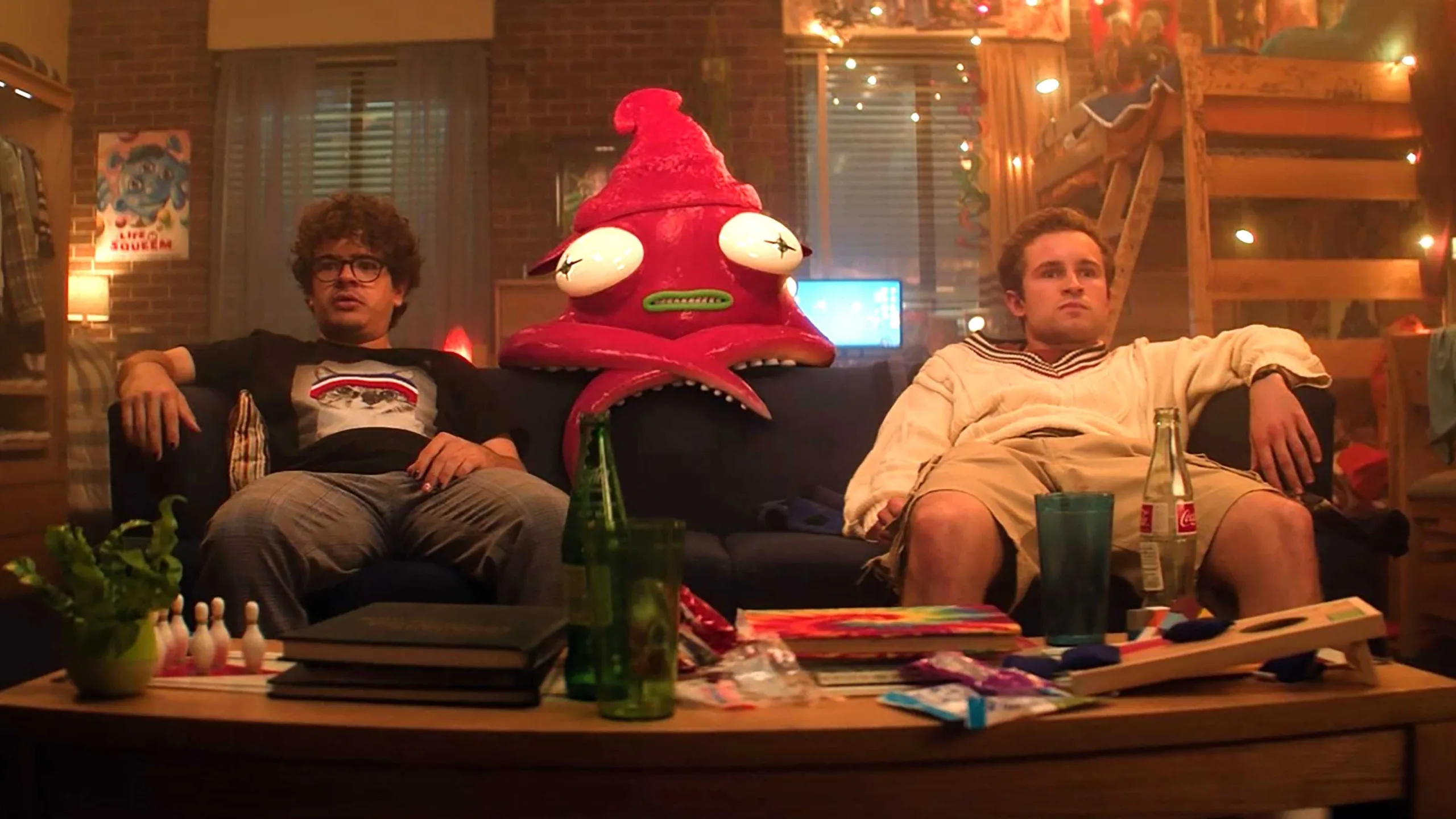
His Montgomery emerges as a “beta-morphic” study in anxiety, all squeaky panic and compressed nerves, like a young Michael J. Fox dropped into a collegiate nightmare. Lulu Wilson, playing Lizzy, shifts gears from her years in horror and channels those instincts into comic timing.
Her face registers terror and joy with remarkable elasticity. She captures the desperation of a campus “swing voter,” pulled toward the cool kids while still tethered to the dorks by memory and affinity. The performance marks a pivot for Wilson. She handles the absurd with the same poise she brings to the demonic, which sounds like a sentence from a fever dream and suits this film perfectly.
Jack Martin plays Blake with the icy exactness of a parody villain, turning the Resident Adviser into a fascist miniature, a portrait of petty authority sharpened to the point of caricature. The role becomes a pointed study of small-time power and its taste for ritual humiliation. Sarah Sherman’s Frankie is the film’s chaotic pulse. She delivers exposition with the manic energy of a late-night infomercial host who has seen the abyss and chosen to monetize it. Her delivery establishes the tone for the entire hallucinatory ordeal. Marcus Scribner’s Logan, a fart-obsessed alpha, embodies the mindless cruelty of the jock class.
Caleb Hearon gives Sidney a distinctive, awkward sadness, sketching the melancholy of the super-senior who cannot release his grip on campus life. Even Daniel Radcliffe’s voice work as the butterfly lends the project a surreal touch of prestige. These performances anchor the absurdity through sheer commitment. Everyone plays the pizza quest with war-drama seriousness. That sincerity keeps the film coherent. It gives the madness weight. The chemistry among the trio carries genuine force, and the stakes feel intimate because the actors believe in them so fully.
Post-Stoner Nihilism and the Glory of the Hermit-core
The film belongs to a strain of post-stoner cinema, tuned to a generation that seems warier of chemistry and its promises. These characters are accidental trippers. Their drug use arrives through error, through dorm-room archaeology, through the random violence of old junk falling out of the ceiling. The film places unusual value on domestic comfort. The quest sends them down the stairs, not across states in search of some mythic burger shrine. That scale matters.
The movie reads as a hymn to hermit-core living, where staying inside and ordering takeout takes on the air of rebellion. A fourth-wall break involving the directors introduces a form of self-reflexive nihilism. They admit the title is stupid. They admit the film operates through fragments. That candor pulls the viewer into complicity. It punctures any pretense of high art and invites laughter at the disorder. Gralk Hall, hanging over the story like an administrative death sentence, mocks the bureaucratic cruelty embedded in modern institutions.
The film leaves behind the redemptive machinery that burdens so many comedies. Montgomery never gets the girl. The thread involving Ashley falls away. No grand moral awakening arrives to tidy the chaos. They eat pizza. They survive. That absence of a lesson feels honest, almost perversely so, because it mirrors the randomness and emptiness that college life can produce. The 90-minute runtime helps. The film takes a microscopic premise and inflates it into a hallucinogenic odyssey without exhausting the viewer.
It mocks its own dumb title and its dumb premise, then finds genuine pleasure in the absurdly simple. Two flights of stairs become a mountain. By the closing credits, the movie has somehow turned a story about almost nothing into a strangely total experience. It feels disposable, and it knows it. That self-awareness gives it shape. The film moves like a comedic sprint with no desire for backward glances. Its cultural charge comes from its refusal to posture as important. It belongs to a fragmented age, and it understands that condition with surprising clarity.
Pizza Movie made its high-energy debut at the SXSW Film Festival on March 13, 2026, and officially arrived for streaming audiences on Hulu on April 3, 2026. This absurdist stoner comedy centers on two social outcasts at Caldwell College who inadvertently ingest a decade-old experimental drug, triggering a series of reality-bending hallucinations. The film captures their desperate race to reach a pizza delivery robot, as a cheesy pie is the only known antidote to stop the trip before it reaches a terrifying final phase. As of today, April 20, 2026, the film is available to stream on Hulu in the United States and is being distributed internationally via Disney+.
Where to Watch Pizza Movie (2026) Online

Full Credits
Title: Pizza Movie
Distributor: Hulu
Release date: March 13, 2026 (SXSW Premiere), April 3, 2026 (Hulu)
Rating: TV-MA
Running time: 97 minutes
Director: Brian McElhaney, Nick Kocher
Writers: Brian McElhaney, Nick Kocher
Producers and Executive Producers: Jeremy Garelick, Will Phelps, Billy Rosenberg, Jason Zaro, Molle DeBartolo, Max A. Butler, Matt Whelan, Gaten Matarazzo (Executive Producer)
Cast: Gaten Matarazzo, Sean Giambrone, Lulu Wilson, Jack Martin, Peyton Elizabeth Lee, Marcus Scribner, Caleb Hearon, Sarah Sherman, Justin Cooley, Daniel Radcliffe, Bobby Moynihan
Director of Photography (Cinematographer): Bella Gonzales
Editors: Matt McBrayer
Composer: Leo Birenberg, Zach Robinson
The Review
Pizza Movie
Pizza Movie operates as a manic, self-aware sprint through the absurdity of the hermit-core collegiate experience. While the narrative engine sometimes sputters, the committed performances and technical flourishes elevate the thin premise. It is a loud, unapologetic celebration of the mundane and the accidental. This work captures the sensory overload of a bad trip with sharp focus.
PROS
- Kinetic visual language
- Committed lead performances
- Sharp meta-humor
- Subversive genre retooling
CONS
- Uneven comedic hit rate
- Slight middle-act stagnation