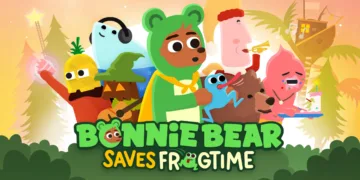




























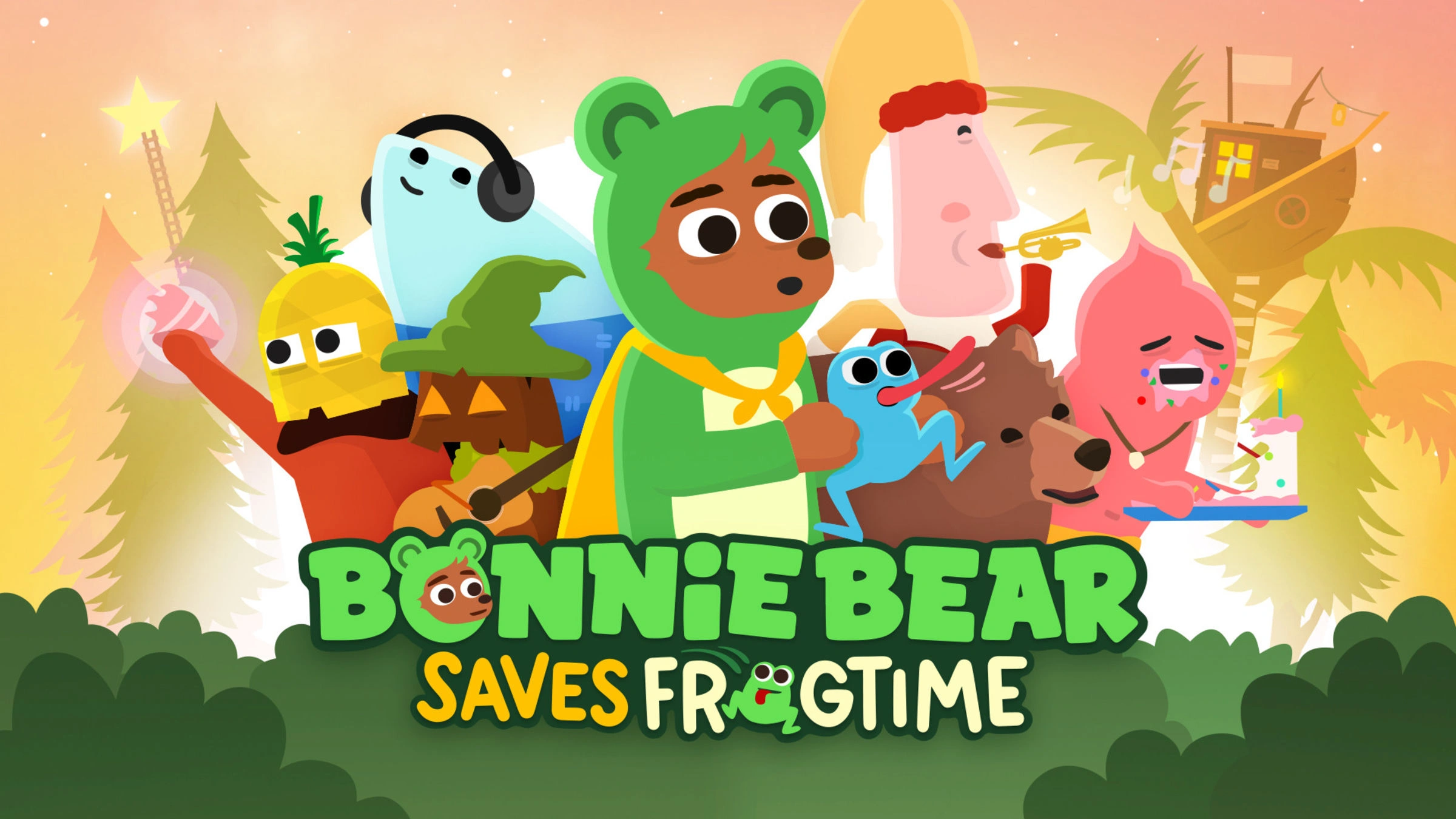

Bonnie Bear makes an immediate impression as an unusual protagonist, wandering her island home in a permanent frog onesie. Her arc starts from a blunt psychological premise. Before the game begins, Bonnie has spent a full year shut inside her treehouse, wrestling with deep personal insecurities.
Her return to the outside world arrives on her Bearday, when her eccentric friends gather to welcome her back. They try to support that recovery by giving her a toad bag, the key item needed for Frogtime, a tactical creature battler that has become an island-wide fixation.
The cozy premise soon breaks into a surreal rescue story with the offbeat community energy of EarthBound or Chulip. Bonnie’s best friend Ann, whose head is a pineapple, gets trapped inside a mysterious trans-dimensional seashell.
That accident pushes Bonnie beyond the safety of home and into the island’s larger social map. Her path runs through direct conflict with Rik Spek, an aggressive beach bully, and Uncle, the local priest. Uncle becomes the main ideological danger because he plans to erase frogs and Frogtime from existence completely.
Grid Positioning and Simultaneous Tactics
Frogtime builds its tactical identity around a compact, linear, three-row board. The layout recalls a combat-heavy variation of checkers, along with the lane-restricted grids of Mega Man Battle Network, where positioning controls the value of every action. Combat runs on simultaneous movement.
You issue commands during the same window as the opponent. If opposing frogs move toward the same tile, both actions cancel, turning each exchange into a prediction test where reading enemy movement becomes mandatory.
The system gains depth through the exact frogs in your bag. Standard Jumpers provide basic mobility by hopping over obstacles, and beefed-up variants deal double standard damage. Specialized units widen the tactical range. The Pusher uses its tongue to shove pieces forward or backward across the grid, giving the player direct control over lane space. Higher-tier archetypes expand those grid dynamics further.
Flyers hover across occupied rows to bypass defenses, and Plungers need three turns of static charging before launching into a fast cross-board dash. Each match keeps a clean, aggressive objective. Victory requires guiding your frogs to the opposite edge of the field. Reaching the enemy base deals structural damage to the opponent’s health bar, and the match ends when one player’s scoreboard hits zero.
Emotional Currency and Amphibian Squad Management
Squad management adds pressure through strict inventory limits. The toad bag holds a maximum of eight frogs, which forces constant judgment calls about the roster. Players must decide which units to discard to create space for stronger combatants.

The main economic loop is built around cocoduds, the currency earned after successful matches. Those coins are spent at local shops on randomized booster eggs, creating a gacha-style pull system familiar from traditional monster-collecting games.
Progress is tied to the self-worth meter, a leveling system that links Bonnie’s psychological state with mechanical capability. Winning matches raises her internal confidence, increases her self-worth level, and opens access to higher, stronger tiers of booster eggs.
Losing a battle applies an immediate penalty to her self-worth score. Defeats carry light structural punishment. The self-worth loss gives failure a pointed emotional and mechanical cost, keeping the difficulty curve connected to Bonnie’s inner condition.
Customization grows through recycling. Discarding redundant frogs gives players special tickets. With three tickets, they can roll for randomized hats. These accessories change the frogs’ visual personality, and they provide important stat adjustments. A rocket-launcher unit wearing a pirate hat or a swift unit wearing a birthday hat gains practical battlefield advantages. That small layer of equipment tuning lets players shape an eight-frog roster around specific opponent gimmicks.
Aesthetic Whimsy and Structural Friction
The visual presentation commits to a distinct style rooted in early 2000s indie animation. That approach supports bizarre character designs, including Hoot, a companion constructed entirely of wood, and Ann, the pineapple-headed friend. The audio identity becomes a major highlight, shaped by the developers’ background as musicians.

The acoustic, lo-fi soundtrack fits smoothly with interactive, improvisational music sequences where Bonnie joins the song. The voice acting uses prominent online creators alongside the developers. The production preserves authentic recording stumbles, sudden laughter, and character breaks, giving the world a loose, strange, unhinged atmosphere.
Pacing and technical execution show clear friction. Readability becomes a serious issue on portable devices like the Switch Lite, where the tiny font used for frog attributes strains the eyes. Touchscreen functionality is absent, so control depends entirely on physical buttons. After a battle defeat, the game’s rhythm stalls.
It offers no rapid retry option, forcing players to wait for characters to reset their physical positions and repeat unskippable dialogue segments. Portable hardware users need the software to maintain a strict target of sixty frames per second. Dropping below that standard makes the entire simulation run in artificial slow motion, creating a needless barrier inside an otherwise charming tactical experience.
The Review
Bonnie Bear Saves Frogtime
Bonnie Bear Saves Frogtime delivers a distinct tactical experience that successfully balances mechanical depth with absurd charm. The simultaneous turn mechanics and confidence-driven progression provide a rewarding strategic loop. Minor interface limitations and unskippable text sequences create pacing issues, yet the expressive audio design and imaginative world minimize these flaws. It stands as an exceptional independent title.
PROS
- Engaging simultaneous movement combat system
- Clever progression mechanics tied to Bonnie's self-worth meter
- Catchy acoustic soundtrack and charismatic, raw vocal performances
- Entertaining narrative and highly imaginative character designs
CONS
- Tedious dialogue repetition after losing battles
- Small font size creates readability issues on portable screens
- Lacks a rapid retry option during combat failures