




























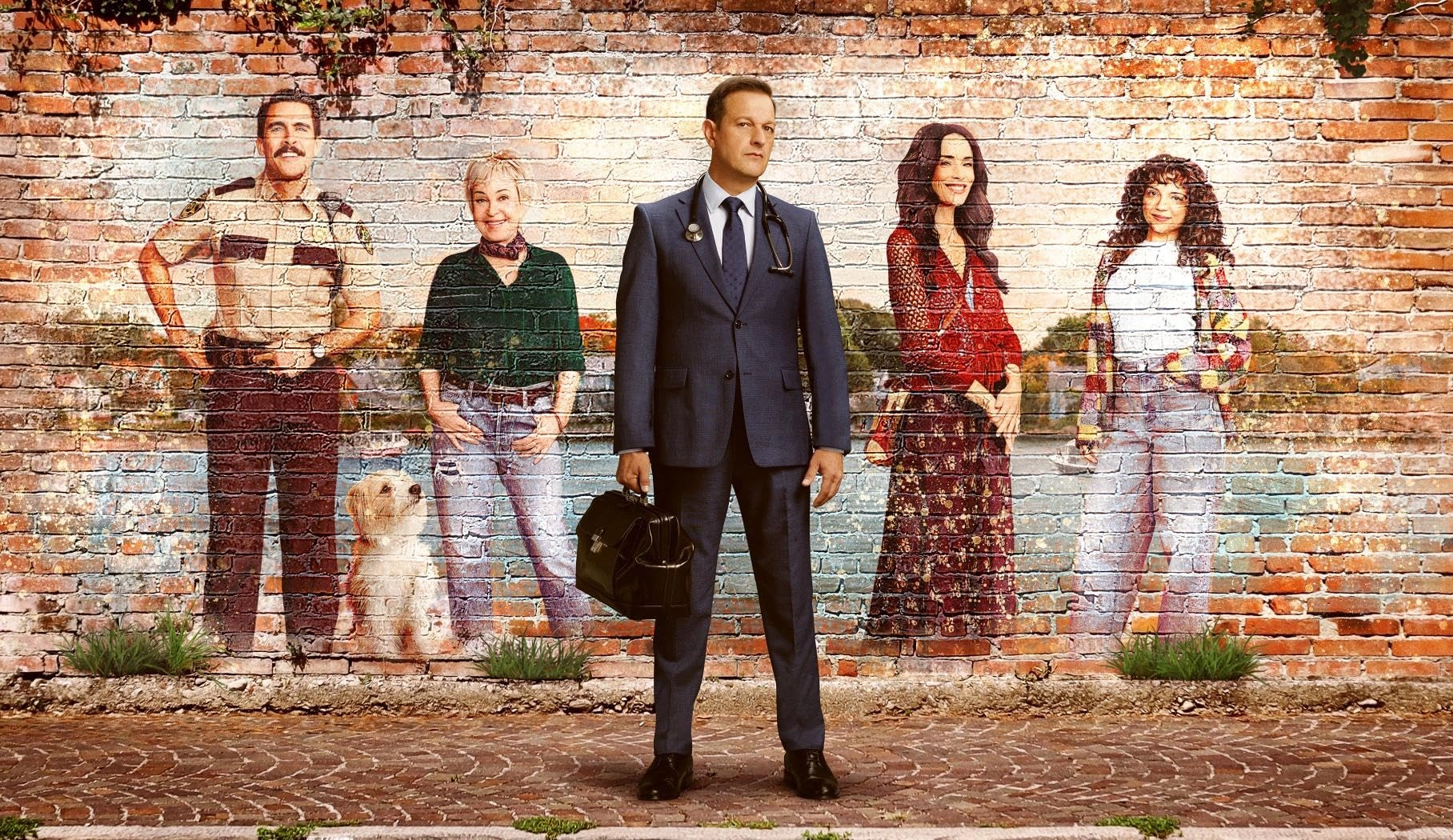

Best Medicine sets its practice in Port Wenn, a fictional Maine fishing town where the sea is picturesque, the locals are nosy, and privacy appears to have been banned by municipal vote. Fox’s medical dramedy follows Dr. Martin Best, played by Josh Charles, a brilliant Boston surgeon whose career takes a strange detour after he develops a fear of blood. That irony gives the series its cleanest hook: a doctor who can spot a medical condition at a glance, yet might collapse at the sight of a skinned knee.
The show trades hospital urgency for community rituals, odd ailments, romantic friction, and the slow thawing of a man who treats warmth like a contagious condition. It is gentle television by design, built for viewers who want character comedy without cruelty and medical storytelling without panic. Its appeal comes from atmosphere, chemistry, and the mild pleasure of watching a rigid outsider get pulled, inch by reluctant inch, into the emotional traffic of a small town.
Port Wenn and the Politics of Comfort
Martin Best arrives in Port Wenn with the polished credentials of a big-city specialist and the social instincts of a locked filing cabinet. He applies to replace the town’s late doctor, and his résumé dazzles the hiring committee. His personality does not. From the start, Best Medicine frames him as a man out of step with the place he has chosen to enter.
He is precise in a town that runs on interruption. He is formal among people who treat a doctor’s office like a public bench. He sees symptoms, patterns, risks. Port Wenn sees tradition, gossip, and the sacred right to yell at a physician over a cancelled baked bean supper.
That clash gives the series its dependable rhythm. Martin’s medical authority meets a community that refuses to be managed by expertise alone. There is a quiet cultural tension here, one that speaks to a modern audience wary of institutions yet still hungry for competent adults in the room. Martin has knowledge, Port Wenn has social memory. The show’s drama grows from the gap between those forms of authority.
His blood phobia deepens the contradiction. A surgeon who cannot handle blood sounds like a sitcom pitch scribbled during a lunch break, yet the series uses it for vulnerability rather than pure gag work. The early connection to childhood trauma makes Martin easier to read emotionally, perhaps a little too easy.
Also Read





There is less mystery around his abrasive behavior because the show wants the audience to forgive him early. That choice fits the current comfort-TV wave, where emotional explanation often arrives before viewers have time to sit with discomfort.
The weekly medical cases are strange without becoming alarming. Gynecomastia linked to estrogen cream, sudden visual diagnoses, minor crises that reveal larger personal habits: these storylines avoid procedural dread. They function as social x-rays. Each ailment exposes something about how Port Wenn operates, from secrecy to denial to the town’s collective inability to leave Martin alone for five consecutive minutes.
The community rituals are equally central. The baked bean supper, sports events, and wilderness traditions turn Port Wenn into a comic machine powered by habit. The town can feel exaggerated, yet that exaggeration has a purpose. In a fragmented television culture, Best Medicine sells the fantasy of a place where everyone knows everyone, and where even conflict confirms belonging.
Josh Charles and the Art of Controlled Irritation
Josh Charles gives Martin Best the dry severity the role needs, then lets small fractures show through the surface. His performance is restrained, physical in tiny doses, and carefully calibrated. A stiff glance, a pause before an insult, a look of horror at yet another human demanding emotional availability: Charles makes Martin’s irritation legible without reducing him to a one-note crank.

That balance matters because the show depends on our willingness to stay with a man who is often rude, impatient, and allergic to social grace. Charles suggests that Martin’s bluntness is both defense and habit. In scenes with Aunt Sarah, the tough lobster fisher who knows his history, his edges soften without melting.
In scenes with Louisa, his discomfort shifts into something closer to curiosity. He may be emotionally underdeveloped, yet Charles never plays him as empty. There is pain beneath the control, and the show is strongest when it trusts that pain to remain partly unspoken.
Abigail Spencer’s Louisa Glasson serves as Martin’s most effective counterweight. A local schoolteacher with firmness and emotional intelligence, she can challenge him without turning every exchange into a lecture. Their chemistry is built on irritation, not instant sparkle, which gives the romantic thread a useful friction. Louisa’s broken engagement to Sheriff Mark Mylow adds a light triangle, though the show treats it with more sweetness than sting.
Josh Segarra brings Mark a looseness that keeps him from becoming a stock small-town fool. Mark is open-hearted, wounded, and often a step behind the conversation, yet Segarra finds dignity in his confusion. His heartbreak over Louisa gives the comedy a human base. He is funny because he wants to be decent and keeps bumping into his own limitations.
The surrounding ensemble gives Port Wenn its texture. Elaine, Martin’s distracted receptionist, belongs to a very current species of comic character: the worker whose attention is split between the job in front of her and the invisible audience in her phone. Her influencer habits are an easy joke, yet they also place the series in a recognizable media moment. Even in a quaint fishing town, the performance of self has gone digital.
Aunt Sarah grounds Martin’s backstory and gives the show a welcome older female presence with grit. Bert and Al Large, Sally Mylow, George and Greg, Glendon Ross, and the dog that keeps adopting Martin all contribute to the town’s comic clutter.
George and Greg, the couple running the local inn and restaurant, signal the show’s interest in making Port Wenn feel casually inclusive. That representation is presented without fanfare, which can be refreshing. It also raises a question the series has not fully answered yet: will these characters gain depth, or remain part of the town’s pleasant decorative architecture?
That is the ensemble’s main challenge. The best supporting figures feel rooted in behavior. Others risk becoming walking quirks, summoned when the plot needs whimsy. Still, the cast has enough ease to keep the town lively, especially when the writing lets banter carry the scene.
A Softer Adaptation for a Softer Broadcast Moment
Best Medicine belongs to a growing television appetite for low-conflict restoration. Streaming has trained viewers to binge trauma, prestige gloom, and serialized dread, while broadcast networks have rediscovered the value of weekly comfort. This show understands that shift. It offers a familiar structure, a scenic town, a reluctant healer, and a cast of locals who will irritate one another into emotional growth.

The humor is wry, situational, and character-driven. Martin’s bedside manner is often terrible, Elaine’s online ambitions clash with basic competence, Mark’s earnestness keeps wandering into comic fog, and Port Wenn’s collective nosiness borders on civic policy. The physical comedy tied to Martin’s blood phobia and his unwanted dog companion gives the series bursts of silliness without derailing its tone.
What makes the show culturally interesting is its faith in repair. Martin enters as a figure of isolated expertise, the kind of professional who knows bodies better than people. Port Wenn answers with communal pressure. In an age shaped by loneliness, remote work, algorithmic sorting, and civic distrust, the series imagines a town where connection is unavoidable. That fantasy is comforting, and perhaps a little suspicious. Anyone who has lived in a small town knows that togetherness can heal, smother, and gossip with equal force.
The show is most American in its softness. Martin’s abrasiveness is cushioned by visible trauma, and the town’s eccentricity is polished into friendliness. The writing prefers acceptance and emotional access over discomfort. That choice will work beautifully for viewers seeking gentle, restorative TV. It may frustrate those who want sharper social observation or messier realism.
There is also a representational contradiction worth noting. Best Medicine gestures toward a wider social fabric through casting and the inclusion of queer community members, yet its central lens remains fairly traditional: a gifted male outsider, a patient female foil, a town ready to improve him through persistence.
The show does not challenge that template so much as humanize it. In industry terms, that may be its real strategy. It updates the edges of a classic format without threatening the audience’s sense of safety. Television executives do love progress when it arrives wearing a cardigan.
Craft, Pacing, and the Weekly Pleasure of Being Reassured
Visually, Best Medicine is clean, scenic, and inviting. The coastal Maine imagery, lobster-town setting, doctor’s office, inn, bar, and gathering spaces all support the show’s main promise: this is a place to visit, not a place to fear. The production design favors warmth and tidiness over grit. Port Wenn looks like a broadcast network dream of local life, with enough salt air to suggest texture and enough polish to keep things cozy.

The pacing follows a steady hour-long pattern. A community issue arises, a medical oddity complicates it, Martin offends someone, a small emotional truth surfaces, and the town resets without fully returning to where it began. That rhythm suits the series. It gives each episode a sense of completion while leaving space for romantic tension, ensemble business, and Martin’s gradual softening.
The format can stretch a little when the medical case lacks weight, since the show is rarely interested in danger. Its stakes are social and emotional, not life-or-death. That limitation is also part of its appeal. Best Medicine uses kindness as its main engine, and kindness is harder to dramatize than catastrophe. The series sometimes solves that problem with quirk, sometimes with genuine tenderness.
Its strongest scenes sit in the gap between Martin’s certainty and Port Wenn’s messiness. He knows what is wrong with a body. He has far less confidence with grief, embarrassment, longing, or rejection. The town, for all its comic intrusions, keeps forcing those conditions into his office.
Best Medicine is modest, pleasant, and occasionally too neat, yet its cast gives the material a sturdy charm. Josh Charles, Abigail Spencer, Josh Segarra, and Annie Potts make the familiar prescription easier to accept. The show may not reinvent medical dramedy, but it understands a need television often overlooks: sometimes viewers want care, not shock. Sometimes they want a doctor who can diagnose everyone except himself.
Best Medicine is an American medical comedy-drama television series that premiered on Fox on January 4, 2026. The series is available for viewing on Fox and its associated streaming options. The story centers on a blunt yet brilliant surgeon who leaves his prestigious career in Boston to become a general practitioner in a quaint fishing village.
Where to Watch Best Medicine Online









Full Credits
Title: Best Medicine
Distributor: Fox
Release date: January 4, 2026
Rating: TV-14
Running time: 41–43 minutes
Director: Jay Karas, Jamie Babbit, Todd Holland, Jaffar Mahmood, Jason Winer, M.J. Delaney, Marcos Siega
Writers: Liz Tuccillo, Elizabeth Evans, Ria Tobaccowala, Cindy Chupack, Scott Prendergast, Matt Ward, Peter Ackerman
Producers and Executive Producers: Ben Silverman, Rodney Ferrell, Liz Tuccillo, Mark Crowdy, Philippa Braithwaite, Howard T. Owens, Jay Karas, Tyson Bidner, Peter Ackerman, Scott Prendergast, Matt Ward, Summer Crockett Moore, Tony Glazer, Josh Charles, Billy Redner, Demian Resnick
Cast: Josh Charles, Abigail Spencer, Josh Segarra, Cree Cicchino, Annie Potts, Stephen Spinella, Jason Veasey, Carter Shimp, Alexandra Sica
Director of Photography (Cinematographer): Wesley Cardino, John G. Inwood, Matthew J. Santo
Editors: Sheri Bylander, Vanessa Procopio, Karen K.H. Sim
Composer: Jeff Cardoni
The Review
Best Medicine
Best Medicine is warm, familiar comfort TV with a sharp enough lead performance to keep its softer instincts from becoming bland. Josh Charles gives Dr. Martin Best the right mix of frost, pain, and deadpan bite, while Port Wenn provides a cozy stage for medical oddities and small-town chaos. The series is predictable and sometimes too polished, yet its kindness, cast chemistry, and gentle humor make the prescription easy to accept.
PROS
- Josh Charles anchors the series with dry comic precision.
- Abigail Spencer gives Louisa warmth and firmness.
- Cozy coastal setting supports the show’s comfort-TV appeal.
- Medical cases are light, strange, and accessible.
- Ensemble chemistry gives Port Wenn an easy charm.
CONS
- Some supporting characters feel thinly sketched.
- The story beats are often predictable.
- The softer tone limits sharper social tension.
- Port Wenn can feel overly polished.
- Some episodes may stretch when the medical case is slight.