


























Alex Vlack’s The Revisionist treats literature like evidence left under poor lighting. A confession here, a family anecdote there, a tape recorder humming in the background, and suddenly the act of writing starts to resemble an interrogation. Vlack’s feature narrative debut is a chamber drama about authorship, legacy, and the quiet violence of turning other people’s pain into usable material.
Jacob, played by Tom Sturridge, has left advertising behind and hopes to write a biography of his father David, a celebrated author whose fame has curdled into vanity, defensiveness, and late-life theatricality. David, played by Dustin Hoffman, has no interest in being handled by his son. Elise, Jacob’s wife and a successful novelist played by Alison Brie, faces her own creative paralysis and helps devise a workaround. John, an old friend played by André Holland, returns after 15 years and becomes David’s confidant, proxy interviewer, and potential usurper.
The film is talk-heavy by design. Its rooms are clean, its surfaces polished, its moral air slightly stale. Everyone has a story. Everyone edits.
Drafts, Lies, and Narrative Control
The structure of The Revisionist behaves like a manuscript changing shape on the desk. Jacob wants a father’s cooperation, then a father’s truth, then perhaps a father’s approval, which is a far less publishable commodity. David wants his life recorded without surrendering ownership of it. John arrives with charm, hunger, and that faintly noirish quality of a man who enters a room already aware of the exits. Elise watches all this with a novelist’s eye, which may be another way of saying she watches with moral flexibility.
The title does plenty of heavy lifting, almost too much. Jacob revises family history into biography. David revises memory into myth. Elise revises lived experience into fiction. John revises failure into proximity to genius. In noir terms, the corpse is truth, and each character keeps moving it to a better-lit part of the room.
Vlack’s smartest idea is that storytelling is a form of power. Biography looks respectable, confession looks intimate, fiction looks safe. In practice, all three can become instruments of possession. The film asks who owns a life once it has been shaped into narrative, and it does so with enough intellectual charge to keep the surface buzzing.
Yet the puzzle-box design also creates distance. The possibility that scenes may be imagined, reframed, or filtered through artistic need gives the film a slippery charge, but it drains some feeling from the characters. The plot becomes so busy commenting on its own machinery that emotional pain can start to look like clever formatting. A dangerous habit. Writers know it well.
Four Writers in Search of a Moral Exit
The cast gives The Revisionist its pulse. Hoffman’s David is the film’s most electrically unpleasant creation, vain, wounded, sharp, and hungry for control. He speaks in anecdotes that feel rehearsed and freshly discovered at once. His presence turns exposition into performance, and his scenes carry the faint glow of chiaroscuro without needing a Venetian blind in sight. The shadow is psychological. The key light comes from ego.
Holland matches him beautifully. John is seductive because he seems to listen better than anyone else in the room, which is often the most efficient form of manipulation. He slides between friend, rival, disciple, opportunist, and romantic threat with a calm that keeps the film alert. His scenes with David have the richest tension, a duel between a fading master and a gifted admirer who may be sharpening the knife under the table. Politely, of course. These are literary people.
Sturridge gives Jacob a quieter ache. His humiliation gathers in small gestures: the pause before speaking, the wounded glance, the grim recognition that his father offers warmth to another man with insulting ease. Jacob’s crisis is creative, filial, and existential. If a son cannot inherit love, perhaps he can inherit material. That is a bleak trade, and the film knows it.
Brie’s Elise is given the thorniest function. She is blocked, observant, desirous, calculating, and ethically restless. The premise is strong: a novelist who begins to arrange real life as if it were a draft. The script, at times, narrows her into symbol and catalyst, leaving Brie to supply interior conflict through looks, stillness, and the tense brightness of someone waiting for inspiration to behave like absolution.
Rooms, Recordings, and the Sound of Control
Vlack directs with a controlled literary sensibility. The opening image of Elise facing a whiteboard packed with Post-its is almost comic in its efficiency: writer’s block reduced to stationery warfare. The pastel home office, the academic spaces, the affluent domestic interiors, and the recording sessions all suggest a world where culture has become décor and confession has become workflow.
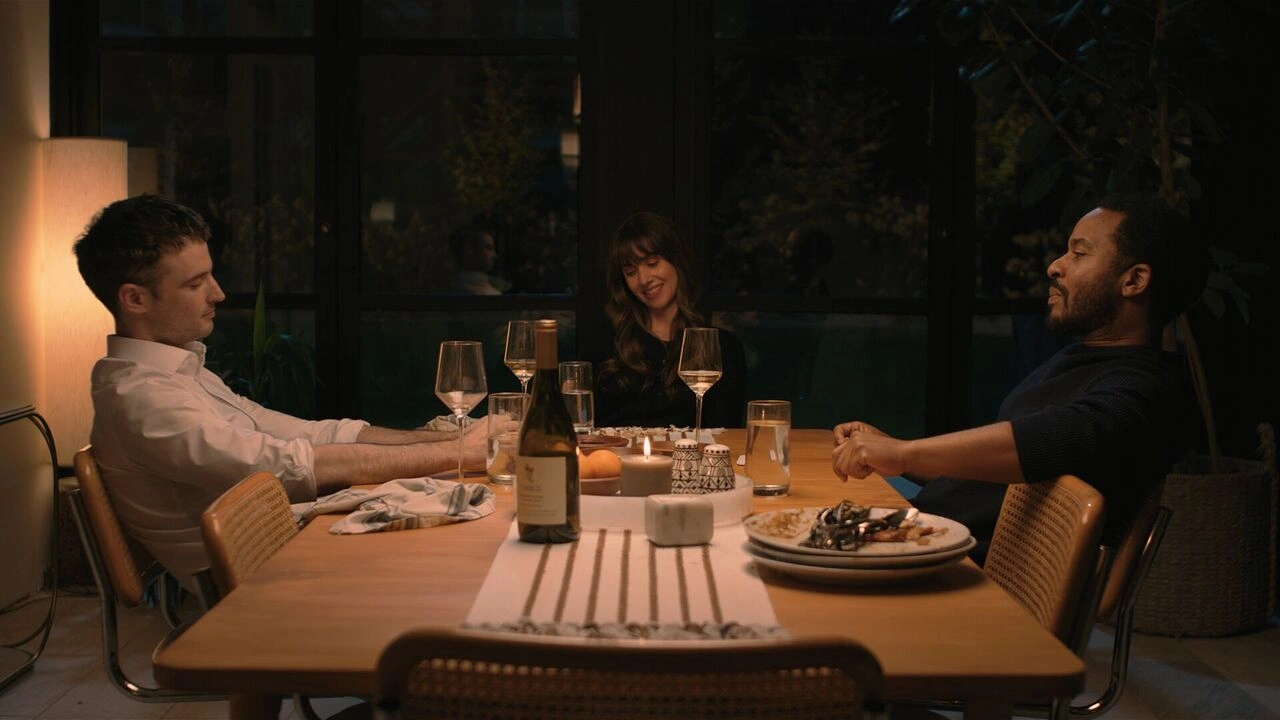
The visual language leans toward restraint rather than overt noir stylization. Still, noir haunts the film through framing and power dynamics. Characters are boxed into rooms, caught across tables, arranged in conversational traps. The camera often seems less interested in movement than in pressure, letting faces become evidence. Light does not slash through the image in classic expressionistic fashion, but the film understands shadow as a moral condition. Every bright room has something hidden in it.
Sound plays a vital role in shaping suspicion. The score’s vocal textures suggest unease before the plot earns it, nudging the audience toward paranoia. Recordings add another layer of instability: a voice preserved, edited, repurposed. The ear becomes as vulnerable as the eye. What we hear may be testimony, seduction, theft, or rehearsal.
The weakness is stasis. Films about writers often risk turning labor into furniture, and The Revisionist does not fully escape that trap. Its 90 minutes feel crowded with father wounds, blocked artistry, old desire, literary ambition, family secrets, and meta-fictional games. The film might have cut deeper as a cruel comedy of manners or as a darker authorship thriller. Instead, it hovers between those shapes, clever and uneven, sustained by actors who know how to make a conversation feel like a crime.
The Revisionist is an American independent drama feature film that made its official world premiere at the Tribeca Festival on June 5, 2026, screening as part of the Spotlight Narrative lineup. Written and directed by Alex Vlack in his feature length directorial debut, the story follows a frustrated, blocked bestselling novelist named Elise who begins manipulating the people in her personal life into characters for her next book. This twisted quest for artistic inspiration forces her husband, an aspiring writer, and their newly resurfaced old friend into an intense psychological game involving her husband’s eccentric, famous novelist father. Audiences interested in this meta-textual character study can watch for its screenings across the summer film festival circuit and track its upcoming commercial theatrical release dates through global sales representatives.
Full Credits
Title: The Revisionist
Distributor: Palisades Park Pictures, WME
Release date: June 5, 2026
Running time: 90 minutes
Director: Alex Vlack
Writers: Alex Vlack
Producers and Executive Producers: Arielle Elwes, Veronica Radaelli, Fiona Robert, Sofia Robert, Zachary Spicer, Alex Vlack, Cassian Elwes
Cast: Alison Brie, Dustin Hoffman, André Holland, Tom Sturridge
Director of Photography (Cinematographer): Byron Werner
Editors: Jon Fine
Composer: Philip Klein
The Review
The Revisionist
The Revisionist is a smart, literate chamber drama carried by sharp performances and a strong central idea: storytelling as theft, confession, and control. Alex Vlack’s debut has wit, tension, and moral unease, especially in the scenes between Dustin Hoffman and André Holland. Its weakness lies in overworked plotting and emotional distance, with meta-fictional tricks sometimes crowding out human feeling. Still, it remains a thoughtful, actor-driven film with enough intellectual sting to linger.
PROS
- Strong cast
- Excellent Hoffman and Holland scenes
- Sharp authorship themes
- Controlled atmosphere
- Clever narrative ambiguity
CONS
- Overstuffed plotting
- Some static stretches
- Elise feels underwritten
- Emotional stakes can feel muted
- Twists are heavily signposted