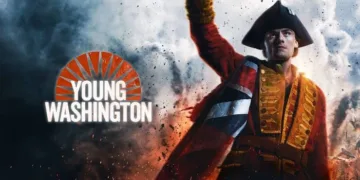




















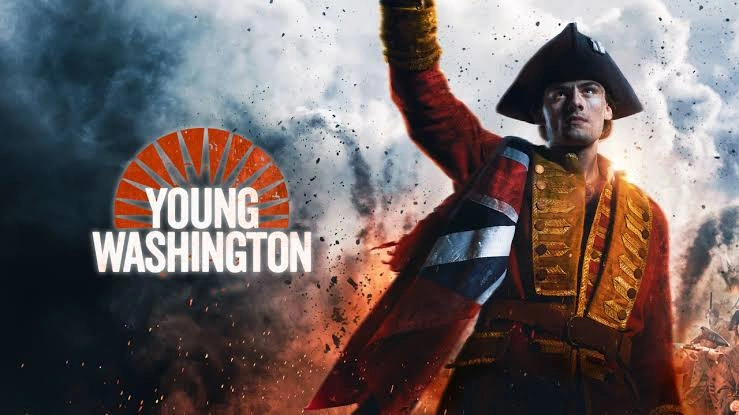

Jon Erwin’s young George Washington wants the British Empire before he learns how to defeat it. That irony gives Young Washington its sharpest idea, and also exposes the limits of the film built around it. Released by Angel Studios and Wonder Project with Independence Day timing, the film arrives packaged as patriotic origin myth, yet its most interesting material belongs to a less polished story: a provincial young man chasing rank inside a system designed to keep him useful, grateful, and slightly beneath notice.
The film avoids the presidency and the Revolutionary War, choosing the French and Indian War as its proving ground. George, played by William Franklyn-Miller, is barely formed when the story catches him. His father’s death has ended his formal education.
His mother, played by Mary-Louise Parker, needs him tied to the family’s practical survival. His half-brother Lawrence, played by John Foss, becomes tutor, mentor, and emotional architect, teaching him the chess maxim that gives the script its favorite refrain: a pawn can take the king.
The line is blunt, and the film repeats it with the confidence of a motto stitched onto a banner. Still, it lands because Washington begins as exactly that kind of figure. He is close enough to power to smell the room, barred enough from it to mistake admission for destiny.
Class Lessons and Courtship Games
The early social scenes understand ambition as performance. George does not drift into the orbit of Lord Fairfax, played by Kelsey Grammer. He inserts himself into it. At a party, he flirts with Sally Cary, played by Mia Rodgers, with the same calculation he brings to his pitch about surveying land in the Ohio Valley. The romance is thin, but its thinness is revealing. Sally is less a fully developed partner than a doorway into the class he wants to enter, a vision of elegance and approval connected to land, rank, and British favor.
Grammer gives Fairfax a small but flavorful authority, treating territorial expansion like dinner-table weather. Ben Kingsley’s Robert Dinwiddie has colder uses for George. His commission sounds like recognition, but the assignment carries the odor of disposability. If the young Virginian succeeds, British power absorbs the credit. If he fails, blame can be placed on colonial inexperience. The film sees this arrangement clearly enough to make George’s eagerness sting.
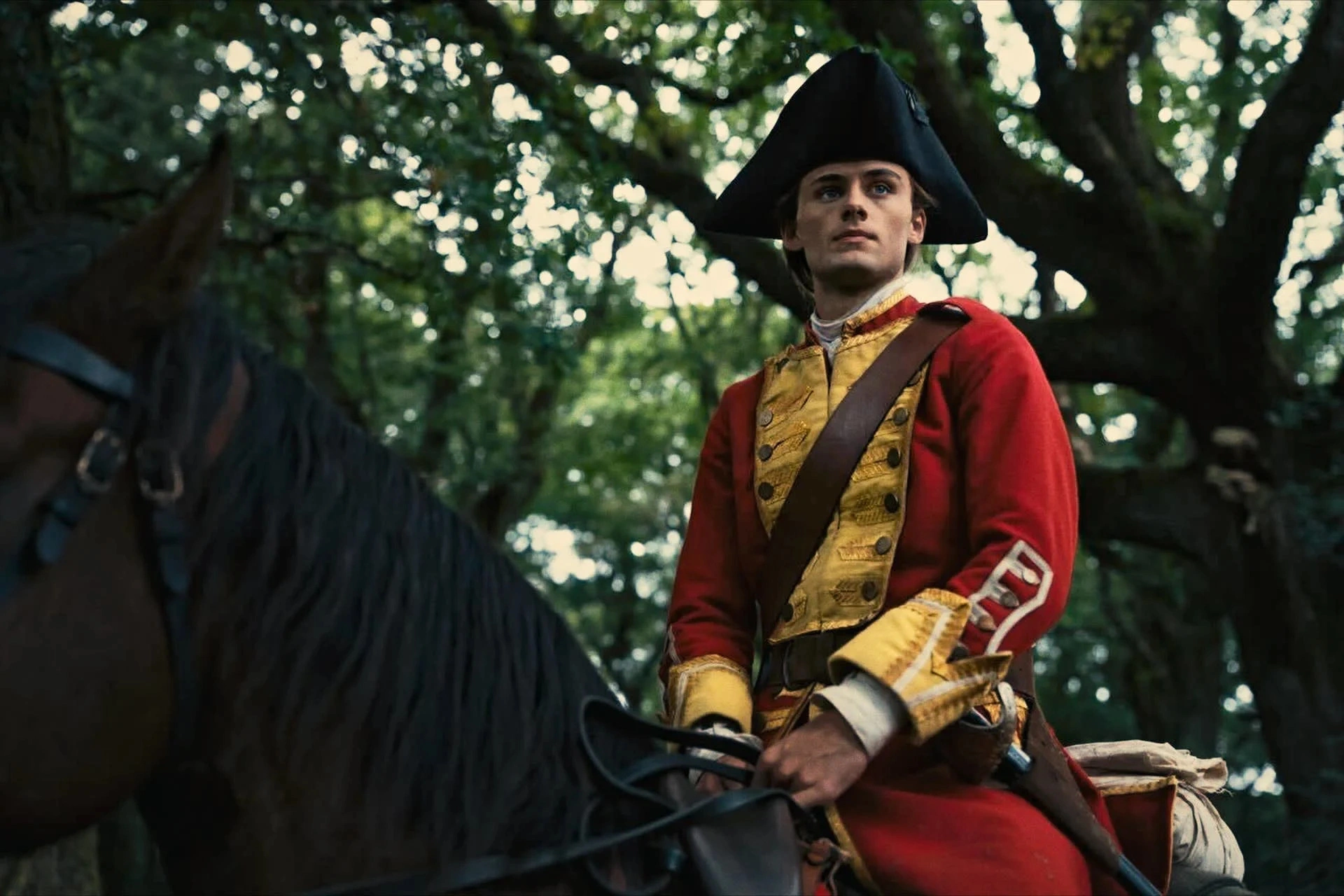
Franklyn-Miller’s performance works best when George is caught between charm and insult. His face tightens when British officers dismiss him. His posture grows too rigid when he enters rooms where pedigree matters. He has the height and polish of someone born for heroic framing, which can make him feel oddly modern, yet his boyishness serves the film in these scenes. This Washington is not yet the marble father of a nation. He is an ambitious young man trying to force history to notice him.
The trouble arrives when the script asks that ambition to become psychology. Shame after Fort Necessity, grief after personal loss, and the slow recognition that his confidence has killed men should mark the character in deeper ways. Too often, they pass through him as plot weather. The film gives Washington a temper, a goal, and a destiny. It gives him fewer private contradictions than the premise demands.
War Gives the Film Its Shape
Erwin’s strongest work is on the battlefield. The film stages war as a collision between ritual and terrain, with British line formations moving into woods that have no respect for European geometry. In the early clashes, musket fire cuts through men with frightening randomness. The panic is legible: inexperienced militia, unfamiliar ground, enemies who refuse to stand where old rules say they should stand.
The Battle of Fort Necessity supplies the story’s necessary humiliation. George’s courage cannot organize chaos. His rank cannot protect his men. His hunger to prove himself becomes a tactical liability, and the film is at its best when it allows that failure to sit in the dirt. The frontier here is not an empty theater for future greatness. It is a contested space where British claims, French military pressure, and Indigenous presence meet in blood and weather.
Ryan Begay’s Tanacharison gives the film one of its few clean cuts through imperial fantasy. His reminder that the land belongs to neither European side widens the moral field at the exact moment the story wants to narrow itself around George. The film needs him. Without Tanacharison, the Ohio Territory risks becoming scenery for a founder’s résumé. With him, even briefly, the land speaks back.
Yet Young Washington rarely stays with that complication long enough. The Seneca leader’s warning carries historical force, then the film returns to George’s formation. Indigenous presence becomes morally clarifying, then narratively secondary. That movement is not accidental. It reflects the film’s governing habit: difficulty enters the frame, then gets arranged around Washington’s rise.
The later battle scenes push him toward legend. George rides through fire, cuts with his sword, fires his pistol, and emerges with the almost comic cleanliness of a man history refuses to puncture. Bullets strike fabric and hat rather than flesh. The spectacle has energy, and the choreography gives the film a welcome muscularity. It also turns survival into proof before the story has earned that proof.
The Handsome Concept of a Founder
Franklyn-Miller has the physical grammar of a young star: tall, lean, clean-featured, built for candlelight and cavalry. This helps Erwin detach Washington from the old portrait face fixed in public memory. The film wants motion, not monument, and the actor supplies it in the riding scenes, the officerly confrontations, and the awkward flashes of social longing.
He is less persuasive when the film needs opacity. A great Washington drama could use the unknowability of the man as a dramatic engine: the distance between public composure and private appetite, between civic virtue and land hunger, between servant leadership and the violence needed to secure power. This film mostly chooses readability. George wants to rise. George fails. George learns. George is marked for greatness.
The supporting actors often supply the missing texture. Kingsley makes Dinwiddie’s aristocratic disdain feel administrative, almost bored, which is more cutting than open cruelty. Andy Serkis gives General Braddock the swagger of an older military order marching into its own obsolescence. John Foss makes Lawrence’s lessons warm enough that the chess metaphor does not collapse under repetition. Parker’s scenes as Mary Washington gesture toward family duty, maternal pressure, and the cost of ambition at home, but the film moves away from her too quickly.
Those exits matter. The mother, the love interest, the mentor, the rival, the patron, the Indigenous ally: too many figures become instruments in Washington’s ascent. A cultural myth can survive such simplification. A drama suffers from it.
Providence Without a Private Soul
For much of its running time, Young Washington is less overtly religious than its Angel Studios identity might suggest. George’s faith, early on, is in his own hands. He believes in effort, rank, daring, and the possibility that willpower can break class barriers. This makes the late turn toward divine protection feel both predictable and underprepared.
The “Indian Prophecy” material frames Washington’s survival as touched by higher design. Indigenous figures recognize that bullets have failed to find him, and the film treats this as spiritual confirmation. The idea is historically resonant enough to fit the mythology around Washington, yet Erwin has not given George a lived religious interior strong enough to make the moment dramatically specific. There are references to Providence, but little sense of prayer, doubt, worship, or private moral reckoning.
So the climax leaves him in a strange symbolic state. He is too secular in his ambition to register as a man shaped by devotion, and too protected by the camera to remain merely human. The film wants divine mystery without the theological labor that would make such mystery meaningful. What appears on screen is closer to bulletproof heroism with sacred lighting.
This is where the film’s patriotism becomes tidier than its material. It acknowledges British arrogance, colonial insecurity, Indigenous dispossession, and the Washington family’s connection to slavery in glancing strokes. Each element could have pressured the myth. Each is permitted into the room, then politely managed.
The closing appeal from Grammer, asking viewers to “Pay It Forward” by buying tickets for others, places a final frame around the experience. The film has already treated Washington’s survival as civic inheritance; the credits turn that inheritance into a purchase prompt. It is an awkwardly fitting gesture. A movie about a young man seeking the approval of empire ends by asking the audience to join a campaign around virtue, freedom, and national feeling, with a QR code waiting like a modern patron at the edge of the battlefield.
The epic historical war drama Young Washington premiered at the Tribeca Festival on June 13, 2026, and is scheduled for a wide United States theatrical release by Angel Studios on July 3, 2026. Audiences can watch the biographical feature exclusively in cinemas nationwide over the Independence Day holiday weekend. Set decades before the American Revolution, the narrative chronicles the early military career of a 22-year-old George Washington as an ambitious soldier navigating dangerous frontier territory and commanding inexperienced militia forces during the outbreak of the French and Indian War.
Where to Watch Young Washington (2026) Online





Full Credits
Title: Young Washington
Distributor: Angel Studios
Release date: June 13, 2026 (Tribeca Festival Premiere), July 3, 2026 (United States Theatrical Release)
Rating: PG-13
Running time: 122 minutes
Director: Jon Erwin
Writers: Jon Erwin, Diederik Hoogstraten, Tom Provost
Producers and Executive Producers: Jon Erwin, Chip Diggins, Adam Abel, Tyler Zacharia, Benton Crane
Cast: William Franklyn-Miller, Mary-Louise Parker, Kelsey Grammer, Andy Serkis, Ben Kingsley, Joel Smallbone, Mia Rodgers, Jonno Davies, John Foss, Leo Hanna, Michael Benz
Director of Photography (Cinematographer): Production Camera Crew
Editors: Production Post-Production Team
Composer: Production Music Department
The Review
Young Washington
Young Washington has the shape of a sharper film about colonial ambition, class resentment, empire, and the making of national myth, yet it keeps sanding its harder edges into patriotic uplift. Jon Erwin stages the battles with real force, and the young George’s hunger for British approval gives the story a useful irony. Still, the film treats Washington too often as destiny in motion rather than a man being formed by failure, violence, and land hunger. The result is engaging, sincere, and politically tidier than its own material demands.
PROS
- Strong battle staging
- Clear colonial-war setting
- Useful irony around British loyalty
- Sharp supporting turns
- Handsome production design
CONS
- Washington feels underwritten
- Myth overtakes psychology
- Indigenous perspective thins out
- Faith angle arrives too late
- Closing pitch sours the tone