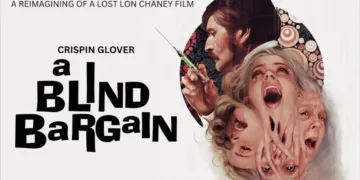


























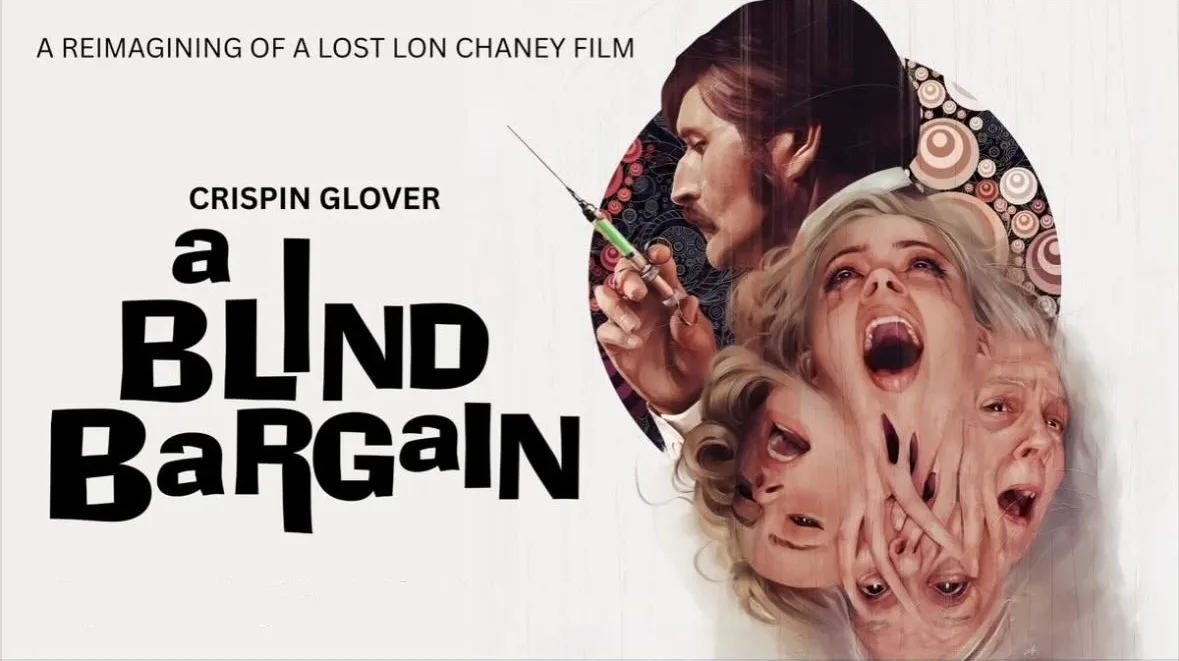

Moral failure rarely arrives with a lab coat and a fake spa brochure, yet A Blind Bargain makes a fairly convincing case for that arrangement. Paul Bunnell’s loose reimagining of the lost 1922 Lon Chaney film moves the story to 1970 Los Angeles, where the promise of rejuvenation, the residue of war, and the grime of addiction all share the same sickly room.
The premise is clean enough to be cruel: Dominic Fontaine, a heroin-addicted Vietnam veteran played by Jake Horowitz, agrees to deliver his elderly mother Joy to Dr. Gruder’s experimental clinic in exchange for money. He does not quite sell her soul. He sells her blood.
That distinction matters only to Dominic, which is the film’s nastiest little joke. Gruder, played by Crispin Glover with the air of a man who learned bedside manner from a taxidermist, wants Joy for research into age reversal. Dominic tells Joy she is going to a spa. Joy believes him because mothers in movies often trust the wrong son, and because Amy Wright plays her trust without stupidity. She gives Joy a softness that makes the lie feel less like plot mechanics and closer to moral vandalism.
The Son Who Refuses to Look
The title’s warning, that a blind man should not bargain for a suit of clothes because he does not know what he is getting, lands less as folklore than diagnosis. Call it moral astigmatism: Dominic can see the cash, the debt, the heroin, the immediate escape route. He cannot focus on the human cost sitting across from him at home.
Horowitz plays that failure unevenly at first. His early scenes carry a strained weaseliness, especially when Dominic is being threatened by Vincent and his retro-styled gang of toughs. Yet the performance gains shape once Dominic starts performing confidence for Nurse Bannister.
When Lucy Loken’s Ellie takes his blood, then lures him deeper into Gruder’s scheme, Horowitz finds the pathetic vanity in him. Dominic wants to be seduced, financially and physically. His corruption is not grand. It is needy.
Wright is the film’s anchor because Joy’s desires are small, recognizable, and sad. She wants relief from age, from disappointment, from the humiliations of a body treated as an old machine. Her excitement about the supposed spa visit makes Dominic’s betrayal sting. Later, when Gruder chloroforms her and the procedure begins to reveal its real nature, the film briefly touches the horror it keeps circling: age has made Joy vulnerable, yet youth is being sold back to her as a trap.
Gruder and His Decorative Monsters
Glover’s Dr. Gruder is less a character than a climate system. He drifts into rooms, tilts the air, then leaves everyone slightly worse. The accent is silly, the mustache-twirling villainy is deliberate, and the twitchy pauses do much of the work that the script declines to do. Glover can make an underwritten line feel like it has been left in a basement for twenty years. That is useful here.
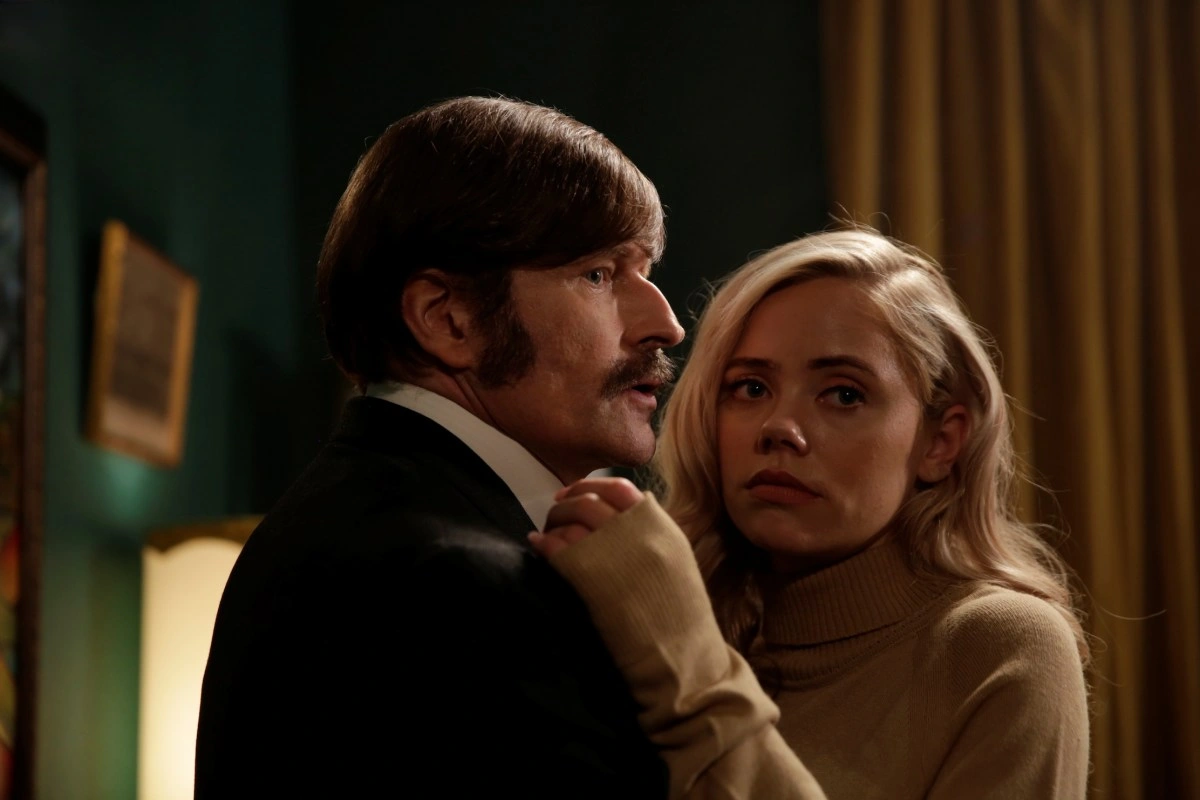
It also exposes the film’s problem. Gruder is fascinating in flashes because the movie withholds him, but the withholding sometimes feels like scarcity rather than mystery. His clinic should be the film’s diseased nervous system, yet too many scenes wander toward side figures who seem imported from louder, less disciplined films.
Vincent is the clearest offender. Rob Mayes gives him a strutting macho presence, all swagger and period-costume menace, but the character mostly repeats the same pressure: Dominic owes money, Dominic is weak, Dominic will be humiliated. Fine. Point made. The birthday party scene, where Gruder’s staff somehow mingles with Vincent’s circle, has the right kind of dream-logic weirdness, then keeps asking us to care about people who function better as background toxins.
Logos, Gruder’s hulking assistant, creates a stranger frustration. His attraction to Joy could have turned the film toward tragic monster-movie tenderness, especially beside the age-reversal experiment. Instead, Jed Rowen is left with an idea, a silhouette, and too little emotional oxygen. A misunderstood creature needs either lyricism or danger. Logos gets posture.
The Seventies as Infection
The strongest argument for A Blind Bargain is visual. Bunnell and cinematographer Francisco Bulgarelli shoot the film with a tactile 1970s grime that makes Los Angeles feel less like a period setting than a contagious surface. The 35mm texture matters. It gives skin, wallpaper, clinic rooms, fur hats, lava lamps, and party spaces a physical unpleasantness that digital nostalgia often fails to fake.
The cold opener is the film at its sharpest: a sick, frantic man demands to see Gruder, vomit and panic breaking the frame before the doctor appears and order becomes something worse than chaos. That sequence promises a nastier film, one with pulp momentum and bodily disgust moving in the same direction. A later treatment hallucination does the same for two minutes, letting psychedelic imagery overtake the screen until the movie appears to remember that horror can be rhythmic, not explanatory. Then it forgets again.
The tone keeps wobbling between camp, exploitation melodrama, body horror, youth satire, and vintage cosplay. I do not mind a film with five impulses (many respectable people contain fewer), but A Blind Bargain rarely gets them to conspire. It is too straight-faced to become a full trash fantasia, too slack to work as tragic moral horror, and too fond of decorative oddity to let its central bargain tighten.
Still, there is something perversely admirable in its commitment to bad taste made carefully. The costumes have intention. The colors have fever. Glover’s Gruder may be thin, but he is thin in an entertaining shape. Dominic’s betrayal may lead to a generic final stretch, but the setup has a nasty ethical clarity. A son sells his mother to buy himself time. The film spends 95 minutes proving that time, like youth, is usually a terrible investment.
A Blind Bargain premiered in limited theatrical release on April 24, 2026, opening in select theaters across major cities. Set in 1970 Los Angeles and shot on grainy Kodak film, this psychological horror thriller follows a desperate, drug-addled Vietnam veteran who strikes a dark deal with an unhinged doctor, unknowingly offering his mother as a test subject for sinister anti-aging experiments.
Where to Watch A Blind Bargain (2025) Online
Full Credits
Title: A Blind Bargain
Distributor: Vitagraph Films
Release date: April 24, 2026
Running time: 95 minutes
Director: Paul Bunnell
Writers: John C. Falotico, Paul Bunnell, Bing Bailey
Producers and Executive Producers: Bing Bailey, Paul Bunnell, John C. Falotico
Cast: Crispin Glover, Jake Horowitz, Lucy Loken, Annalisa Cochrane, Amy Wright, Sean Whalen, Jed Rowen, Rob Mayes
Director of Photography (Cinematographer): Sara Ross-Samko
Editors: Paul Bunnell
Composer: Ego Plum
The Review
A Blind Bargain
A Blind Bargain has the peculiar courage of a film that knows its images are sharper than its plot. Dominic’s betrayal of Joy gives it a nasty moral engine, and the 1970s texture gives every clinic room and party scene a diseased charm. Yet the film keeps drifting toward side characters who feel like decorative symptoms rather than causes. Gruder fascinates because Crispin Glover can weaponize a pause, but the movie around him runs out of blood before the experiment ends.
PROS
- Tactile 1970s visuals
- Amy Wright’s vulnerable Joy
- Crispin Glover’s strange menace
- Strong moral premise
- Hallucinatory treatment imagery
CONS
- Thin feature-length story
- Distracting side characters
- Uneven camp tone
- Generic final stretch
- Underwritten Gruder