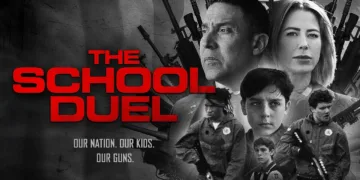




















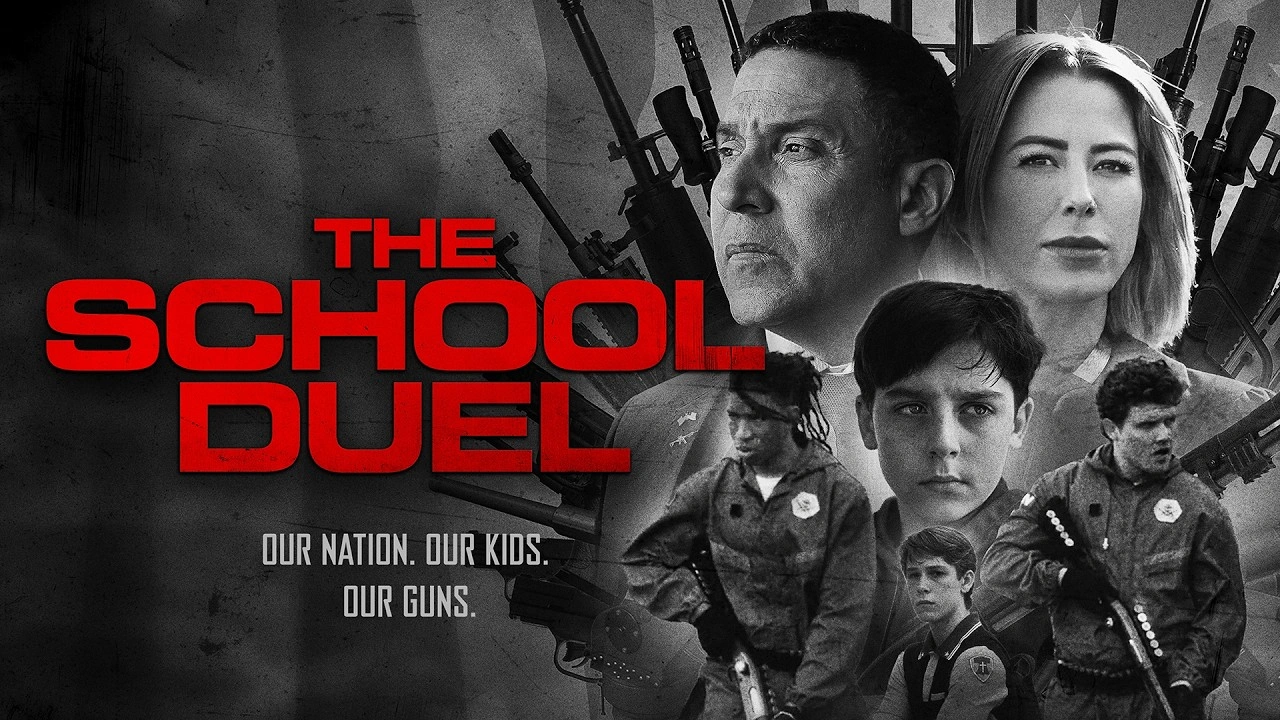

Florida, in Todd Wiseman Jr.’s nightmare, has learned to call child sacrifice public policy. The School Duel imagines a near future where gun control has been erased, Christian nationalism has settled into public schools, and the state’s answer to school shootings is a televised gunfight among boys. It is an absurd premise with very little distance from the present, which is part of its anger and part of its trap.
The film follows Sammy Miller, played by Kue Lawrence, a bullied 13-year-old living with his widowed mother Beth. He is small enough to be mocked, angry enough to be noticed, and wounded enough to confuse violence with shape. A veteran recruiter played by Michael Sean Tighe enters his life like a bad prophet, flattering the boy into believing that the School Duel might turn him into a hero. The state sees something colder. It sees a usable body.
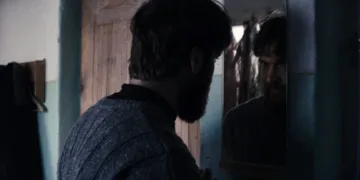
Wiseman shoots this world in black and white, drained into greys that make daylight look sick. The choice is severe, sometimes too eager to announce severity, yet it works whenever the film finds the right object to hold. The most frightening one sits in Principal Wigton’s office. She punishes Sammy for violence while framed against a glass display case full of rifles. The joke is almost too clean. The horror is that it barely feels like a joke.
The Boy Made Useful
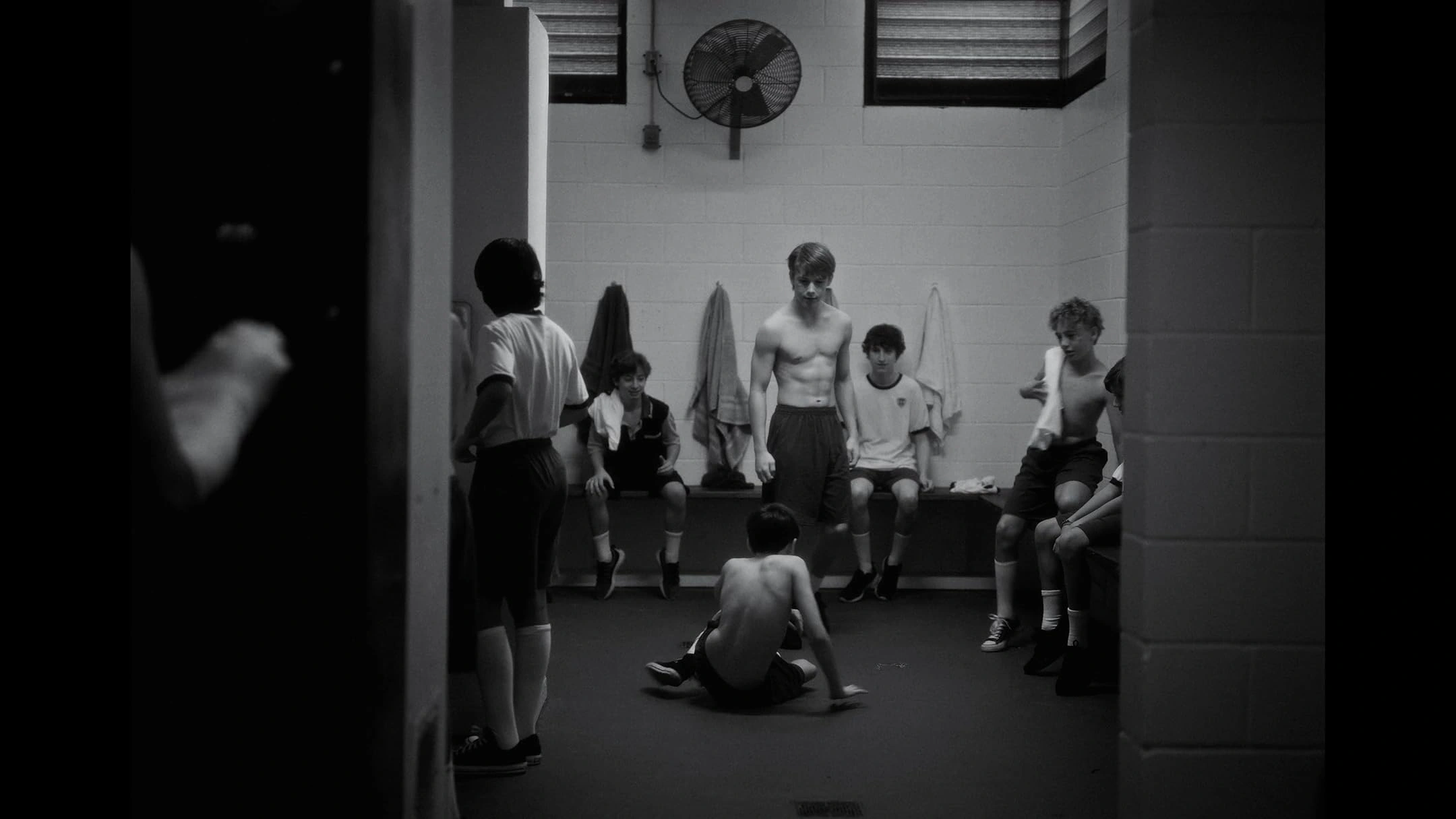
Sammy is written as both victim and warning, and Lawrence gives him the awkward opacity of a child who does not yet understand the shape of his own rage. In the schoolyard, he absorbs humiliation from classmates and discipline from adults. At home, he handles his dead father’s gun with the false solemnity of ritual. The film understands something bleak about adolescent pain: it often wants an audience before it wants language.
Beth, played by Christina Brucato, becomes one of the film’s quieter wounds. She is frightened for her son, yet the house itself has already accepted the logic that might destroy him. A gun is available. The dead father remains present through it. When Sammy consumes macho online rhetoric, video-game swagger, and cheap fantasies of domination, the film does not treat those influences as the sole cause of his damage. They are tinder scattered across a room already leaking gas.
The recruiter’s scenes bring a bitter theatricality. Tighe plays him with the warmth of a salesman and the eyes of someone measuring a product. He tells Sammy the kinds of things a lonely boy wants to hear: courage, destiny, selection, strength. The cruelty lies in the gap between Sammy’s fantasy and the institution’s plan for him. To Sammy, the Duel is a doorway out of humiliation. To the state, he is raw material for a broadcast.
Public Faith, Private Blood
Governor Anthony “The Ram” Ramiro, played by Oscar Nuñez, speaks in the language of kings, martyrs, sheep, wolves, and national healing. His rhetoric is ridiculous until it starts sounding familiar. The School Duel is strongest when it treats politics as ceremony rather than argument. Crosses on school uniforms, rifles in offices, a neighbor mowing the lawn with an AR-15 on his shoulder: each detail suggests a society that has stopped noticing its own altar.
Wiseman’s satire is blunt. Sometimes bluntness feels correct here. A subtler film might seem dishonest about a culture that has already made children practice lockdown drills and then asked them to behave like nothing metaphysical has happened. Yet bluntness becomes a cage.
Authority figures often speak in slogans. The other duelists arrive carrying labels before they carry histories: the bully with the heroic jaw, the frightened boy who runs for the fence, the street-tough kid who still has tenderness in him.
This is where the film’s anger begins to flatten its people. Sammy has enough contradiction to breathe, but the surrounding world can feel arranged purely to prove the thesis. The result is a dystopia that stings in flashes rather than deepens across scenes. The principal’s rifle case has the density the governor’s speeches lack. One image contains a civilization. Several speeches merely underline it.
The Arena of Boys
The School Duel delays its central combat until roughly the halfway point, which gives Sammy’s private damage time to gather. That patience has value. It also leaves the rules of the game slightly undernourished before the boys enter the arena. When the event begins, the setup has a cruel sports-pageantry clarity: armor, timed rounds, weapon selections from a spinning wheel, adults watching, cheerleaders turning murder into school spirit.
The violence is tense without being especially graphic. Bodies fall from gunshots, boys hide, alliances form, and fear moves faster than strategy. Wiseman’s limited resources show in the scale of the action, yet the smaller frame sometimes helps. The combat does not become a grand spectacle. It remains a field full of children pretending to understand death until death corrects them.
The camera’s static placements in classrooms, homes, and the arena suggest surveillance without needing to decorate the idea. The cropped frame presses people inward, making rooms feel like boxes and the field feel like another kind of classroom. In those moments, the film’s form carries its despair better than the script does. The world has taught Sammy a lesson, then built an arena where he can demonstrate it.
The final stretch is bleak by design, though one late turn strains for a neatness the film’s grief does not need. Wiseman wants the last image to cut like prophecy. It cuts, yes, but the deeper wound is earlier: a boy sitting inside a culture that has mistaken a weapon for an inheritance.
The independent dystopian thriller The School Duel originally debuted at the Deauville American Film Festival in September 2024, where it won the Canal+ Award, before launching its United States limited theatrical rollout via distributor Altered Innocence on April 24, 2026. Audiences can view the feature at select arthouse cinema venues across major cities, with streaming accessibility expanding through Prime Video. Set in a bleak, near future Florida where gun control has been abolished, the dark social satire follows a troubled thirteen year old outcast named Sammy who secretly signs up for a brutal, government sanctioned, televised fight to the death tournament intended to replace school shootings, discovering the harrowing consequences of nationalistic fanaticism once he enters the live arena.
Where to Watch The School Duel (2024) Online


Full Credits
Title: The School Duel
Distributor: Altered Innocence
Release date: September 6, 2024 (Deauville American Film Festival Premiere), April 24, 2026 (United States Theatrical Release)
Rating: 16+
Running time: 92 minutes
Director: Todd Wiseman Jr.
Writers: Todd Wiseman Jr.
Producers and Executive Producers: Todd Wiseman Jr., Christa Boarini, Bryan Gaynor, Bobby Marinelli, Tim Blake Nelson
Cast: Kue Lawrence, Christina Brucato, Oscar Nuñez, Jamad Mays, Michael Sean Tighe, Eugenie Bondurant, Clayton Royal Johnson, Hudson Meek, Kelsey Darragh
Director of Photography (Cinematographer): Kyle Deitz
Editors: Bryan Gaynor
Composer: Trevor Gureckis
The Review
The School Duel
The School Duel is angry, stark, and sometimes trapped by the obviousness of its own nightmare. Its black-and-white Florida feels drained of mercy, and Sammy’s small body inside the gun ritual gives the satire its wound. When Wiseman trusts images like the rifle case in the principal’s office, the film cuts deep; when characters speak in slogans, the blade dulls. Still, its blunt protest has force.
PROS
- Striking black-and-white photography
- Kue Lawrence’s vulnerable presence
- Sharp principal’s office scene
- Bitter political anger
- Strong dystopian premise
CONS
- Heavy-handed dialogue
- Thin supporting characters
- Limited world-building
- Familiar genre structure
- Uneven final twist