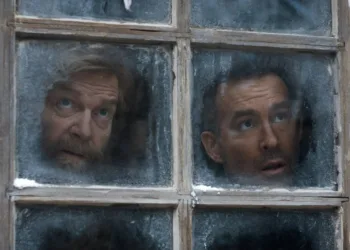

















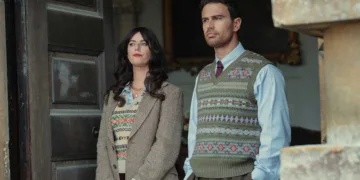












Paid leave turns the beach into a crime scene before anyone finds the corpse. That is the sharpest idea in Summer of ’36, a six-episode French period mystery set on the Côte d’Azur in August 1936, when France’s first paid worker holidays send working families into spaces the rich had mistaken for private property. The sand has not changed. The guest list has.
The series opens with prosecutor Jacquart found dead in his room at the Riviera Hotel, blood seeping under the door for maximum housekeeping inconvenience. Around him gathers the necessary suspect buffet: Eugénie, the working-class woman he once expected to marry; Jean, her wounded husband; Blanche, her wealthy sister and Jacquart’s discarded lover; Giulia, the hotel housekeeper trapped by gambling debt; Léonie, a new police assistant trying to save her condemned father; and Raoul, a businessman whose money leaves stains deeper than wine on linen.
It is a lot of table-setting. The show knows it. The first episode moves like a waiter carrying six trays through a crowded lobby, impressive until you notice the soup leaning.
A Mystery With Too Many Keys
Jacquart is a useful murder victim because the series makes hatred practical. He threatens Eugénie by claiming that Louis is his son and that paternity papers are already moving. He breaks Blanche’s heart with the casual cruelty of a man who has never had to clean up after himself. He refuses Léonie’s plea to reopen her father’s case. He pressures Giulia over her debts. He has enough enemies to qualify as a civic problem.
The early clue work has the right texture. Episode 2 gives Raven and Léonie two sets of room keys, a burned letter, Jacquart’s cheque from Raoul, and Odette’s memory of an argument behind the door. The mechanics are tidy enough to keep the viewer leaning forward. Then the series starts adding compartments to the suitcase after it has already been packed.
Blanche is arrested over the angry love letter. Édouard confesses, apparently to protect a wife who has shown little interest in protecting him. Léonie steals files tied to her father’s case. Raoul pushes Giulia to retrieve Jacquart’s notebook from the hotel safe.
By episode 3, the murder has company: Nazi money-laundering, antisemitic documents, factory injuries, an emergency shareholder threat, two romances, and Edgar found dead in his office. Somewhere, Agatha Christie is asking for a spreadsheet.
The whodunit stays watchable because each twist has a human pressure point, but it rarely feels engineered with the satisfying click of a true puzzle. The show uses the mystery as a social mixer, which is valid television strategy. Someone still has to watch the drinks.
The Women Carry the Hour
The series becomes steadier whenever it stops chasing clues and watches its women maneuver through rooms built to shrink them. Eugénie is the cleanest example. Her return to Henri’s orbit reopens a class betrayal, a family wound, and a private terror around Louis’s parentage. When she rejects Jacquart’s claim on her son, the scene works because the threat is legal, sexual, social, and maternal at the same time. A lesser show would pick one.
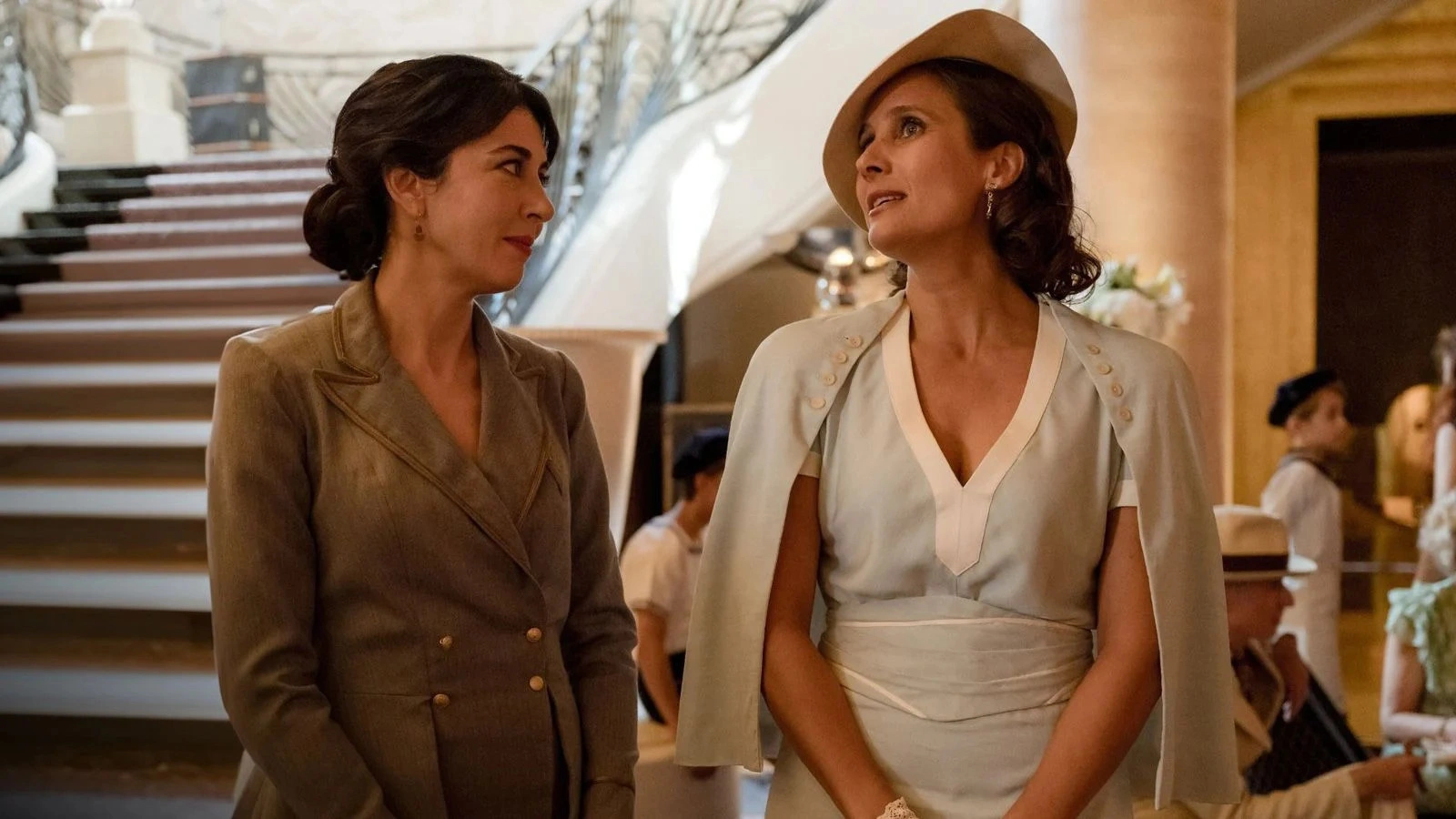
Léonie gives the police storyline its bite. She enters the force as an assistant, then keeps proving sharper than the men who tolerate her presence. Her challenge to the coroner’s assumption that the killer must be male is one of the show’s best procedural beats, small enough to feel period-accurate and pointed enough to draw blood. Her theft of trial papers complicates that intelligence. She is right to suspect the system and reckless enough to hand it ammunition.
Giulia, played through clenched panic, turns the hotel into a trap disguised as employment. She steals from the bar, loses money at poker, begs for time on her daughter’s school fees, then has Raoul weaponize the debt Jacquart left behind. Her discovery of the notebook pulls her out of service-corridor melodrama and into the political rot upstairs. The hotel keeps asking her to be invisible. The plot refuses to let her.
Blanche is the trickiest figure because the writing starts her in selfish territory, then asks for late sympathy. Her shock at finding Jacquart’s antisemitic documents gives the character a necessary fracture. Julie de Bona plays that turn with enough stunned disgust to make Blanche briefly see the room she has been standing in all along. Nice of her to arrive, morally speaking.
Riviera Polish, Episode Traffic
The show looks expensive in the way streaming period drama has learned to look expensive: shining hotel corridors, sun-baked promenades, crowded beaches, crisp uniforms, gala gowns, and cafés arranged for emotional damage. The Riviera Hotel is photographed as a place where everyone is performing class before breakfast. Costumes do half the exposition. Workers’ holiday clothes, staff uniforms, and elite eveningwear create a social map before the dialogue starts underlining it.
The concert and gala sequences show the series at its most efficient and most overloaded. They gather suspects into glamorous public spaces, then let threats play out in corners, stairwells, and rooms where nobody should be. The editing understands television rhythm: cut from music to blackmail, from dance lessons to police suspicion, from champagne to a safe that should have stayed closed. Then the episode keeps cutting. And cutting. And inviting subplots to cut in.
The romances suffer most from that traffic. Léonie and Félix have charm, and the racist insult thrown at them reminds the viewer how narrow public life remains in this world. Gabriel and Angèle make sense as a class-crossing flirtation, especially with dancing as the social language between them. Both threads needed more breathing room. Instead, they are asked to decorate a narrative already balancing a corpse, a false confession, a family inheritance fight, and fascist money. Romance is hard. Scheduling is harder.
Summer of ’36 has a stronger sense of historical pressure than mystery architecture. Its best scenes turn 1936 into behavior: who gets served, who gets believed, who gets a room, who gets a future. The body in the hotel room starts the plot. The beach tells the truth first.
Summer of 36 is a French historical drama miniseries that premiered on April 29, 2026, and became available for streaming on Netflix on June 1, 2026. Set in Nice during the sunny summer of 1936, the plot follows four women from different social classes who become entangled in a murder investigation at a luxury hotel just as the introduction of the first paid working-class vacations upends local society.
Where to Watch Summer of 36 Online


Full Credits
Title: Summer of 36 (L’Été 36)
Distributor: TF1, RTL TVI, RTS1, Netflix
Release date: April 29, 2026
Rating: TV-14
Running time: 52 minutes per episode
Director: Fred Garson
Writers: Marie Deshaires, Catherine Touzet
Producers and Executive Producers: Iris Bucher, Marc Brégain
Cast: Julie de Bona, Sofia Essaïdi, Nolwenn Leroy, Constance Gay, Miou-Miou, François-Xavier Demaison, Sam Karmann, Assaad Bouab, Arnaud Binard, Clément Aubert
Director of Photography (Cinematographer): Virginie Saint-Martin
Editors: Joël Jacovella, Nicolas Pechitch
Composer: Pascal Lafa
The Review
Summer of 36
Summer of ’36 works best when paid holidays turn the Riviera into a pressure cooker of class resentment, family shame, and inconvenient corpses. The murder gives the show a clean hook, then the plot keeps inviting every subplot in town to the party. Some arrive overdressed. Still, Eugénie, Léonie, Giulia, and Blanche give the drama bite, and the period detail keeps the hotel looking guilty before anyone says a word.
PROS
- Strong historical setting
- Rich female characters
- Sharp class tension
- Handsome Riviera production design
- Effective suspect setup
CONS
- Overcrowded middle episodes
- Rushed romantic subplots
- Édouard’s confession feels thin
- Mystery lacks tight puzzle craft