






















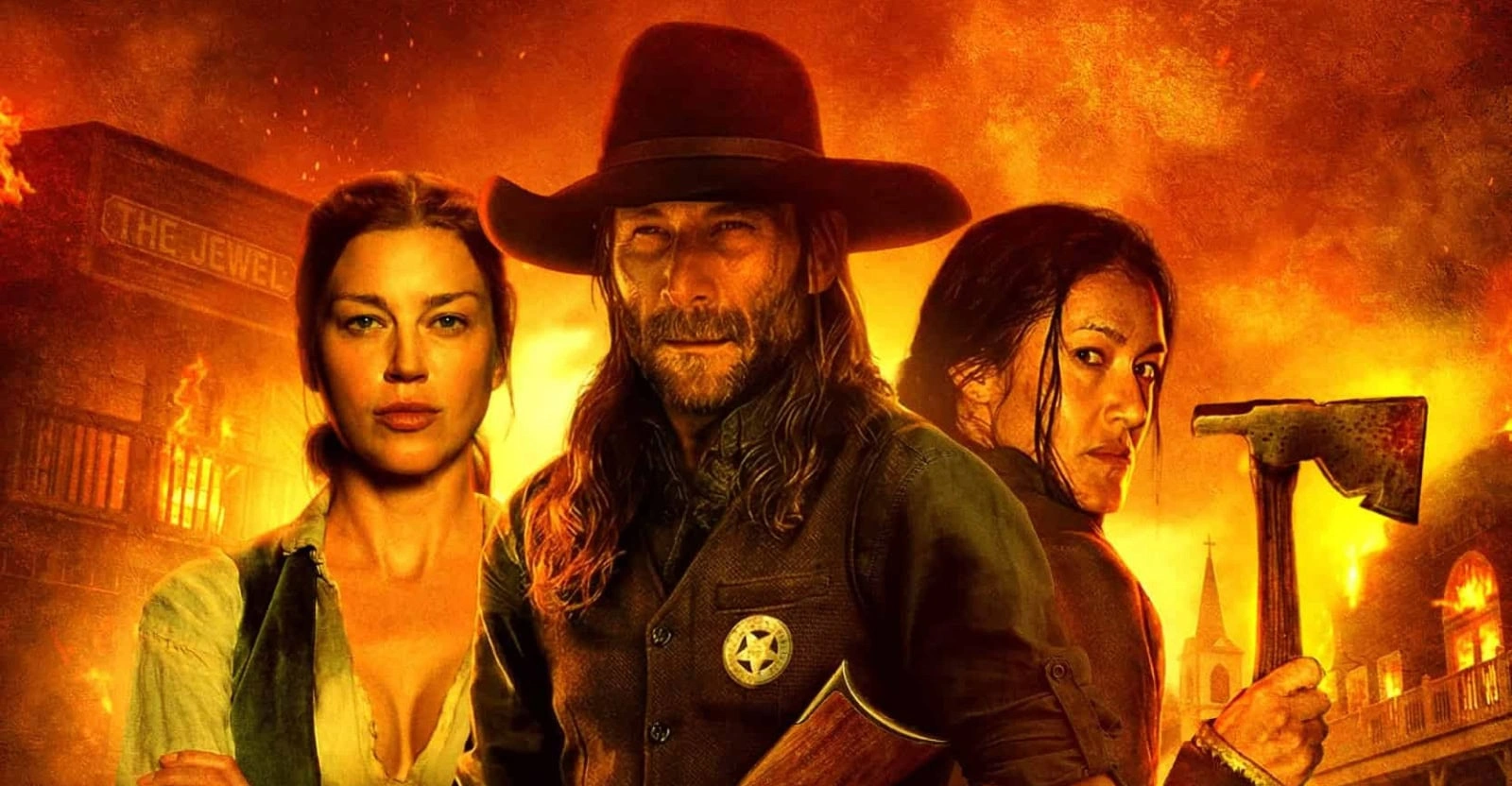

Hemlock Gulch has the civic anxiety of a Western town and the old hunger of a European nightmare. That mixture gives The Wolf and the Lamb its best idea: corruption does not arrive with the monster. The monster simply finds a community already trained to feed.
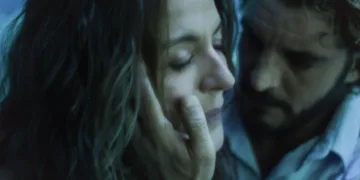
Directed and scripted by Michael Schilf from a story by Schilf and Miah Smith, the film is set in Montana Territory in 1873, where missing children and slaughtered animals disturb an unstable truce between settlers and the Indigenous people living near the surrounding woods. Jo Beckett, played by Cassandra Scerbo, is a tutor and single mother whose son Henry vanishes, then returns changed in ways the town would rather explain badly than confront honestly.
Schilf builds the film as a supernatural folk horror Western, with vampires moving through frontier politics, property theft, racial suspicion, and maternal panic. It is an ambitious fusion. Sometimes it bites.
The Town Before the Teeth
The Western side carries the film with greater confidence than the horror. Hemlock Gulch is mapped through disputes over land, labor, reputation, and public authority. Clint Howard’s George Derne is the kind of frontier capitalist who sees law as a weapon with paperwork attached. His plan to use Chief Justice Everett and eminent domain against Liz’s saloon gives the town’s evil a human face before the vampires step out of the mist.
That matters because the film’s monsters draw from an older cinematic lineage. The vampire belongs to European folklore and Gothic cinema, a creature of castles, plague, aristocracy, and inheritance. Placing that figure in 1870s Montana turns the American frontier into contested myth rather than heroic expansion. The land is being claimed by men who call theft civilization. The vampire becomes less foreign than familiar.
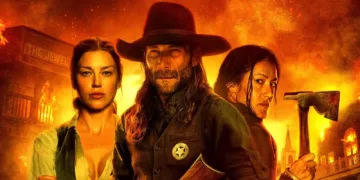
The ensemble helps that idea. Adrianne Palicki gives Liz a guarded authority that makes her saloon feel like contested territory rather than a genre backdrop. Rob Nagle’s Jean LaGrange, Eric Nelsen’s Dr. Roy Hawkins, Angus Macfadyen’s Reverend Elias Frémont, and Sammi Rotibi and Q’orianka Kilcher as Solomon and Mary all widen the town’s moral map. They are not equally served by the script, but each suggests a different social pressure point: faith, medicine, race, money, sex work, law.
Henry Returns Wrong
The film’s sharpest horror image is not a kill. It is Henry after his return. Jaydon Clark has no need to explain the transformation because his body does the work: the drained stillness, the altered gaze, the sense that a child has come back carrying an appetite that does not belong to childhood. The best parent-child horror often rests on that sickening recognition, the loved one present in shape and absent in spirit.
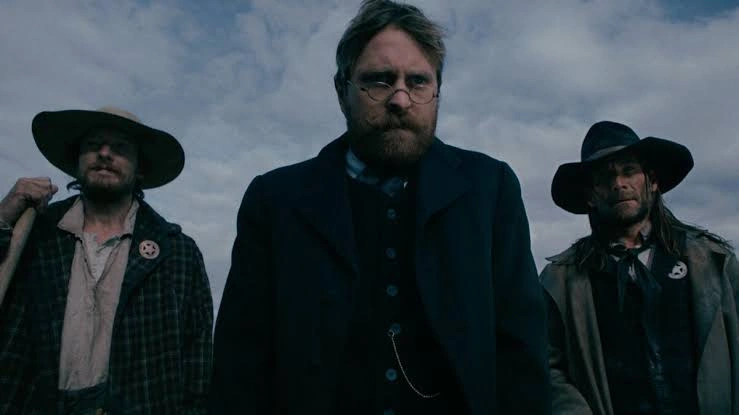
Scerbo plays Jo’s panic with direct emotional force. Her strongest scenes come when the town’s debates about danger become useless beside Henry’s physical presence. She is surrounded by men with speeches, theories, titles, badges, and clerical authority, yet none of them can make her son feel like her son again. In those moments, the film finds a grief that crosses cultures easily: the terror of return without restoration.
The trouble is that the vampire mythology keeps shifting under the film’s feet. One creature appears vulnerable to a gunshot and a slit throat. Later, familiar methods such as beheading and staking reappear. Crosses carry little apparent weight. Daylight is not the clean boundary viewers may expect. Some looseness can deepen folk horror, since local myths rarely come with rulebooks, but here the inconsistency feels less like mystery than convenience.
The missing children thread suffers from the same problem. Henry’s condition pulls the story into focus, then several other vanished children fade from urgency. A film this invested in communal rot needs those absences to haunt the town beyond their function in Jo’s arc.
Too Many Voices at the Gallows
Schilf clearly wants Hemlock Gulch to feel like a full society rather than a stage set waiting for vampires. That instinct is admirable. It also crowds the film. The land conspiracy, the brothel politics, the fragile racial peace, the religious conflict, Jo’s motherhood, Henry’s transformation, the sheriff’s hostility, and the undead threat all compete inside a compact running time.
The dialogue often reveals the strain. Dr. Hawkins’s ornate phrasing can work because Nelsen treats it as a defense mechanism, the language of a civilized man trying to remain civilized in a place that keeps asking him to lower himself. Elsewhere, the period speech grows heavy. Characters sometimes sound as if they are delivering declarations to history rather than speaking to the person in front of them.
Zach McGowan’s Sheriff Frank Martin and James Landry Hébert’s Deputy Jim Cooley embody the town’s uglier instincts, while Elias Kacavas gives Deputy Charlie Quinn a softer uncertainty. The racist suspicion directed toward Indigenous characters and outsiders links the film to the long Western tradition of communities defining themselves through exclusion. The idea is clear. The scenes are too brief to carry the full moral weight Schilf places on them.
Color, Dirt, and Smoke
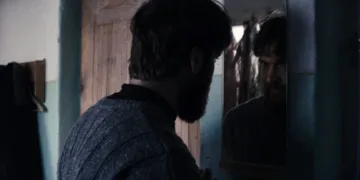
Philip Roy’s cinematography gives the film its most persuasive argument. The Montana locations have the texture many low-budget Westerns fake and fail to fake: rough wood, open ground, rooms that feel built from need rather than design. Blue, red, and green lighting choices give the town a moral weather system, with red saved for corruption and menace, blue for fragile decency, green for compromise.
Keefe Kaupanger-Swacker’s editing keeps the supernatural threat alive through brief vampiric flashes, glimpsed like warnings from a future the town has already invited. The smoke and mist surrounding the vampires may be a familiar effect, yet it works because it lets the horror seep into ordinary scenes instead of announcing itself every time.
The film is at its strongest when the landscape, the land grab, and Henry’s changed body speak together. It is weakest when the vampire rules wobble, the dialogue stiffens, and the ensemble lines up for its allotted turn. Hemlock Gulch deserved a sharper curse, but its dirt has memory, and some of that memory draws blood.
The supernatural folk horror Western The Wolf and the Lamb made its official debut with a simultaneous theatrical and digital release via Samuel Goldwyn Films on April 24, 2026. Viewers can actively stream or purchase the independent feature across major video-on-demand networks, including Apple TV and Amazon Prime Video. Set in a remote 1870s Montana mining settlement, the dark narrative chronicles the grueling psychological trial of a widowed schoolteacher whose young son mysteriously vanishes, only to return deeply transformed by an ancient, predatory vampiric evil that quickly sparks mass paranoia and gruesome violence across the isolated frontier community.
Where to Watch The Wolf and the Lamb (2026) Online









Full Credits
Title: The Wolf and the Lamb
Distributor: Samuel Goldwyn Films
Release date: April 24, 2026
Running time: 96 minutes
Director: Michael Schilf
Writers: Michael Schilf, Miah Smith
Producers and Executive Producers: Chase Kuker, Jordan Kuker, Miah Smith, Nicholas Adam Clark, Jordan Wagner, James MacMillan, Cassandra Scerbo, Ve Neill, Mike C. Manning
Cast: Cassandra Scerbo, Adrianne Palicki, Zach McGowan, Angus Macfadyen, Eric Nelsen, Q’orianka Kilcher, James Landry Hébert, Clint Howard, Jaydon Clark, Sammi Rotibi, Elias Kacavas, Kevin Keppy, Rob Nagle, Hanna Balicki, William Rothlein, Lilliya Scarlett Reid, Eadie Gray, Mike C. Manning
Director of Photography (Cinematographer): Philip Roy
Editors: Keefe Kaupanger-Swacker
Composer: Chromosomes (Chase Kuker and Ryan D. Wood), Hudson Laird
The Review
The Wolf and the Lamb
The Wolf and the Lamb treats the American frontier as a place where legal power, racial panic, and old-world vampiric dread all feed from the same wound. That is a sharp idea. The film’s Montana textures, Henry’s eerie return, and Clint Howard’s land-hungry villainy give it flavor, yet the vampire lore slips whenever the story needs a shortcut. Hemlock Gulch feels alive; the horror inside it feels underfed.
PROS
- Strong Montana frontier atmosphere
- Jaydon Clark’s unsettling physical performance
- Corruption and horror linked cleanly
- Clint Howard and Adrianne Palicki stand out
CONS
- Crowded ensemble
- Inconsistent vampire rules
- Overwritten period dialogue
- Missing-children thread left dangling
- Horror payoff feels thin