





















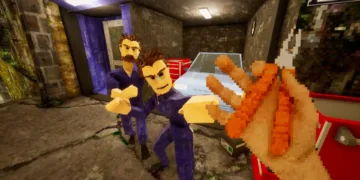

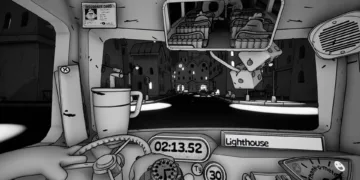




Local television used to have a texture you could almost smell: discount furniture stores, personal injury lawyers, muffled jingles, restaurants promising food that looked better in the voiceover than on the plate. Buffet Infinity takes that half-remembered broadcast world and turns it into a delivery system for cosmic horror.
Simon Glassman’s Canadian horror comedy is built from fake commercials, news clips, PSAs, and channel-surfing fragments, set in Westridge County, where a beloved sandwich shop and a faceless all-you-can-eat buffet become locked in a rivalry that slowly stops looking like business competition and starts looking like the end of days.
The risky part is obvious. There is no conventional main character guiding us through the story. The film asks us to watch ads for Jen’s Sandwich Shop, Buffet Infinity, Mosley Rosin’s law practice, Ahmed’s pawn shop, local insurance services, and other bits of regional programming, then piece together what is happening in the gaps. That sounds like a sketch-show stunt. The surprise is how carefully it becomes cinema.
Commercial Break Storytelling
The plot hides in plain sight. Jennifer Joy Avery’s sandwich shop is introduced through the sort of local ad that feels held together with enthusiasm and poor lighting, with special attention paid to her secret Italian sandwich sauce. Buffet Infinity answers with commercials that feel larger, slicker, and wrong in ways that take time to register. Its meals are too big. Its promises are too absolute. Its growth near a mysterious sinkhole gives the joke a physical threat: this restaurant does not expand like a business, it spreads like a disease.
What Glassman understands is that repetition can be narrative. A commercial returns, but a line has shifted. A familiar face looks more strained. A business pitch starts responding to a crisis the previous ad pretended was not happening. Ahmed moves from selling ordinary pawn shop goods to pitching supplies for bunkers, and the gag lands because the sales instinct never leaves him. The town may be collapsing, but somebody still has inventory to move.
That structure gives the film a distinct rhythm. Instead of scenes building through dialogue, the movie builds through accumulation. A news clip mentions disappearances. A commercial reframes fear as an opportunity. Buffet Infinity absorbs nearby businesses, and the fake broadcast never pauses long enough to let the town mourn. The viewer becomes the editor, stitching together cult rumors, protests, violence, vanished citizens, and a restaurant that seems to have infinite hunger.
The format will test some viewers. Anyone waiting for a hero to step forward and explain the rules may feel locked outside the movie’s emotional center. I felt that distance at times, especially in the middle stretch, where the absurdism briefly gets ahead of the escalation. Still, the film’s commitment keeps pulling the experiment back into shape.
Jokes That Learn to Rot
The comedy works because the actors play these ads as ads, not as horror sketches wearing fake mustaches. Kevin Singh’s Mosley Rosin has the perfect blank confidence of a local lawyer who has said the same pitch into the same camera for years. His deadpan presence turns legal opportunism into a running beat, and the film is smart enough to let the joke sit without underlining it.
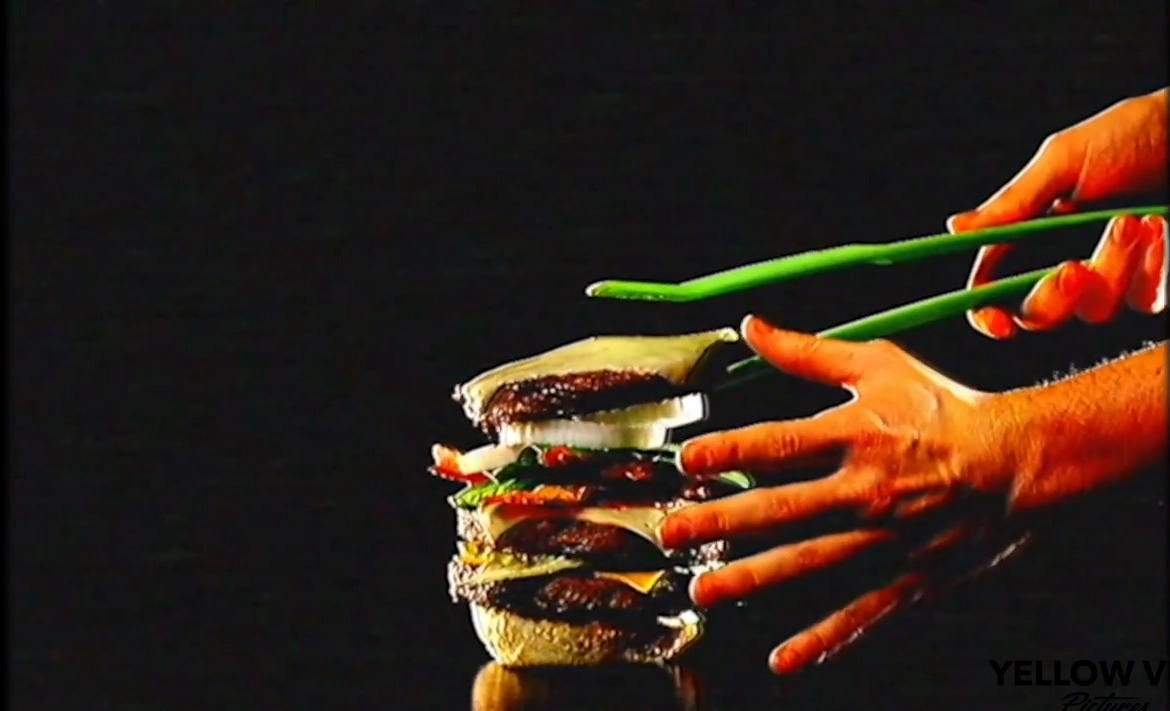
Allison Bench gives Jennifer Joy Avery a small-business sincerity that matters once Buffet Infinity starts devouring the town’s commercial ecosystem. One of the film’s best recurring jokes comes from the Buffet Infinity voiceover casting doubt on her Italian heritage while promoting its own grotesque abundance. It is petty, specific, and mean in the exact way advertising can be mean. The horror is funnier because the insult is so low-stakes before the stakes become enormous.
Ahmed Ahmed’s pawn shop owner may be the film’s sharpest comic creation. His ads adapt to each new disaster with frightening speed. When the town’s panic deepens, Ahmed does not become a prophet or a rebel. He becomes a better salesman. That choice says plenty about the film’s view of commerce under pressure. Panic creates demand. Apocalypse creates a product category.
Claire Theobald’s insurance spokeswoman and the other recurring personalities fill out the broadcast world with the same sincerity. Nobody appears to be winking from outside the premise. That restraint matters. Once the static, glitches, and sudden tonal ruptures start making the commercials feel infected, the performances have already taught us to accept the world as real enough to be damaged.
The Haunted Tape Economy
The craft is intentionally cheap-looking, which is different from careless. The lighting has the flat glare of local TV. The edits arrive in clipped bursts. The audio sometimes sounds compressed into a box. Static and channel changes interrupt the flow like a nervous system misfiring. Early on, those details create nostalgia. Later, they become hostile. The safe space of bad commercials turns into a trap.
Buffet Infinity works best as a satire of advertising that refuses to stop selling while reality breaks apart around it. The buffet itself functions as restaurant, corporation, cult, and cosmic entity. It promises endless consumption, then reveals the appetite behind the promise. Its grotesque meals and expanding physical presence turn abundance into a threat. The place is not scary because it serves too much food. It is scary because it seems to understand desire better than the people it consumes.
That idea connects the film’s retro format to a modern anxiety. The fake commercials look like artifacts from a less targeted media age, but their behavior feels painfully current. They adapt. They follow the mood. They sell bunker supplies when people are afraid, reassurance when people are confused, normalcy when normalcy has clearly failed. The town’s disaster becomes programming.
By the final stretch, Buffet Infinity feels less like a parody tape and closer to a broadcast signal that should have been buried. Its most unsettling achievement is making the viewer laugh at the format long enough to stay tuned after the format turns against them.
The surreal Canadian satirical horror comedy Buffet Infinity celebrated its world premiere at the Fantasia International Film Festival on July 28, 2025, where it won a special jury mention, before launching a limited theatrical rollout via Yellow Veil Pictures on April 24, 2026. Audiences can currently stream the experimental found footage feature online following its digital release on platforms like Prime Video. Styled like a barrage of cheap, late night local TV commercials, the narrative maps an escalating interdimensional corporate rivalry in a small Alberta town where a mysterious, rapidly expanding restaurant franchise begins swallowing up neighboring businesses, triggering bizarre missing persons cases, sinkholes, and cosmic chaos.
Where to Watch Buffet Infinity (2026) Online










Full Credits
Title: Buffet Infinity
Distributor: Yellow Veil Pictures, Peterson Polaris
Release date: July 28, 2025 (Fantasia International Film Festival Premiere), April 24, 2026 (United States Theatrical Release)
Running time: 100 minutes
Director: Simon Glassman
Writers: Simon Glassman, Allison Bench, Elisia Snyder
Producers and Executive Producers: Michael Peterson, Simon Glassman, Allison Bench
Cast: Kevin Singh, Claire Theobald, Donovan Workun, Ahmed Ahmed, Brandon Vanderwall, Allison Bench, Jennifer Joy Avery, Ben Bauce, Siobhan Theobald
Director of Photography (Cinematographer): Simon Glassman
Editors: Simon Glassman
Composer: Earl Drilon
The Review
Buffet Infinity
Buffet Infinity turns fake local commercials into a surprisingly disciplined horror-comedy machine. Simon Glassman’s film works because the ads are funny before they are frightening, and the repeated bits slowly mutate into signs of a town being eaten alive by commerce, panic, and something much worse. The missing central protagonist may test some viewers, but the channel-surfing structure has real nerve and a nasty sense of escalation.
PROS
- Inventive ad-based structure
- Strong VHS-era detail
- Funny recurring characters
- Smart consumer satire
- Creeping cosmic dread
CONS
- Thin emotional anchor
- Absurdism sometimes runs wild
- Fragmented format may alienate some viewers