





















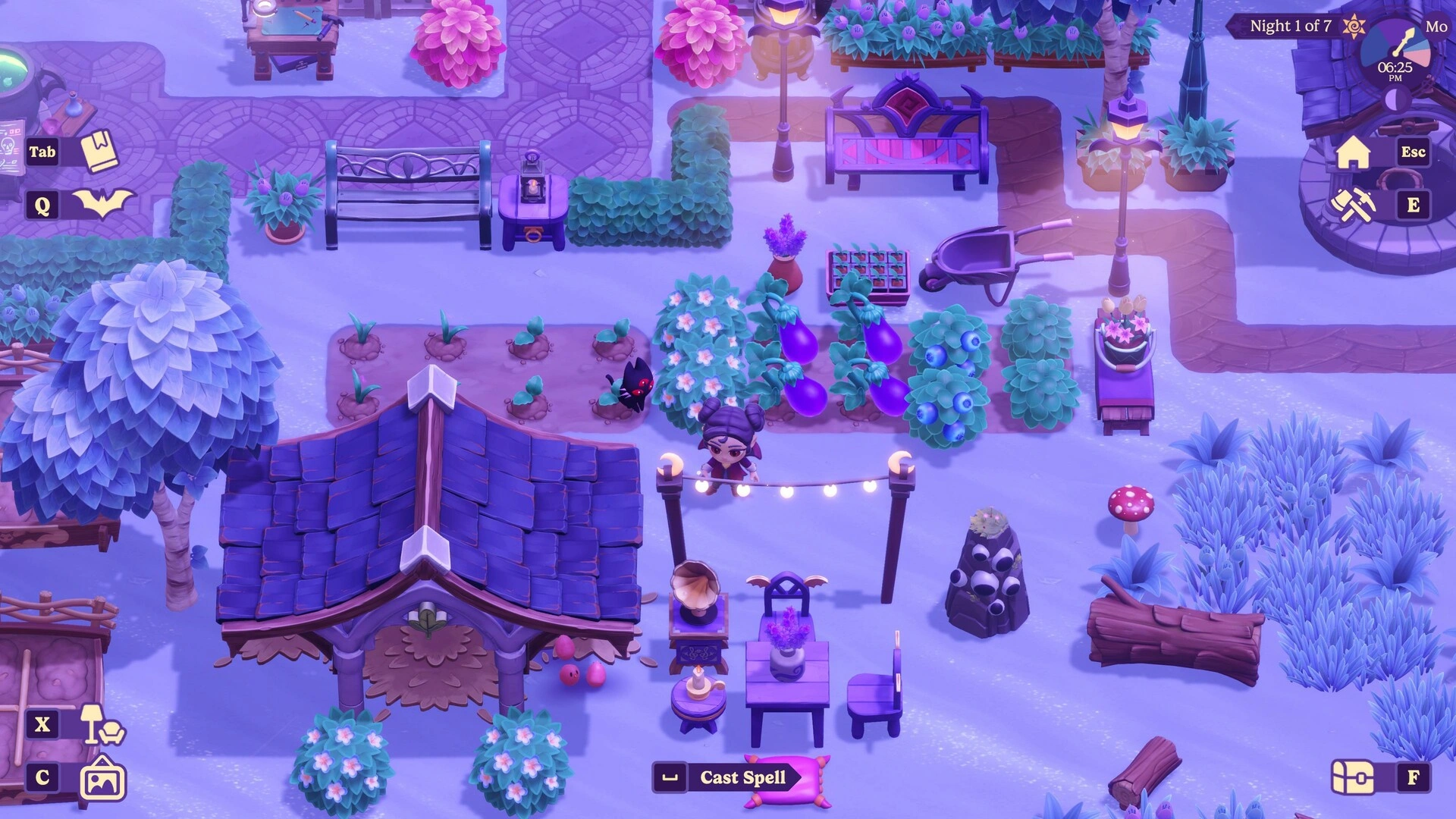
Going to bed at sunrise changes the emotional rhythm of a farming game in a surprisingly immediate way. The clock in Moonlight Peaks counts toward daylight, your vampire farmer needs to return to a coffin, and every glowing crop or purple-lit path feels tied to the same strange schedule. Familiar chores suddenly take place in the hours other life sims usually ask you to avoid.
You play as one of Dracula’s children, leaving home to escape the weight of the family name and restore an abandoned homestead in a supernatural town. Werewolves run businesses, witches sell seeds, vampires carry old grudges, and your three-eyed cat waits back at the farm. The chibi character designs keep everything gentle. Mausoleums and jack-o’-lanterns decorate a world closer to Halloween comfort than horror.
That atmosphere does a lot of work because the farming underneath it is instantly recognizable. You clear rocks, chop trees, plant crops, cook, craft, raise animals, and slowly turn an overgrown patch of land into somewhere personal. Moonlight Peaks rarely tries to hide its genre roots. It finds feeling in changing the scenery around them.
A Wand Beside the Watering Can
One of the earliest requests sends you after a bottle of red wine for Olrock. Getting it requires clearing farm space, growing grapes, constructing a cask, and processing the harvest. It is a smart quest because the character request and farming tutorial become the same activity. By the time Olrock gets his drink, you have learned several systems without spending an hour clicking through instructional boxes.
The trouble is that your fledgling vampire has the endurance of someone who has never touched an axe and deeply regrets starting now. A few chopped trees can drain most of your stamina. Bloodgrape juice and red velvet tarts restore energy, yet buying them repeatedly is expensive before your own farm can produce reliable supplies. During the first nights, new quests keep appearing while money, time, and energy remain painfully limited.
The night length can be extended from roughly 15 minutes to 25, which helps, but the pressure never comes purely from the clock. It comes from seeing ten useful jobs and having enough stamina for three. Cozy games often create satisfaction through tiny routines, and Moonlight Peaks initially makes those routines feel like unfinished lists.
Magic softens the workload once your wand is repaired. Summoned tools can water crops, chop trees, or break rocks, while other spells move buildings around the farm. Some magical crops specifically need spell-based watering, so mana becomes part of cultivation rather than a decorative fantasy meter.
There are awkward spells. The spectral hands that harvest crops leave you unable to do much while they work, and mana recovers slowly enough that experimentation can feel expensive. Yet turning mundane labor into witchcraft gives familiar systems personality. I have watered thousands of virtual crops. Watching an ethereal tool do it beneath a purple sky still made me smile.
Transformations are even better because their emotional reward is immediate. The Hellcat form doubles your movement speed. Bat form lets you cross hedges and barriers that previously shaped your route through town. Story progress changes how moving through Moonlight Peaks feels, and the map suddenly becomes smaller, friendlier, almost yours.
Knowing the Monsters
The residents give the town a reason to exist beyond its farm plots. Moonlight Peaks has seven old supernatural families, and returning as a Dracula means entering conflicts that started long before your arrival. Mayor Brook Logan distrusts you. Members of the Ambrosia family are warmer. Every introduction carries some small judgment about your surname.
The stronger quest lines use those histories to turn cute monsters into troubled neighbors. Olrock’s drinking becomes harder to treat as a joke once his children express genuine concern for him. The friction between Brook and his brother Ridge reveals another family whose problems have survived years of proximity. These scenes work because they interrupt routine at exactly the right moments. You can spend several minutes thinking about crop placement, walk into a new area, and suddenly find two siblings reopening an old wound.
Relationships grow through conversations and gifts, with a large group of romance options and few restrictions on dating. Mina, the barista and baker, can take many nights of visits and presents before noticeably warming to you. That pace suits a game designed around repetition. Affection becomes another routine, one built from stopping by rather than selecting a dramatic dialogue option.
Sadly, dialogue choices rarely change what happens next. Once that becomes clear, some conversations lose tension. Character depth is uneven too. Residents connected to major quests receive family histories and memorable scenes, while others need repeated investigation before their personalities emerge.
The town still finds smaller ways to pull you away from work. Nokturna offers a collectible card game against residents. Embroidery and flower arranging are quieter distractions. Recipes, furniture blueprints, decorations, and structures arrive constantly through mining, digging, and requests. There may be too many unlocks for each one to feel special, but for players who enjoy designing houses and completing collections, this place can swallow nights whole.
Purple Skies and Rough Corners
The permanent darkness gives Moonlight Peaks its strongest visual identity and one of its few atmospheric weaknesses. Cool greens, purples, wispy lights, moonflowers, and glowing decorations make the village immediately recognizable. The clay-like chibi models carry plenty of charm, though their illustrated portraits sometimes look strangely disconnected from the characters standing beside them.
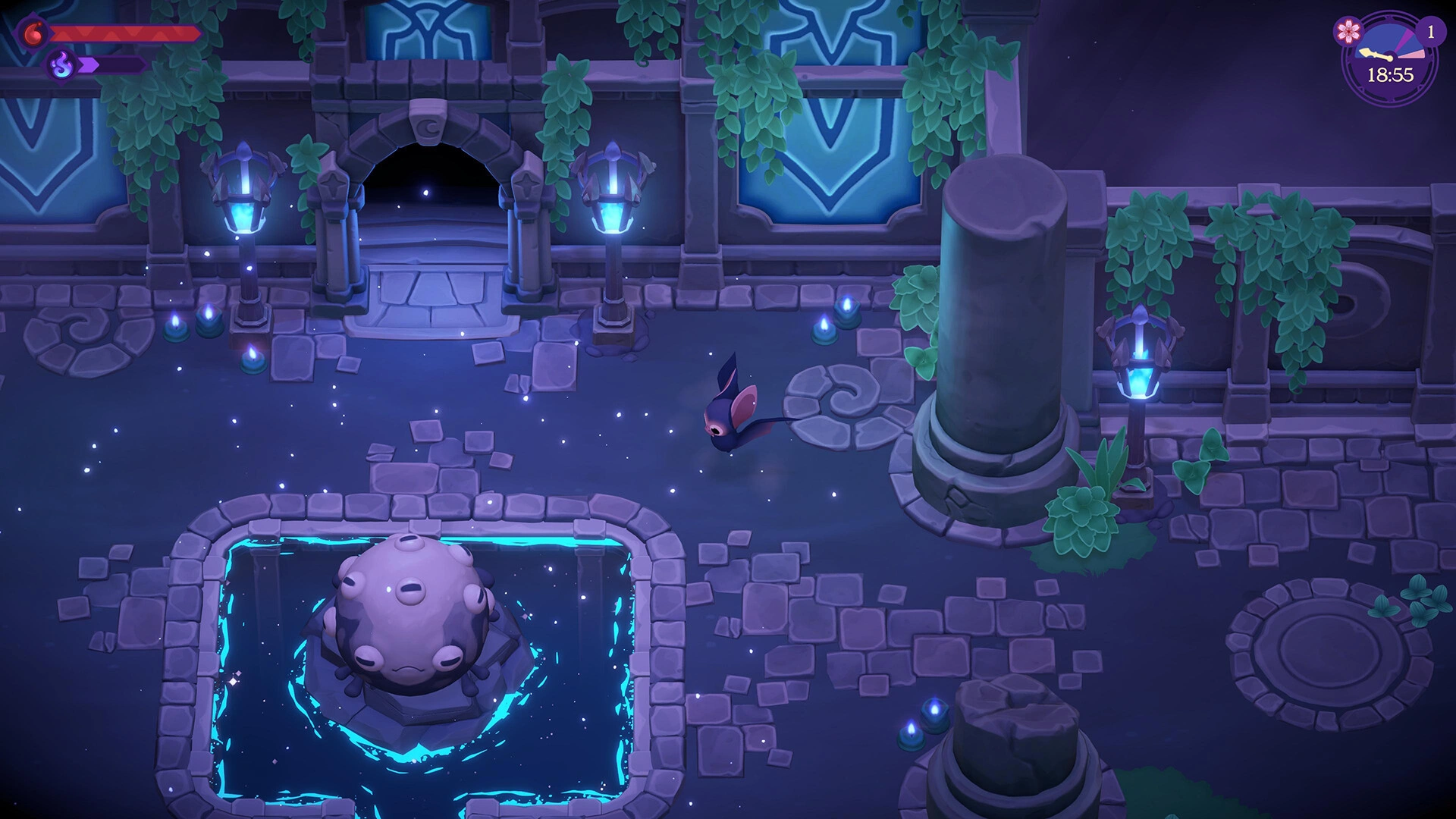
After enough spring and summer nights, the lack of daylight can become tiring. Farming games often use changing light to make seasons feel physically different. Here, the supernatural premise locks the world into a narrower visual mood.
Sound handles that limitation beautifully. Wind, insects, crickets, and distant nighttime wildlife surround the farm with a soft summer-evening calm. The music is harder to appreciate because it often sits too low beneath the ambience, and increasing the audio can make the environmental effects overly loud.
Long loading times between nights also break the game’s gentle rhythm, while occasional animation glitches and moments of getting stuck expose some technical roughness. Controller play feels smoother than the default keyboard and mouse setup, and the absence of a mid-night save is especially irritating when leaving early means repeating the entire evening.
Still, once stamina improves and bat form opens shortcuts through the village, Moonlight Peaks settles into the feeling it spends its opening hours chasing. One quest becomes one crop harvest, which becomes one visit to a neighbor, which becomes a card game, which becomes dawn creeping closer while you are still three streets from your coffin. Yes, one more night sounds reasonable.
The Review
Moonlight Peaks
Moonlight Peaks turns a familiar farming routine into something quietly charming by letting magic, perpetual night, and a town full of supernatural families shape how that routine feels. The stamina and mana limits make its first nights rougher than a cozy game needs to be, while slow loading and weak dialogue choices leave visible cracks. Still, turning into a bat to cross hedges, learning a neighbour’s family feud, or hearing crickets beneath a purple sky gives this little world its pull.
PROS
- Distinct Halloween atmosphere
- Charming supernatural residents
- Transformations improve exploration
- Magic fits the farming loop
- Strong nighttime ambience
CONS
- Stressful early stamina limits
- Mana recovery feels restrictive
- Uneven character development
- Long loading times
- No mid-night saving