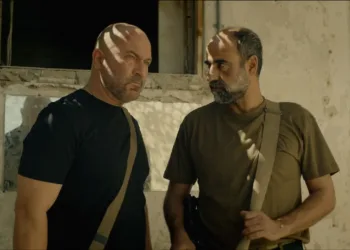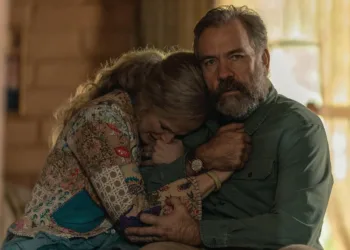















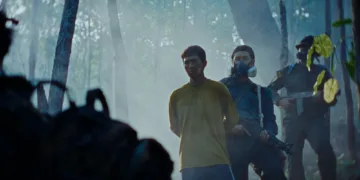













American boxing movies have long treated the ring as a machine that converts private hardship into public recognition. Liborio enters that machine carrying a border on his back. Jonás Cuarón’s Campeón Gabacho takes the familiar underdog shape and filters it through a young Mexican migrant who reaches New York only to discover that arrival is another form of crossing.
Juan Daniel García Treviño plays Liborio with a defensive swagger strongest when he speaks directly to the camera. His claim that he was “born dead” is a survival habit. The film tests it through the bookstore loft where he sleeps, the street where local men provoke him, and the police beating that strips language of any protective value.
The sharpest early scene comes when Aireen asks his name. Liborio answers with a catalogue of nicknames and slurs others have used for him. Cuarón stages a feverish parade of imposed identities, turning migration into a problem of authorship: everybody has language for Liborio except Liborio.
A City Built From Displacement
Liborio’s first fragile home is the bookstore run by Chief, Eddie Marsan’s irritable Southern transplant. Liborio cleans, works for little money, and sleeps above the shop. The books give him private space inside a city that keeps reducing him to labor. When he tells the camera that he is building a bank account in his mind, reading becomes a migrant currency that cannot be confiscated.
That stability collapses after Liborio defends Aireen from men on the street. His punches humiliate them, so they return and burn the bookstore. The sequence fits the logic of border cinema from Mexico and the United States: safety is temporary, and claimed space can be revoked by somebody with greater power.
Cuarón moves away from plain realism during the police assault. Liborio appears pulled out of his body and into a psychic void while officers strike him. Dissociation replaces spectacle. The camera shows a consciousness escaping a body that institutions have decided is available for punishment.
Treviño keeps these flourishes grounded. His clipped delivery with Chief, suspicion toward Aireen’s kindness, and rigid posture after the fire grow from the same instinct: help is dangerous because it creates a debt. His performance holds the pride of surviving alone beside the exhaustion of having to keep proving it.
New York Seen From Mexico City
Cuarón reconstructs Liborio’s New York neighborhood on a Mexico City soundstage, and the artificiality becomes part of the film’s cultural language. The recurring street under overhead tracks functions like a theatrical set, with characters entering, colliding, and disappearing through the same geography. This is far from the observational realism often expected from immigrant drama.
The choice places Campeón Gabacho closer to heightened Latin American storytelling than the grey social realism of many American migration films. Pepe Ávila del Pino’s cinematography keeps a muted layer over the neighborhood, then lets a lightbulb, costume, or fantasy image cut through it. Aireen appearing through a filament and the lovers floating into the atmosphere give desire the scale of folklore.
Cuarón uses the same grammar for memory. When Liborio falls backward while cleaning and lands in the water of his Rio Grande crossing, the past does not arrive through a conventional flashback. It invades the present physically. Distance changes geography, but memory refuses to respect national borders.
The film can overplay this freedom. Fourth-wall addresses, background freezes, camera pushes, and time manipulation recur so often that their surprise weakens. Rosario Dawson’s Doble-Ú suffers from similar excess. Her futuristic clothes and four-million-follower persona fit the fabricated city, yet she remains an idea about digital visibility. She films Liborio’s fight and sees a brand before she sees a man.
Fighting for a Place in the Frame
Boxing gives Cuarón a genre American cinema has exported around the world. Liborio first enters the gym as paid flesh, earning roughly $300 a week to spar with a favored fighter. The arrangement mirrors his working life outside the ring: his body has value when somebody else controls the terms.
Liborio soon proves better than the boxer he was hired to prepare. His right hand, built through street survival rather than formal training, disrupts the gym hierarchy. The film refuses to treat talent as instant liberation. Liborio rejects assistance, distrusts Doble-Ú, and shrugs at the future Abacuc sees for him.
Rubén Blades gives Abacuc a weathered patience suited to a man running a shelter for children already placed at the margins. He gives Liborio a bed, watches him fight, and insists that discipline can turn instinct into choice. Liborio’s exchanges with the children matter for the same reason. Their insults and jokes create belonging without asking him for a speech about gratitude.
The final bout uses expected blood, sweat, and repeated returns to the canvas. Cuarón finds his own angle when the camera leaves Liborio and studies the crowd: Latino workers, shelter children, ordinary faces watching a man once treated as nameless occupy the frame. In a genre built around individual triumph, that pan shifts the fight toward collective recognition. Liborio gets up again, and this time people know what to call him.
The Mexican immigrant sports drama Campeón Gabacho made its highly anticipated international debut at the SXSW Film Festival on March 17, 2026. Audiences following its film festival run can expect upcoming streaming and theatrical release distribution windows through independent global channels later this year. The narrative centers on a resilient Mexican migrant who boxes his way through immense cultural walls and systemic discrimination in America, relying on his boxing prowess and unyielding optimism to protect his hopes.
Full Credits
Title: Campeón Gabacho
Distributor: Esperanto Filmoj, SXSW Film Festival
Release date: March 17, 2026
Running time: 95 minutes
Director: Jonás Cuarón
Writers: Jonás Cuarón, Aura Xilonen
Producers and Executive Producers: Alfonso Cuarón, Gabriela Rodriguez, Nicolás Celis, Jonás Cuarón
Cast: Juan Daniel García Treviño, Leslie Grace, Rubén Blades, Eddie Marsan, Rosario Dawson
Director of Photography (Cinematographer): Pepe Avila del Pino
Editors: Jonás Cuarón, Production Editorial Team
Composer: Mexico Film Music Department
The Review
Campeón Gabacho
Campeón Gabacho takes the grammar of the American boxing film and lets a Mexican migrant reshape it from inside. Jonás Cuarón's theatrical New York, fluid memories, and bursts of fantasy turn Liborio's displacement into a visual language, while Juan Daniel García Treviño keeps every flourish tied to bruised human reality. The final fight follows a familiar rhythm, and Doble-Ú never gains comparable depth, yet the film's cultural perspective gives old underdog machinery fresh pressure. Liborio's victory matters because the country around him spent so long refusing to learn his name.
PROS
- García Treviño's magnetic lead performance
- Expressive magical realism
- Distinct cross-border perspective
- Strong Liborio and Abacuc relationship
- Inventive soundstage production design
CONS
- Thin Doble-Ú characterization
- Repetitive stylistic tricks
- Loose sense of time
- Familiar boxing finale