

























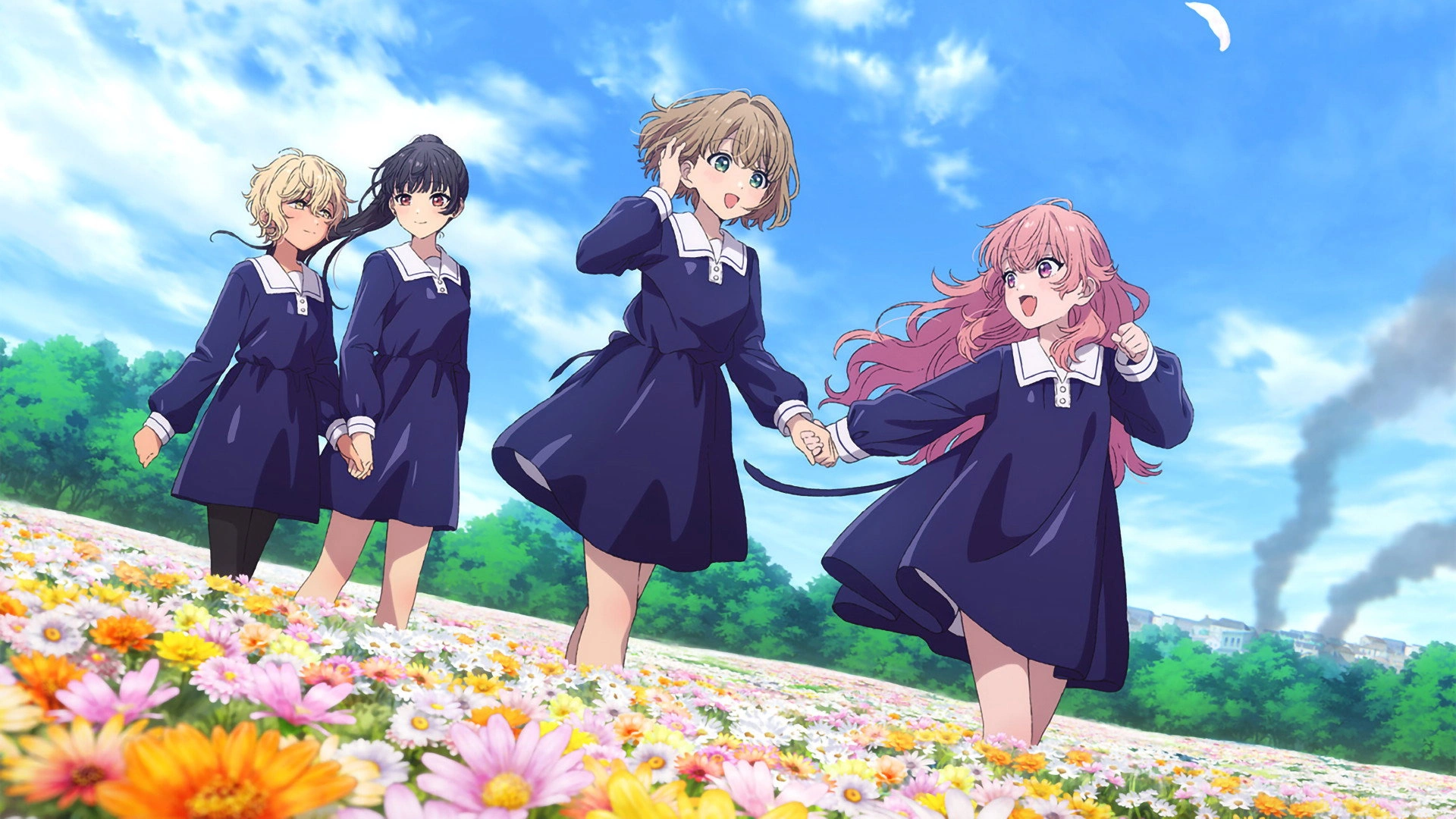

The most revealing sound in the premiere is a list of numbers being called over the academy speakers. Kagari Mimi is summoned to battle, yet the institution does not use her name. It requests a unit. Anime has spent decades turning magical schools into places of adolescent freedom, friendship, and conveniently explosive examinations. I Want to Love You Till Your Dying Day looks at the same architecture and asks a less marketable question: what if the school understood gifted children exactly as institutions often do, as resources?
The National Warfare Sorcery Weapon Training Institute takes in orphans, teaches them magic, and sends them to war. Its brutality is established before Totsuki Sheena enters class, through an injured girl being killed in a forest amid fighting sorcerers. The sharper scene comes the following morning. Teacher Omi announces the death of Sheena’s roommate, then asks the class to summon their wands. No speech. No institutional reckoning. The lesson continues.
Sheena cannot perform the spell. Grief has left her distracted, and her limited magical ability already puts her behind her classmates. Omi sends her away to sort through her dead roommate’s belongings, effectively transforming bereavement into another school chore. The academy’s horror comes from procedure. Children die, empty caskets are prepared because bodies disappear, and teachers return to the curriculum.
Plenty of dark fantasy uses child soldiers because damaged teenagers look excellent on promotional posters. This premiere is interested in the bureaucratic language that makes their exploitation possible.
Lucky Enough to Be Weak
Sheena’s weakness carries a strange privilege. Her classmates call her lucky, echoing something her roommate once told her: poor magic may keep her away from combat. The idea is vicious because the school has inverted every ordinary measure of childhood achievement. Students should improve. Students should become capable. Here, talent increases the chance that a loudspeaker will read your number and send you somewhere you may dissolve before anyone can recover your body.
Sheena’s response to her roommate’s death is quiet. She sorts through possessions until only a stuffed rabbit remains, then places it inside the girl’s empty casket during a farewell ceremony. The school can offer a symbolic coffin. Sheena supplies the evidence that a person lived.
Mimi arrives carrying a very different relationship with death. She walks into the cafeteria covered in blood, asks Sheena for a rice ball, eats both, and comments on her smell. Rina Hidaka’s vocal performance gives Mimi a cheerful immediacy that makes the blood harder to ignore. She does not deliver the scene like a traumatised soldier struggling to act normal. Her normality appears genuine, which is considerably stranger.
By the next day, Mimi has joined Sheena’s class and become her roommate. Seiran and Ali explain the whispers circulating among the students: generations have supposedly known of a secret weapon called Mimi, and this girl may be responsible for numerous deaths during the previous operation.
The premiere wisely leaves the mythology incomplete. Mimi tells Fran that Sheena smells like “Mama.” Fran cannot explain the comment. The name Mimi itself appears to carry a history longer than the girl standing in the classroom. Sheena survives near the bottom of this military hierarchy because she is weak. Mimi may sit at its highest point because she kills efficiently. The institution has found a way to make both positions lonely.
Restoration Magic
Yuri anime has often been asked to justify physical intimacy with a peculiar degree of caution. A look can last three episodes. A confession can require a season and a meteorological event. Here, two girls kissing can simply be healthcare.

Sheena explains the practice after she and Mimi see a pair of students together at night. Restoration magic requires a person to pour magic directly into another body. The kiss has a function, yet the world-building does not erase its intimacy. It gives intimacy institutional terminology.
That distinction matters when Sheena later lies awake with stomach pain. Mimi notices her groaning, crosses to her bed, and kisses her. Sheena registers the smell of soap and the faint taste of blood on Mimi’s mouth.
The premiere has spent most of its runtime placing war and ordinary adolescence beside each other. Students gossip in the cafeteria, fuss over Mimi’s cuteness, make friends, and kiss. Some of them will then hear their numbers called. Mimi compresses that contradiction into one body. She can eat Sheena’s rice balls with childish enthusiasm and return from combat drenched in blood.
Their relationship has barely reached romance at this point. What exists is curiosity, proximity, and Mimi’s immediate fascination with Sheena. That slower development suits a story where attachment itself carries political weight. The academy reduces children to military usefulness. Sheena and Mimi begin learning details that have no value to the institution: a favourite food, a familiar smell, the sound someone makes when her stomach hurts. Apparently, personhood survives in the margins of the timetable.
Soap, Blood, and the Long Setup
The episode asks for patience. It leaves the enemy undefined, refuses to explain why dead soldiers disappear, gives Mimi a possibly inherited identity, and introduces “Mama” without providing a usable answer. Sheena’s old roommate dies before the audience can form a strong attachment to her, so the funeral scene works intellectually before it fully works emotionally.
Some visual compromises are harder to overlook. CGI in distant models and the bell tower sequence clashes with the hand-drawn character work, briefly exposing the production machinery during scenes that depend on atmosphere. Anime production has developed an impressive habit of asking viewers to discuss animators’ working conditions while studios sell increasingly crowded seasonal schedules. One can admire the craft and still notice the warning lights.
The stronger compositions favour restraint. Gray school grounds and misty exterior spaces make the academy feel drained rather than gothic. Empty caskets are presented without theatrical horror. The final bedroom scene is lit with enough softness to suggest safety, while the blood on Mimi’s mouth quietly rejects that comfort.
The first episode has yet to make its romance devastating or its war story fully frightening. Its intelligence lies in understanding that both need time. For now, it gives Sheena a dead roommate, Mimi a deployment number, and the audience one kiss that tastes faintly of blood.
The dark fantasy yuri anime television series I Want to Love You Till Your Dying Day premiered its first episode yesterday, July 7, 2026, across Japanese networks like Tokyo MX before heading to international streaming services. Viewers can watch the weekly episodic simulcast on Crunchyroll with an active premium subscription plan. Adapted from the popular manga, the suspenseful story takes place at a secluded orphanage where young, family-less girls are trained to become magical weapons of war, tracing the deep romantic attraction and ideological tension that forms when a pacifist student becomes roommates with a blood-soaked, immortal child soldier.
Where to Watch I Want to Love You Till Your Dying Day Online

Full Credits
Title: I Want to Love You Till Your Dying Day
Distributor: Ichijinsha, KIMISHINU Partners, Tokyo MX, Crunchyroll
Release date: July 7, 2026
Rating: TV-14
Running time: 24 minutes per episode
Director: Yasushi Tomoda, Takudai Kakuchi
Writers: Jukki Hanada, Nachi Aono
Producers and Executive Producers: Kazuaki Ōchi, Ichijinsha Animation Planning Division, KIMISHINU Production Committee
Cast: Rie Takahashi, Rina Hidaka, Asami Seto, Yui Ishikawa, Yumi Uchiyama, Ai Kayano
Director of Photography (Cinematographer): Ting Zhen Xu
Editors: Michi Takigawa
Composer: Yukari Hashimoto, MICHIRU
The Review
I Want to Love You Till Your Dying Day
The premiere finds its sharpest critique in the school's administrative language: dead children get empty coffins, living ones get numbers, and another deployment can interrupt lunch. Mimi and Sheena's developing intimacy gives that machinery a human cost, especially when restoration magic turns a kiss into medical procedure and leaves blood on the palate. The episode is slow and its CGI occasionally betrays the production strain, yet the restraint feels purposeful. Anime has no shortage of magical academies. Few admit this clearly what institutions often want from gifted children: usefulness first, personhood later.
PROS
- Chilling institutional world-building
- Strong Sheena and Mimi dynamic
- Restoration magic carries thematic weight
- Effective tonal unease
CONS
- Slow, setup-heavy pacing
- Uneven CGI sequences
- Limited emotional investment in the first death