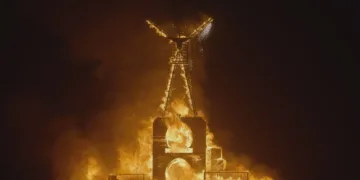























Burning Man survives by pretending survival is beside the point. Its wooden figure must disappear into flame, its city must vanish into dust, and its participants must return home carrying proof that impermanence can still be organized on an industrial scale. That last phrase is where the trouble begins.
Jehane Noujaim and Vikram Gandhi spent five years filming the people who build, govern, finance, and mythologize Black Rock City. Their four-part HBO series, The Man Will Burn, benefits from access few documentaries could secure: boardroom arguments, archival footage, veteran testimony, first-time attendees, renegade burners, artists, logistics teams, and the 2023 flood that turned the Nevada playa into mud. The material contains several documentaries, and the finished series keeps switching among them before any one can become dangerous.
Its central contradiction is already rich enough. Burning Man sells no goods inside its temporary city and treats decommodification as sacred law, yet the event depends on tickets, travel, equipment, unpaid labor, wealthy donors, permanent administration, and a logistical apparatus capable of supporting tens of thousands of people in hostile terrain. Freedom has a procurement department. Noujaim and Gandhi see it, then hesitate.
The Myth Before the Management
Archival images trace the festival back to Larry Harvey’s beach bonfire in San Francisco, where a small group gathered around a wooden human figure and found community in its destruction. The ritual grew, the crowds expanded, and the burn moved to Nevada’s Black Rock Desert in 1990. Members of the Cacophony Society, including John Law and Michael Mikel, shaped a culture of pranksterism, danger, participation, and civic intimacy.
The series understands the religious energy of this history. “The man must burn” functions less like a slogan than a commandment. Harvey’s principles are discussed with scriptural seriousness, especially radical self-reliance, communal effort, immediacy, and decommodification. A news clip calls the gathering an apocalyptic neo-pagan freak fest, yet the footage quietly confirms the theology: desert pilgrimage, ritual hardship, symbolic death, communal rebirth.
Noujaim and Gandhi intercut this founding story with the 2021 argument over canceling the festival during the pandemic. The connection is intelligent. Every public-health restriction revives the old fight between risk and control. Every administrative decision asks if Burning Man has become the institution its founders once fled.
Also Read






The structure weakens the idea it creates. Beach footage gives way to board meetings, which give way to first-time burners, which return us to guns, accidents, 1996, Larry Harvey, Black Rock City LLC, and Marian Goodell’s leadership. The series locates historical pressure points, then treats them like scenic stops. The move from unruly gathering to global operation needed a firmer chronology because the transformation is the story. Instead, history arrives as atmosphere.
Call it mythic compression: decades of conflict become proof that the same communal spirit endured. Yet institutions rarely preserve a spirit without changing its meaning. Black Rock City did not simply grow larger. It acquired permits, hierarchies, donors, public relations, land interests, and people whose job is to decide how much anarchy can be safely scheduled.
Who Gets to Order the Fire?
The strongest footage comes from the Burning Man Project board debating the 2021 festival. COVID had already canceled the 2020 gathering. Vaccinations remained incomplete, international travel faced restrictions, and bringing 70,000 or 80,000 people into one desert city carried obvious public-health risks. Marian Goodell treats cancellation as an act of responsibility. Kimbal Musk treats it as spiritual failure.

Musk’s insistence that “the man must burn” turns a safety dispute into a struggle over ownership. Who has the authority to define Burning Man’s essence? The CEO managing the organization, the donors financing it, the founders who created its mythology, or the participants who believe the event belongs to them?
Kimbal Musk embodies a contradiction the series keeps polishing instead of opening. He is both benefactor and threat, a wealthy insider speaking the language of rebellion from inside a boardroom. The documentary records his pressure, his confidence, and his eventual departure from the board, yet it offers little account of the leverage attached to his money or the political meaning of his exit. Everyone disagrees profoundly while remaining curiously well behaved for the camera.
The presence of Grover Norquist complicates the standard portrait of Burning Man as progressive counterculture. Libertarians, conservatives, artists, veterans, spiritual seekers, and Silicon Valley investors can all find a version of themselves there. That ideological openness may be genuine. It can also hide a simpler organizing principle: people with resources have greater freedom to practice self-reliance.
No money is exchanged inside Black Rock City. Getting there still demands tickets, transport, shelter, food, water, equipment, time away from work, and often access to an established camp. Luxury RV compounds turn anti-commerce into a premium experience. The rich can purchase distance from hardship, then call the remaining inconvenience purification (the desert has always been generous with metaphors for inequality).
The filmmakers raise these tensions, especially through veteran complaints about tech wealth and social-media culture. Their interviews rarely force anyone to explain how a community opposed to commodification became dependent on plutocrats who can bankroll its continuity. The fire belongs to everyone. The invoice does not.
A Community With an Entry Fee
Lindsay and Ray Christian serve as first-time guides into burner culture. Lindsay is a professor teaching online from Pasadena. Ray is a Black former Army paratrooper in rural North Carolina, a father with multiple degrees who hopes the festival may help him live with PTSD. Their anticipation gives the series a human scale no aerial image can.
Ray’s story carries special weight because he does not fit the easy caricature of the aging tech worker seeking chemical enlightenment between conference calls. He approaches Burning Man as a place where communal effort might offer relief from isolation and military trauma. His disappointment after cancellation and continued desire to attend show why the mythology persists. People arrive carrying needs that cannot be dismissed as lifestyle branding.
Veteran burners such as Zoe Nightingale describe Black Rock City as family, sanctuary, workshop, and experiment. Artists discuss impossible structures built for temporary use. Organizers explain the labor required to transform empty desert into a functioning settlement. Participants talk about gifting, shared responsibility, and the intimacy created when survival depends on strangers.
The series presents a community wider in age, race, and politics than its public image suggests. It also acknowledges that Burning Man remains overwhelmingly white and financially selective. Those facts sit beside each other without much friction. Diversity appears through selected lives, while access remains a structural question the documentary keeps personalizing.
Radical self-reliance sounds democratic until one calculates its prerequisites. A person needs money, mobility, health, equipment, time, and enough stability elsewhere to vanish for a week. Existing camps soften those barriers while creating networks of invitation and status. The festival may welcome outsiders, yet entry into its practical systems often depends on knowing how the inside already works.
Noujaim previously examined coercive belief in The Vow. Here, she and Gandhi listen as burners repeat ideas about family, transformation, belonging, and sacred responsibility. The language can be moving. It can also sound institutional, especially when every conflict is folded back into proof of communal resilience. The camera hears testimony where a more skeptical film might hear doctrine.
Mud on the Myth
The 2021 cancellation produces an unofficial renegade gathering in the desert. Without the project’s usual infrastructure, participants reclaim the event’s anarchic roots and expose why they were tamed. Sanitation, emergency response, traffic management, and responsibility do not disappear because bureaucracy is unfashionable. They become somebody else’s problem.
That renegade burn gives the series one of its sharpest possibilities. The organization can be guardian or captor, protecting the culture through systems that control it. When the sanctioned festival returns, the documentary could test which function dominates. Instead, it treats the tension as another family dispute that communal feeling can absorb.
The 2023 deluge provides a harsher test. Torrential rain turns the playa into thick mud, traps vehicles, closes roads, and generates breathless news coverage. Noujaim and Gandhi capture the flooded landscape with eerie beauty. Art installations stand against gray skies. Participants drag themselves between camps. Mutant vehicles become stranded monuments to confidence.
Community does matter here. Burners share supplies, help neighbors, and adapt to the conditions. The crisis also reveals divisions between participants prepared to endure discomfort and glampers trying to escape in expensive RVs before the roads are ready or the site is cleaned. Mud is socially clarifying. Everyone sinks, but some arrive with better suspension.
The documentary grows defensive during this material. Interviewees insist the media exaggerated danger and failed to understand burner competence. Some reports may well have been sensational. The series gives little space to separating false alarm from legitimate concern, or participant resilience from organizational image management. Its access begins to feel like allegiance.
The images remain extraordinary: drone shots of Black Rock City’s geometry, pyrotechnics swallowing the night, illuminated vehicles crossing dust, monumental art designed for destruction. The visual language communicates why people return and exposes the film’s timidity. Burning Man builds impractical machines, risks collapse, and destroys its own monuments. The Man Will Burn prefers polished aerials and reconciled disagreements.
Questions about Gerlach, local law enforcement, land purchases, a proposed philosophical center, leadership conflict, and later financial strain appear, then evaporate. The series stops in 2023, as if the flood supplied a natural ending and the institution’s unresolved future belonged to another story. Five years of access brought the filmmakers to the locked door. They admired the craftsmanship.
This four-part documentary series premiered on July 9, 2026, and is currently available to watch on Max and Hulu. The series provides an intimate, behind-the-scenes look at the evolution of the Burning Man festival, tracing its history from anarchic countercultural roots in San Francisco to the massive, modern-day desert gathering while examining the challenges the organization faced during years of unprecedented crisis.
Where to Watch The Man Will Burn Online



Full Credits
Title: The Man Will Burn
Distributor: HBO, Max, Hulu
Release date: July 9, 2026
Rating: TV-MA
Running time: Approximately 60 minutes per episode
Director: Jehane Noujaim, Vikram Gandhi
Writers: Jehane Noujaim, Vikram Gandhi
Producers and Executive Producers: Jehane Noujaim, Vikram Gandhi, Nina Fialkow, David Fialkow, Nushin Sabet, Farhad Mohit, Karim Amer, Lyn Lear, Kristin Ólafsdóttir, Thor Björgólfsson, Dana O’Keefe, Yariv Milchan, Teddy Schwarzman, Michael Heimler, Natalie Lehmann, Emily Selinger, Nancy Abraham, Lisa Heller, Sara Rodriguez
Cast: Marian Goodell, Farhad Mohit, Kimbal Musk, Nushin Sabet, Harley DuBois, Larry Harvey, John Law, Michael Mikel, Crimson Rose, Will Roger, Stuart Mangrum, Tony Perez, Bryant Tan, Quill Hyde
Director of Photography (Cinematographer): Benji Lanpher, Consuelo Althouse, Natalie Sim, Sam Price Waldman, Chris Darnell
Editors: Raúl Santos, Kim Hall, Karim Fanous, Austin Reedy, Kevin Chapados, Evan Wise
Composer: Tori Letzler, Steven Richard Davis
The Review
The Man Will Burn
The Man Will Burn documents a festival built around impermanence through an institution terrified of disappearing. Its desert images retain the event’s strange magnetism, while five years of access reveal a bureaucracy negotiating public health, billionaire influence, class privilege, and its own sacred mythology. Yet the series repeatedly mistakes proximity for scrutiny. Call it access paralysis: the closer the filmmakers get, the less willing they seem to disturb anything. Burning Man survives fire, cancellation, rebellion, and mud. The documentary survives by keeping its questions safely unlit.
PROS
- Extraordinary behind-the-scenes access
- Spectacular desert cinematography
- Fascinating 2021 boardroom conflict
- Strong archival festival history
- Memorable participant perspectives
CONS
- Disjointed four-hour structure
- Conflicts end without examination
- Billionaire influence remains underexplored
- Defensive treatment of the 2023 flood
- Stops before recent financial turmoil