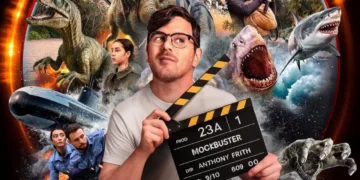













Anthony Frith gets his first feature-directing job by emailing a studio that never asks to see his previous work. The speed of that agreement should feel encouraging. It mostly feels diagnostic.
Frith has spent years directing corporate training and safety videos in Australia while waiting for the career he imagined at film school to materialize. He has made shorts with friends, worked briefly with Werner Herzog, started a family, and watched the practical demands of adulthood crowd his ambitions. Then he contacts The Asylum, the company behind Sharknado and a long catalogue of bargain-bin genre pictures, asking for a chance to direct.
The studio responds almost immediately. Soon, Frith is assigned The Land That Time Forgot, a dinosaur adventure derived from Edgar Rice Burroughs’s public-domain novel. He decides to film the process, turning one risky production into two feature credits. It is a smart move. The documentary becomes his chance to record the personality that the commissioned film has little room to accommodate. There is one problem. Mockbuster is much clearer about the opportunity Frith receives than the filmmaker he hopes the opportunity will reveal.
Cinema by Deadline
The Asylum’s executives describe their business with a bluntness that major studios usually reserve for closed meetings. They make cheap movies quickly, build titles around familiar Hollywood successes, and keep costs low enough that financial disaster becomes difficult. Artistic prestige never enters the equation. Dinosaurs sell. Public-domain material is free. Ninety minutes fills a distribution slot. The machinery is crude, but the machinery works.
Frith receives a one-page synopsis, a budget of roughly $75,000, and six days to shoot a feature containing action, creatures, explosions, and enough dialogue to connect them. A normal production might spend six days filming several complicated scenes. Here, the crew may need to cover over 20 script pages before dinner. Lunch presumably counts as a special effect.
The documentary is strongest when it studies the labor hidden beneath this disposable model. Frith must cast actors, find locations, assemble a crew, and shape unfinished material before a complete script has settled. Visual-effects supervisor Glenn Campbell explains his work with dry pragmatism, checking shots for usable angles rather than cinematic beauty. In one sequence, he points out that computer-generated raptors cannot enter from the same side of the frame the characters have just used to escape. Continuity has survived another extinction event.
Interviews with studio figures, Eric Roberts, and Michael Paré widen the portrait. Roberts treats the assignment with total professionalism, apparently seeing little practical distinction between a prestigious set and one populated by imaginary dinosaurs. The script may be disposable. His working day is not.
Six Days of Controlled Panic
The production footage gives Mockbuster its structure, tension, and sharpest comedy. A producer leaves. The cinematographer resists the schedule before surrendering to it. An actor clashes with the director of photography. Costume approval stalls because The Asylum’s decision-makers are awake in another time zone. First assistant director Stephanie Jaclyn argues with Frith as delays consume minutes the schedule never possessed.
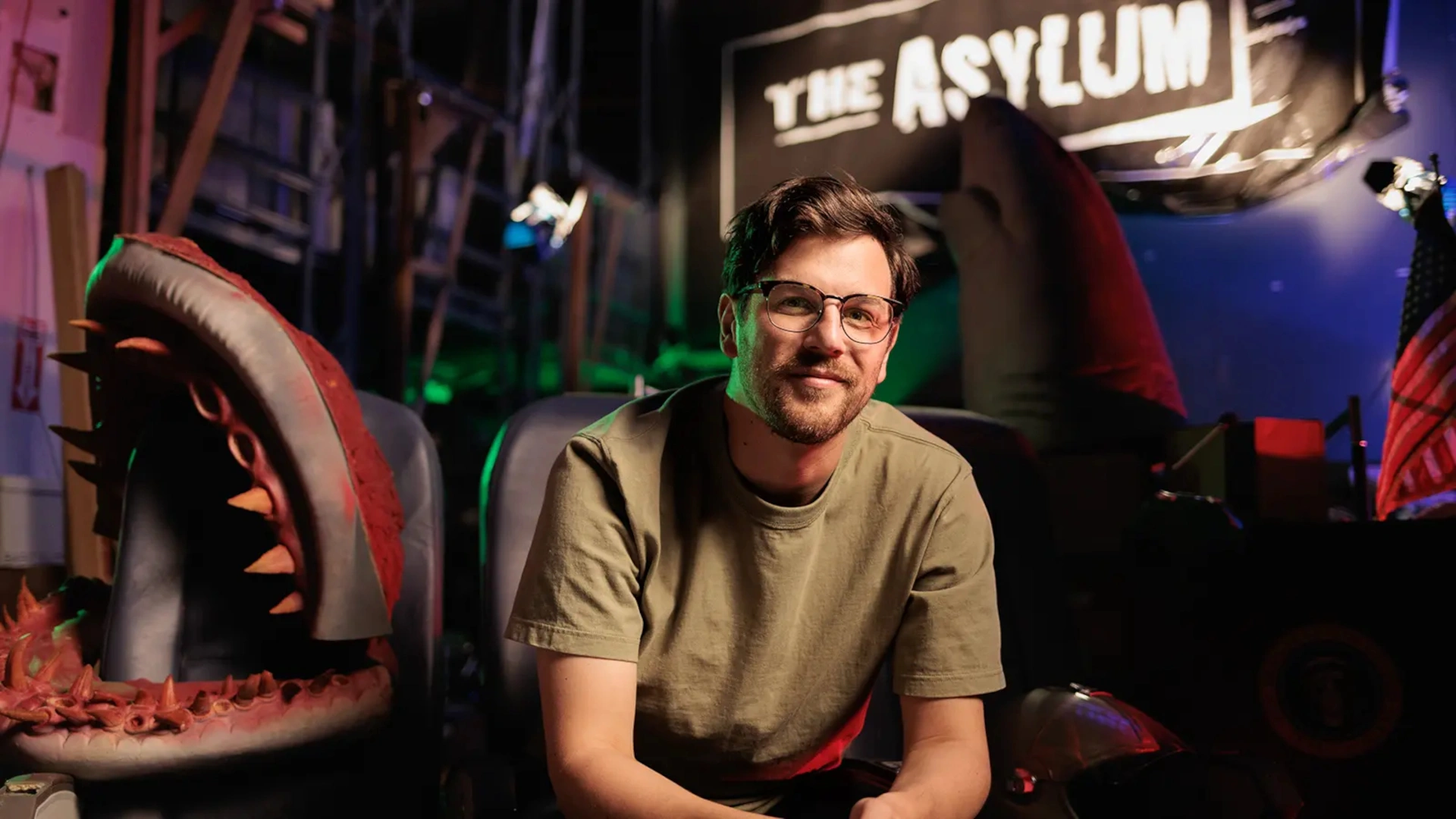
These scenes work because nobody has time to manufacture a flattering version of events. Behind-the-scenes documentaries often polish conflict into an anecdote everyone can laugh about later. Frith leaves in the exhausted faces, raised voices, awkward silences, and apologies that follow. The crew members are not fighting over grand artistic principles. They are trying to finish the day without losing essential footage or their patience.
That distinction matters. The documentary does not pretend that making a cheap film turns it into a good film. It shows why cheap films still require judgment, stamina, and coordination. A missing costume can halt production. A dangerous location can narrow the available angles. A weak line still needs an actor to sell it. A rushed shot still needs to cut against the next one.
The six-day deadline also keeps the narrative moving. Each setback creates an immediate practical question: can the crew recover before daylight disappears? The film loses momentum once the shoot ends. Required reshoots and the addition of a Michael Paré subplot are mentioned, yet the path from raw footage to finished feature remains muddy. Editing, effects assembly, and studio notes receive less attention than repeated discussions of Frith’s anxiety. The documentary has built a sturdy second act, then misplaces several scenes from the third.
The Missing Arc
Frith is open about his fear that this assignment could define him. He wants to place his own stamp on The Land That Time Forgot, worries that the finished film will embarrass him, and repeatedly asks what directing an Asylum feature means for his future. These doubts give the documentary an emotional line, but the writing circles them without developing them.
His narration often announces a lesson before the footage has earned it, then returns to explain the same lesson again. He speaks of creative ambition without identifying the films he wants to make, the directors who shaped him, or the choices inside The Land That Time Forgot that carry his signature. The documentary shows that he can remain functional under pressure. It offers less evidence of what he would do with time, money, and genuine control.
The personal stakes are also softer than the voiceover suggests. A failed production would be disappointing, perhaps professionally awkward, but Frith is not shown risking his family’s security or losing access to other creative work. The film keeps insisting that everything depends on this chance because its subject badly wants that to be true.
The premiere provides a sincere payoff. Cast and crew members watch their hurried labor become a completed movie, enjoying the strange glamour of a project assembled from compromises, tempers, and rubbery prehistoric threats. Frith has proved that he can finish a feature under conditions designed to defeat precision. Mockbuster never quite proves what he wants to say once survival stops being the assignment.
This documentary premiered in the United States on July 10, 2026, and is available to watch on various digital platforms such as Apple TV and Amazon Prime Video. It offers a behind-the-scenes look at director Anthony Frith’s grueling experience filming a low-budget dinosaur movie for The Asylum, capturing the comedic chaos and professional pressures of creating a “mockbuster” in just six days.
Where to Watch Mockbuster (2026) Online






Full Credits
Title: Mockbuster
Distributor: Giant Pictures (Worldwide), Umbrella Entertainment (Australia and New Zealand)
Release date: July 10, 2026 (United States theatrical and digital)
Running time: 90 minutes
Director: Anthony Frith
Writers: Anthony Frith, Sandy Cameron
Producers and Executive Producers: David Elliot-Jones, Sandy Cameron, Naomi Ball
Cast: Anthony Frith, Brendan Petrizzo, David Rimawi, David Latt, Paul Bales, Michelle Bauer, Eliza Roberts
Director of Photography (Cinematographer): Maxx Corkindale
Editors: David Scarborough
Composer: Bryony Marks
The Review
Mockbuster
Mockbuster finds its best material whenever Anthony Frith stops explaining the production and lets the production collapse in front of him. The six-day shoot, costume delays, crew clashes, continuity mistakes, and improvised reshoots form a funny, revealing account of industrial filmmaking under absurd pressure. Frith’s personal arc is less disciplined. His narration repeats the stakes without defining the filmmaker he hopes to become, and the abrupt final stretch leaves crucial postproduction steps unseen. The documentary proves that making a bad movie is hard work. It remains uncertain what Frith learned from doing it.
PROS
- Candid production breakdowns
- Strong behind-the-scenes access
- Funny crew conflicts
- Revealing studio pragmatism
- Memorable industry personalities
CONS
- Repetitive personal narration
- Vague creative ambitions
- Uneven pacing
- Abrupt final act
- Underdeveloped postproduction