


























The smartest structural decision in Quarterback Season 3 is adding a fourth player. Seven episodes now move between four careers traveling in different directions, giving the series a stronger internal rhythm than a standard procession of game recaps.
Tennessee Titans rookie Cam Ward enters the NFL as the first overall pick, carrying expectations before he has played a meaningful professional snap. Washington Commanders star Jayden Daniels faces a different burden after an impressive first year. Tampa Bay Buccaneers quarterback Baker Mayfield is trying to protect the stability he fought to regain. Joe Flacco, now 40, keeps searching for another Sunday on which a team needs him.
The series cuts between these men according to pressure rather than chronology alone. Ward’s difficult adjustment can lead into Daniels dealing with injury. Mayfield’s rehabilitation work sits beside Flacco trying to memorize a new offense. The careers become points on the same line, each showing what the position demands at a different age.
Giving four players sufficient screen time remains a challenge. Certain stretches leave Ward or Daniels absent long enough for their stories to lose momentum. The trade-off is worthwhile, since the expanded structure prevents one weak week from flattening an entire episode.
Rookie Expectations and Veteran Survival
Ward’s material gains its personality away from the field. His mother produces his first speeding ticket and teases him about it, cutting through the solemn treatment usually given to a top draft pick. Those family exchanges show a young man who can laugh at himself, even while Tennessee’s losing season turns every mistake into evidence for a public trial.
Daniels enters his second year under heavier scrutiny. His running ability makes his game footage dynamic, yet the same style places his body at constant risk. The season’s attention to his injury works because it interrupts the clean progression expected from a rising franchise quarterback. Development does not move in a straight line. Knees, shoulders and defensive linemen tend to object.
His relationship with his mother, Regina Jackson, gives his chapters a distinct shape. Jackson is an NFLPA-certified agent handling contracts, marketing and business management. Family conversations can carry professional consequences, and professional decisions remain tied to maternal concern. The series rarely finds such a useful overlap between emotional access and the machinery surrounding an NFL career.
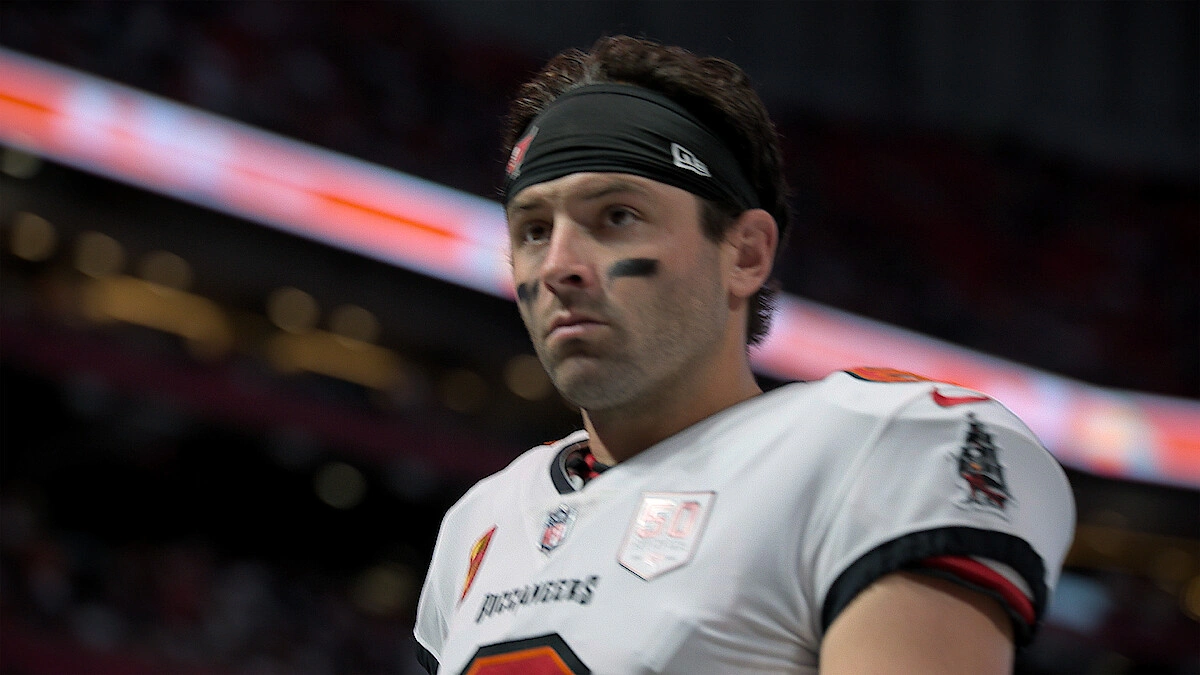
Mayfield’s storyline is built around preservation. The footage of him playing through injuries confirms the physical cost visible during Tampa Bay’s season, while his home life shows how that cost follows him after the stadium empties. His best sequence arrives in the finale, when he sits at home watching rival teams and hoping their results can rescue the Buccaneers’ playoff chances. The quarterback is reduced to a spectator, which may be the one position he cannot control through effort.
Flacco Calls the Audible
Flacco provides the season’s strongest narrative because his circumstances force the production to abandon its plan. His midseason trade from Cleveland to Cincinnati sends the crew to a new organization after Joe Burrow’s injury leaves the Bengals desperate for stable quarterback play.
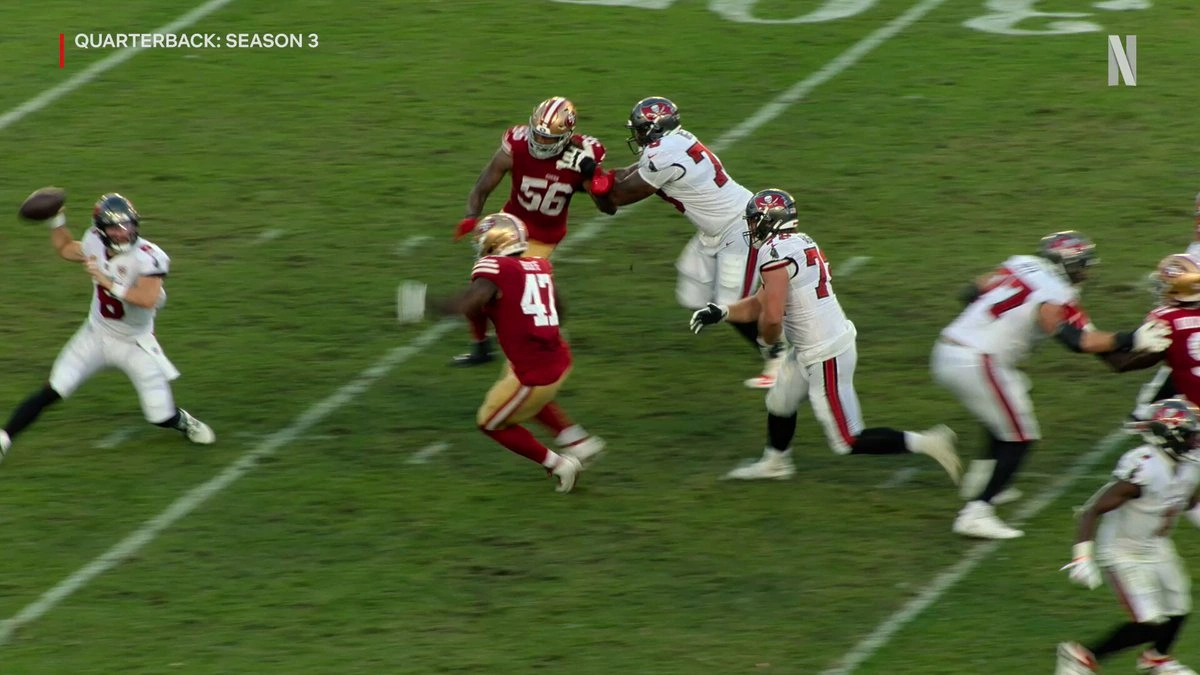
The resulting footage captures adaptation rather than polished preparation. Flacco has less than a week to absorb Cincinnati’s lengthy play calls, meet unfamiliar teammates and operate an offense built for someone else. Watching him struggle with the terminology gives the football detail immediate dramatic purpose. The playbook is no longer background information. It is the obstacle.
His candor sharpens nearly every scene. Flacco jokes about his son benching him in fantasy football and mocks Shedeur Sanders for wearing a visor. These moments work because they emerge from his established manner rather than an editor’s attempt to manufacture comic relief. Younger players still have reputations to construct. Flacco appears comfortable leaving his unvarnished.
The trade also exposes the fragility of NFL employment. A former Super Bowl MVP can still be moved, benched or asked to prove he belongs in a building he entered days earlier. Longevity offers experience. It does not provide immunity.
Access Beyond the Highlights
The series remains strongest when it treats televised games as consequences of unseen labor. Film sessions, rehabilitation routines and locker-room reactions reveal how much of a quarterback’s week is spent repairing the previous Sunday while preparing to survive the next one.
Post-game access gives losses particular weight. Victory speeches have a familiar rhythm, but defeated locker rooms create silence, evasive glances and short exchanges that cannot be polished into inspiration. The quarterback remains the focal point, even when the failure belongs to an entire roster.
Peyton Manning’s influence through Omaha Productions is visible in the attention given to terminology, preparation and physical recovery. The football material assumes some viewer knowledge, yet scenes such as Flacco learning Cincinnati’s calls provide enough context for casual audiences. The technical language matters because a person must master it under pressure.
Family footage sometimes drifts toward the polished domestic material used throughout modern sports documentaries. The Mayfield and Flacco sequences survive that tendency through humor, injury and genuine uncertainty. Other scenes feel designed to reassure viewers that elite athletes also have kitchens.
Season 3 does not redesign Quarterback. It improves the existing structure by finding four players whose careers naturally argue with one another. Ward represents expectation, Daniels carries escalation, Mayfield protects reinvention, and Flacco lives week to week. The series places them in the same formation and lets professional football supply the collisions.
This documentary series premiered on Netflix on July 14, 2026, offering exclusive, behind-the-scenes access to professional football players during the NFL season. The show follows multiple quarterbacks on and off the field, capturing the immense pressure and physical toll required to excel at the position.
Where to Watch Quarterback Season 3 Online


Full Credits
Title: Quarterback: Season 3
Distributor: Netflix
Release date: July 14, 2026
Rating: TV-MA
Running time: 7 episodes
Producers and Executive Producers: Peyton Manning, Jamie Horowitz, Ross Ketover
Cast: Jayden Daniels, Joe Flacco, Baker Mayfield, Cam Ward
The Review
Quarterback Season 3
Quarterback Season 3 strengthens its established formula by choosing four careers moving in different directions. Cam Ward brings rookie uncertainty, Jayden Daniels carries the burden of expectation, Baker Mayfield fights through injury, and Joe Flacco turns a midseason trade into the season’s sharpest storyline. The expanded format occasionally limits how deeply each arc can develop, yet the editing keeps their pressures in productive conversation. Flacco’s unfiltered humor and frantic Cincinnati transition give the series the disruption it needed.
PROS
- Strong four-quarterback structure
- Flacco’s candid veteran perspective
- Effective family access
- Revealing injury and preparation footage
- Smart cross-cutting between career stages
CONS
- Limited time for each player
- Familiar family-documentary beats
- Institutional NFL pressures remain underexplored