















Cyberwar has a television problem: the damage may reach airports, elections, and nuclear systems, while the people causing it remain seated under fluorescent lights. The Undeclared War has spent two seasons trying to solve that problem.
Its first run, created and directed by Peter Kosminsky, treated digital conflict with studied seriousness and often drained the drama from the room. Season two, written by Colin Teevan and directed by Paul McGuigan, moves faster, shifts its attention toward GCHQ operations chief Danny Patrick, and gives the threat a human shape through a mole inside his team.
The timeline carries its own irony. Season one aired in 2022 and imagined April 2024. The second season arrives four years later, picks up only two weeks after the cliffhanger, and continues inside a future that has already expired. Television loves a near-future warning until production schedules turn prophecy into period drama.
The conflict remains a Russian campaign against Britain’s communications networks and political institutions. Vadim, the young FSB hacker who secretly helped GCHQ, is trapped in Russia. Saara still exchanges messages with him through a gaming server. Danny faces ministers demanding retaliation, a military rapid-reaction unit enters GCHQ, and a security investigation begins hunting one of his own.
A New Lead in the Operations Room
Season one built its story around Saara, a computer science student whose first day on work experience coincided with a major attack on Britain’s internet infrastructure. Within hours, she found elements hidden inside the Russian malware that experienced analysts had missed. The outsider who sees what the institution cannot is a useful television device. Here, the device kept showing.
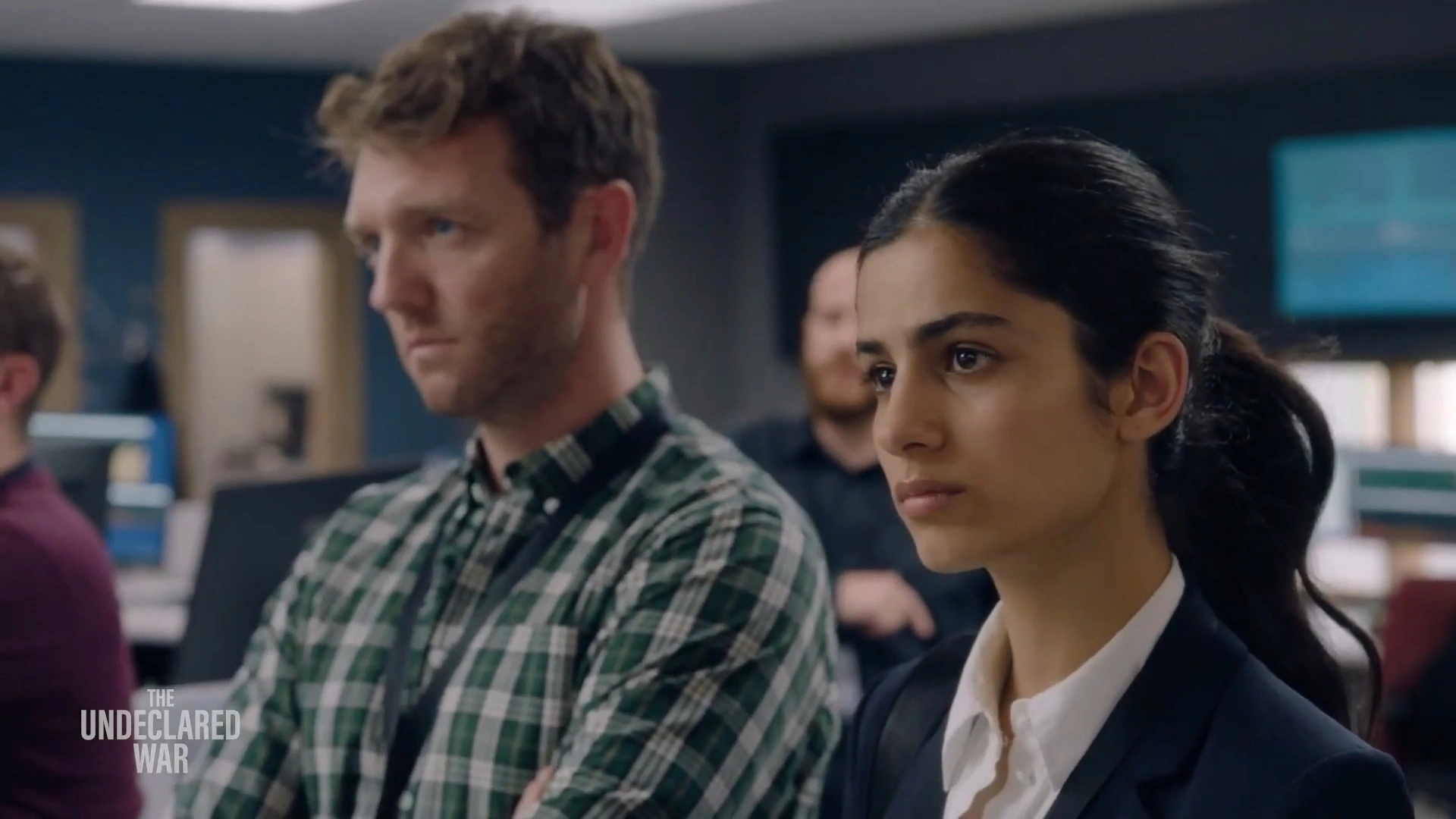
Saara’s intelligence was never the issue. The writing asked viewers to accept a system where Britain’s leading cyber specialists repeatedly needed an intern to notice the next concealed threat. Her father’s death, strained relationship with James, attraction to Kathy, and position as a young British Muslim inside GCHQ all had dramatic potential.
The season moved through these parts of her life without letting any one of them shape the others. A character positioned at the intersection of family expectation, sexuality, public service, and national suspicion became a delivery system for discoveries.
Hannah Khalique-Brown played Saara with a quietness that sometimes suited the isolation of the role. It also exposed how little emotional continuity the script supplied. Her relationship with Kathy appeared before the workplace intimacy supporting it had taken form. Her family scenes carried grief, then the plot hurried back to another encrypted message.
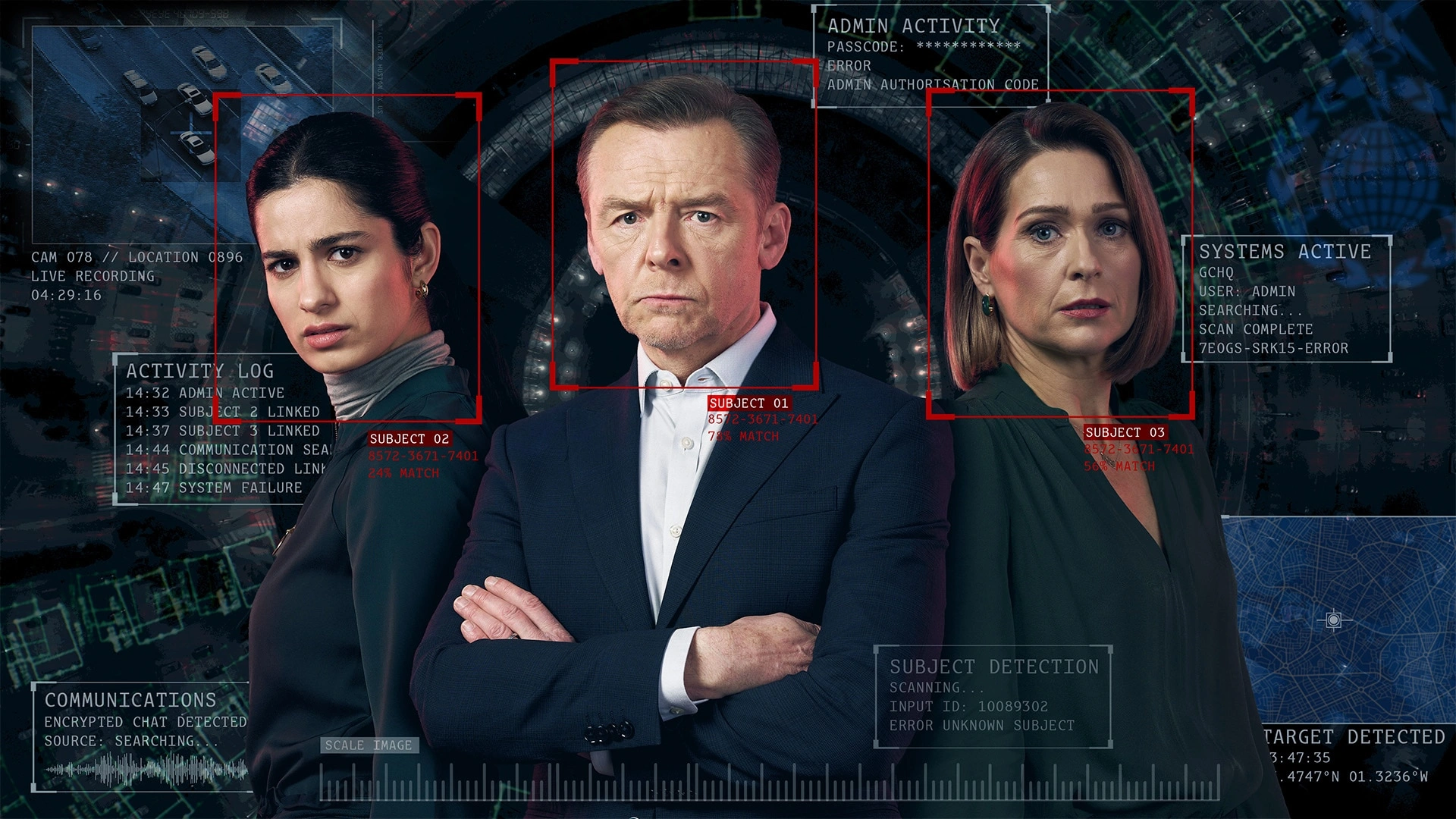
Season two makes Danny the lead and announces the change with a long take. McGuigan’s camera follows him through corridors and conference rooms as assistants hand over information, underlings wait for decisions, and several crises compete for his attention. Simon Pegg turns the movement into character. Danny walks quickly because stopping would mean admitting how tired he is.
The home scenes extend that pressure. Danny arrives late, falls into bed fully dressed, and wakes almost at once for the school run. Barbara greets the routine with affection and dry mockery, then the series reveals that she leads GCHQ’s China team. Siân Brooke gives those scenes an ease that the first season rarely found. Their home is a refuge run by two people who know the office can enter it at any hour.
Danny’s closest friend, Charlie, leads the search for the mole. That decision folds friendship, command, and suspicion into one line of pressure. Season one kept Saara’s private life beside the cyber plot. Season two lets Danny’s private life become part of the security architecture.
Code, Corridors, and the Problem of Action
Kosminsky tried to make hacking visible by placing Saara inside a physical version of code. In her early challenge, she descends through a manhole, breaks through walls, and searches rooms for hidden information. The sequence turns digital layers into space, yet it resembles a game-show puzzle placed inside a national-security drama. Once the metaphor ends, the series returns to banks of monitors, urgent typing, dark rooms, and explanations dense enough to make the malware sound offended by ordinary language.
The research was clearly serious. Season one mapped attacks across internet provision, election systems, military communications, and surveillance networks with procedural detail. Credibility helped the ideas. It did not fix the pacing. Analysts stared at code while the effects happened elsewhere.
McGuigan gives season two greater physical motion. The opening take turns information transfer into choreography. Meetings begin in corridors and spill into operations rooms. The arrival of a rapid-reaction unit creates another source of friction, led by Chloe Pirrie’s tightly controlled lieutenant colonel. Her team occupies GCHQ like an invading department, complete with a rival chain of command and less patience for Danny’s caution.
The faster direction cannot fully hide the series’ airlessness. Airport disruption appears in a news report. Service failures are described around tables. The country is said to be approaching collapse, yet civilians barely enter the frame. The series understands cyberwar as systems failure, then keeps the people dependent on those systems outside the building.
The mole plot changes the temperature. Once Charlie begins testing loyalties, every access request, private conversation, and misplaced detail can carry intent. Around the middle of the season, the traitor’s history and motivation pull the series away from technical abstraction. Code becomes evidence of a personal decision. Surveillance becomes the record of someone lying to colleagues who trust them.
Charlie explains that betrayal rarely starts with a grand declaration. People are cornered through love, sex, money, fear, or blackmail. That insight gives the season a sharper understanding of institutions than its cabinet scenes do.
Elections, Propaganda, and Escalation
The first season was strongest when it treated cyberwar as an attack on public reality. Russia’s campaign disrupted Britain’s internet during an election, manipulated exit-poll information, and blocked ethnic minority voters from casting ballots. Protest followed. The government declared a state of emergency. James joined a movement influenced by misinformation without seeing the machinery shaping it.
Those episodes understood something television still tends to simplify about digital propaganda. False information does not need to persuade everyone. It needs to alter behaviour at the right moment. A rigged poll can suppress turnout. A fabricated story can redirect anger. A disrupted service can be presented as proof that democratic government has lost control.
The fake broadcast involving GCHQ employee John Yeabsley gave that argument its clearest image. Russian television presented him as a British traitor speaking from Moscow. Saara discovered that he had already died before the interview aired. A dead man had been converted into usable political evidence, linking image manipulation, institutional panic, and grief.
Vadim’s story offered another view of the same system. Forced into FSB cyber work after his kidnapping, he watched Marina enter Russian state media and saw private relationships absorbed by political machinery. His warnings revealed that GCHQ’s computers and security cameras had been compromised from the start. Britain then attacked Russian arms factories, Russia threatened retaliation, military communications failed, and nuclear submarine systems were compromised.
Season two retains the argument and narrows its political vocabulary. Danny warns that a symmetrical response would be “highly escalatory.” David Neal occupies the managerial middle. Foreign secretary Richard Marston demands visible retaliation. Ed Stoppard gives Marston the confidence of a man who treats risk as something other people will experience.
Danny is nearly always the prudent institutional conscience, Marston the reckless politician, and David the buffer between them. Their debates repeat the same moral arrangement. A series alert to misinformation should be wary of reducing politics to such clean roles. The public is manipulated by complex systems, while cabinet government becomes one sensible man arguing with one dangerous one.
Where the Series Finds Its Pulse
Pegg gives the second season its steadiest human line. He keeps Danny’s authority controlled in briefings, then lets fatigue show through his posture at home. When the mole investigation turns his team into a field of suspects, instructions become tests and familiar faces become possible threats.
Brooke’s Barbara has less screen time, yet her presence changes Danny’s character. She can comfort him, mock him, and understand the classified gaps in his speech without becoming the spouse who asks what he cannot say. Her position leading the China team places a woman inside the intelligence hierarchy without turning her competence into a speech about representation. Television might try this trick again sometime.
Danny Sapani gives Charlie a different authority. His account of how traitors are made treats betrayal as a process of pressure rather than a personality type. The mole storyline follows that principle. The revelation matters through motive, access, and relationships, not through a theatrical declaration of evil.
Vadim remains the bridge between Britain and Russia. German Segal carries his fear and divided loyalty with urgency, yet his continued communication with Saara through a gaming server stretches belief once the extent of surveillance is clear. The series wants the intimacy of a secret chat and the omniscience of a modern security state at the same time.
Its best scenes choose the person over the interface: Saara learning that Yeabsley’s broadcast was fabricated, Vadim risking capture to send evidence, Danny realising that a colleague has been feeding information to the enemy. The threat becomes real when somebody has to live with the choice behind the code.
This British cyber-thriller series premiered on June 30, 2022, on Channel 4 and Peacock. The story follows a leading team of analysts at GCHQ secretly working to ward off a devastating series of cyber-attacks on the United Kingdom during a high-stakes general election.
Where to Watch The Undeclared War Online


Full Credits
Title: The Undeclared War
Distributor: Channel 4, Peacock
Release date: June 30, 2022
Rating: TV-MA
Running time: 60 minutes per episode
Director: Peter Kosminsky
Writers: Peter Kosminsky, Declan Lawn, Adam Patterson, Amelia Spencer
Producers and Executive Producers: Robert Jones, Colin Callender, Noëlette Buckley, Tom Carver
Cast: Hannah Khalique-Brown, Simon Pegg, Maisie Richardson-Sellers, Edward Holcroft, Adrian Lester, Alex Jennings, Mark Rylance, German Segal
Director of Photography (Cinematographer): Gavin Finney
Editors: David Blackmore
Composer: Sarah Warne
The Review
The Undeclared War
Season two gives The Undeclared War the urgency its subject always promised, shifting attention toward Danny’s exhausted command and a mole investigation rooted in coercion, trust, and institutional failure. Simon Pegg and Siân Brooke bring human texture to rooms crowded with monitors, while the political writing still reduces caution and aggression to familiar opposing speeches. The series understands how digital warfare can distort elections and public truth. It remains less certain about how to make that damage visible on television.
PROS
- Stronger mole storyline
- Simon Pegg’s controlled performance
- Siân Brooke’s grounded presence
- Faster, livelier direction
- Credible misinformation themes
CONS
- Cyberattacks remain visually distant
- Repetitive political debates
- Limited civilian perspective
- Implausible secret communications
- Uneven early pacing