






















The Enterprise spends its fourth season behaving like a television network with an unusually generous costume department. One week brings volcanic terrain and prehistoric predators. The next turns the ship into a black-and-white noir set, then abandons it for a derelict vessel filled with mutilated bodies, before asking its officers to survive medical catastrophe, chaotic shore leave, and life as felt puppets. Consistency has been relieved of duty.
This creative restlessness restores something Season 3 misplaced. Its longer threats, particularly the Vezda material, pressed the series toward the serialized model that streaming platforms treat as natural law. Season 4 rejects that pressure. Akiva Goldsman and Henry Alonso Myers build the first six episodes as discrete pieces of television, connected through character relationships rather than a villain waiting behind every closing scene.
The approach suits a series caught between two futures. A shortened fifth season will bring Strange New Worlds close to the moment when James T. Kirk assumes command of the Enterprise, leaving Christopher Pike and several members of his crew outside the history recorded by The Original Series. Season 4 therefore has two jobs: preserve the episodic freedom that made the series distinctive and prepare its less canonically protected characters for departure. It handles the first task with exuberance. The second receives far less attention.
Six Episodes, Six Languages
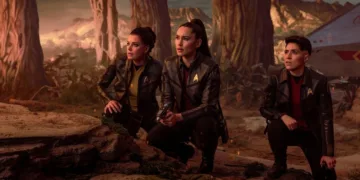
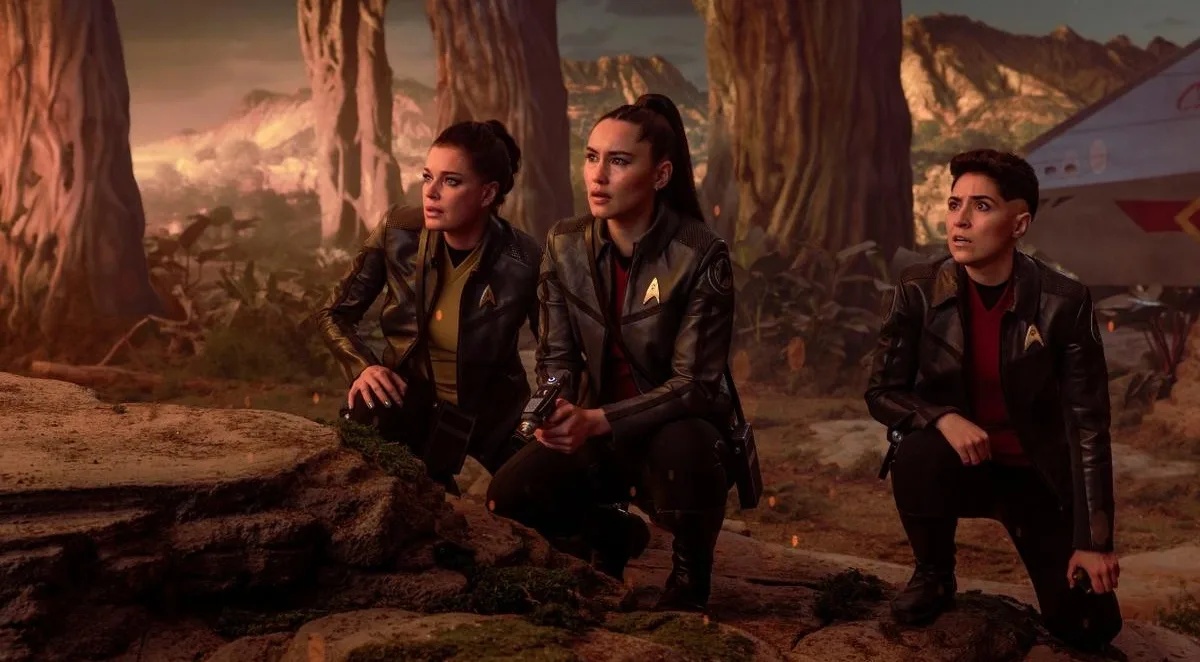
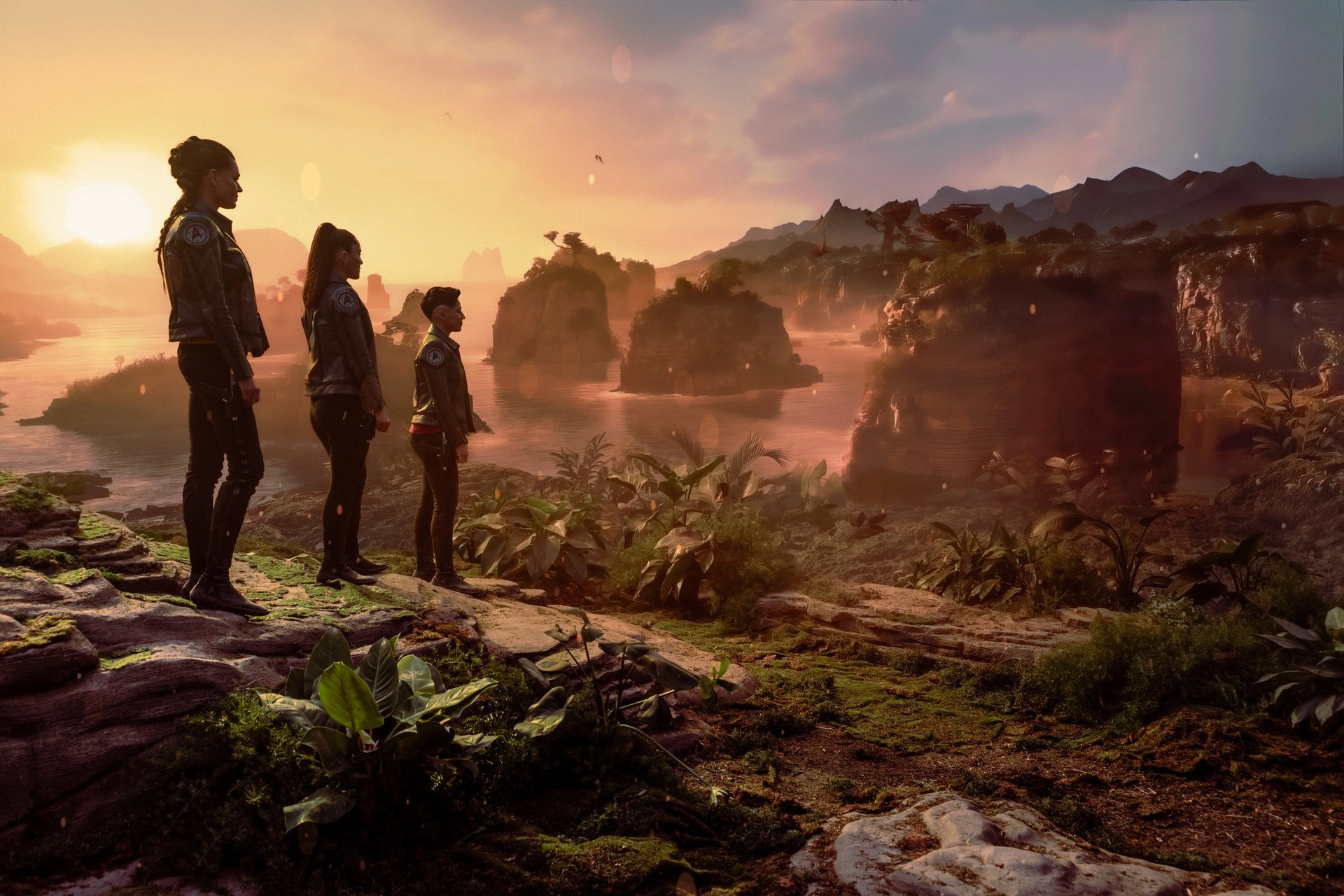
“Valles Marineris” offers the closest thing to a conventional season premiere. The mission places Una Chin-Riley, Erica Ortegas, and La’an Noonien-Singh inside a volcanic environment where prehistoric danger turns exploration into survival. The landscape carries the scale of an adventure film, while the pairing gives three officers outside Kirk’s future command a chance to operate without Pike, Spock, or the franchise’s most familiar names dominating the action.
Mars also permits Pike a desert interlude involving horses, a detail tailored so perfectly to Anson Mount’s version of the captain that it almost feels contractually guaranteed. The image is charming, yet brief. Pike’s pleasure in the open terrain supplies a glimpse of the man beyond the chair before the episode returns him to the edge of its action.
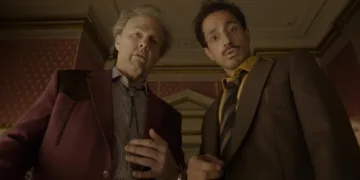
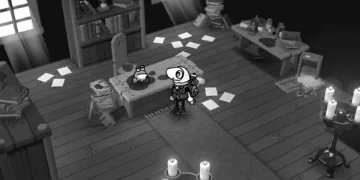
“A Case of Chiaroscuro” makes a stronger argument for the season’s format. Filmed in black and white, the episode borrows the visual grammar of wartime noir: Art Deco interiors, hazy gradients, tilted compositions, and faces divided between light and shadow. Klingons fill the occupying-force role within a story recalling Casablanca, but the episode avoids becoming a collection of references. Its stylisation sharpens tensions already present between the characters. The genre is a dramatic instrument rather than an elaborate costume.
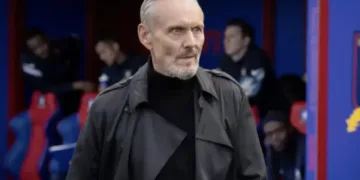
“The Griffin Incident” moves toward horror with similar discipline. A missing Starfleet ship becomes a haunted house whose corridors replace gothic staircases and locked attics. The violence is startlingly graphic for this series, including a body exposed to space with gruesome force. Gore alone would register as an attempt to announce maturity through internal organs, one of television’s less dignified rituals. Here, physical horror activates the crew’s existing trauma. The deserted ship becomes frightening because it knows which memories to disturb.
A later disaster episode relies on a literal countdown and escalating triage scenarios. Separating the officers across simultaneous emergencies lets the editing reveal how the Enterprise functions as a community of specialists. Medical decisions collide with mechanical failures. Each cut transfers pressure from one person to another, while the exterior shots give the ship a scale that recent episodes have sometimes sacrificed for close conversational scenes. Danger gains weight through coordination rather than surprise.
The lighter experiments produce mixed results. A dinosaur threat carries uncomplicated pulp energy. Chaotic shore leave leans into intoxicated farce. The puppet episode commits fully to its premise, transforming the crew into felt bodies while preserving Starfleet protocol, personal anxieties, and recognizable performance rhythms. The puppeteers give Spock, Pike, and the others expressive physical identities that never feel like static imitations of the actors.
Sincerity keeps the episode from collapsing into parody, but its later turns stretch the concept past its dramatic capacity. The production begins to seem pleased with its own audacity. A puppet can carry emotion. It cannot automatically provide meaning simply because someone spent months stitching its uniform.
Character as Continuity
Without a single enemy binding the episodes, the crew becomes the season’s continuing story. Rebecca Romijn benefits most from this arrangement. Una leads missions with calm tactical intelligence, while quieter moments allow uncertainty about her future to surface. Her authority never depends on imitation of Pike. Romijn gives Una a firmer, less performative command style, visible when she assesses danger before the others finish reacting to it.
La’an’s anxiety about her genetic inheritance remains one of the series’ strongest recurring ideas. Her connection to the Noonien-Singh name turns aggression into something she monitors within herself, as if every angry impulse might confirm a history she rejects. The season’s horror and comedy place this fear under different forms of pressure. In each case, Christina Chong keeps La’an’s restraint visible in her posture and clipped responses.
Ortegas gains a useful partner in Scotty. Their mutual irritation sharpens once the rest of the crew is incapacitated, forcing them to solve a crisis while confronting the habits that make cooperation difficult. Melissa Navia and Martin Quinn play the friction as professional rather than childish. Neither character suddenly becomes agreeable. They reach common ground by recognising competence, which is often how trust develops inside institutions that cannot afford emotional harmony.
Ethan Peck’s Spock remains the most secure interpretation of a legacy character in the series. His comic timing grows from precision: a pause held slightly too long, a correction delivered with unnecessary exactness, a body struggling to remain composed while surrounded by absurdity. This season reduces the romantic emphasis that shaped earlier episodes and invests instead in his friendship with Jim Kirk.
That relationship has obvious historical weight, but Paul Wesley’s continued presence carries an air of franchise impatience. Kirk receives traumatic material in one episode without a persuasive dramatic reason for being the character assigned to it. The experience could have belonged to Pike, Una, Ortegas, or La’an, each of whom has less time remaining and fewer canonical guarantees. Kirk sometimes appears because history demands his approach, not because the episode needs him.
The ensemble survives the season’s violent changes in tone because each actor protects a stable centre. Celia Rose Gooding’s Uhura, Jess Bush’s Chapel, Babs Olusanmokun’s M’Benga, Carol Kane’s Pelia, and Quinn’s Scotty remain identifiable across noir, horror, medical drama, and comedy.
Episode six demonstrates this most clearly by isolating the officers and letting their individual skills reveal the structure of the team. The Enterprise is convincing as a workplace because its crew members solve problems differently. The scripts understand that affection means little without function.
Canon Has Read the Ending
Prequels ask audiences to fear outcomes they already know cannot occur. Spock, Uhura, Scotty, Chapel, M’Benga, Kirk, and Pike survive the immediate crises presented across these episodes because later history requires them. A ticking clock can accelerate the editing, and a decompressed body can shock the eye, yet the future has already issued several characters a certificate of survival.
Season 4 compensates by changing the nature of the threat each week. This strategy keeps the episodes fresh, but it cannot fully restore suspense. The less established characters carry greater dramatic vulnerability. Una, Ortegas, Pelia, and La’an are absent from the familiar Enterprise crew, so their choices possess uncertainty that no monster can create for Spock.
This imbalance should place Pike at the centre of the season. His command is nearing its end, and his knowledge of the accident awaiting him gives every ordinary decision a tragic undertow. The premiere briefly acknowledges his grief for Captain Marie Batel, with another character recognising a pain Pike prefers to manage privately. Mount responds with the quiet composure that has defined his performance: warmth maintained through effort, authority made humane by the awareness that it will not last. Then the season repeatedly sidelines him.
Pike remains a capable captain, appearing at the margins to issue decisions, reassure officers, or trust someone else with the task at hand. These choices fit his leadership style, yet they deny him a sustained emotional movement. Even his horse-riding material passes quickly, a reminder of a personal life the season rarely permits him to inhabit.
The issue is not that every episode must revolve around the captain. The problem is that Kirk’s growing presence occupies narrative space while Pike’s remaining time becomes increasingly precious. A prequel can honour the legend approaching the bridge without treating the man still sitting in the chair as administrative furniture.
The Cost of Reinvention
Season 3’s serialized threats made several episodes blend together. Season 4 creates the opposite problem. Its stories are so determined to distinguish themselves that the season can resemble a collection of elaborate demonstrations: noir lighting, haunted corridors, disaster cross-cutting, dinosaurs, drunken comedy, puppetry. Each announces its identity immediately.
At their best, these experiments expose character. The monochrome imagery of “A Case of Chiaroscuro” turns moral uncertainty into visual texture. “The Griffin Incident” uses bodily horror to disturb psychological wounds. The disaster episode converts professional competence into suspense by showing how one officer’s failure would spread through the ship.
The weaker chapters begin from the question of what Star Trek has never attempted, then search for a reason afterward. Ambition still matters. Episodic television needs permission to fail differently from week to week, rather than repeating one successful formula until it becomes indistinguishable from obligation. Yet a season approaching its final stretch cannot live on formal possibility alone.
One or two direct stories about exploration, diplomacy, or contact with an unfamiliar civilisation would provide useful resistance to the spectacle. Such episodes could return attention to the ethical and political questions that made earlier chapters like “Ad Astra per Aspera” and “Under the Cloak of War” memorable. Strange settings carry little value when the people entering them remain unchanged.
The first six episodes prove that this Enterprise can travel anywhere television allows. The remaining task is harder: deciding which members of its crew deserve to arrive somewhere before Kirk takes the chair.
This science fiction television series premieres its fourth season on Paramount+ on July 23, 2026. The story follows Captain Christopher Pike and the crew of the U.S.S. Enterprise as they explore uncharted frontiers and confront new challenges across the galaxy.
Where to Watch Star Trek: Strange New Worlds Season 4 Online









Full Credits
Title: Star Trek: Strange New Worlds
Distributor: Paramount+
Release date: July 23, 2026
Rating: TV-PG
Running time: 50 minutes per episode
Director: Akiva Goldsman, Henry Alonso Myers, Kathryn Lyn, Skylar J. Ojeda, Axelle Carolyn, Jordan Canning, Bill Wolkoff
Writers: Akiva Goldsman, Henry Alonso Myers, Alan B. McElroy, Kathryn Lyn, Skylar J. Ojeda, Dana Horgan, Robbie Thompson, Bill Wolkoff, Onitra Johnson
Producers and Executive Producers: Akiva Goldsman, Henry Alonso Myers, Alex Kurtzman, Jenny Lumet, Rod Roddenberry, Trevor Roth, Frank Siracusa, John Weber
Cast: Anson Mount, Ethan Peck, Rebecca Romijn, Jess Bush, Christina Chong, Celia Rose Gooding, Melissa Navia, Babs Olusanmokun, Martin Quinn, Carol Kane
Composer: Nami Melumad
The Review
Star Trek: Strange New Worlds Season 4
Star Trek: Strange New Worlds Season 4 recovers the adventurous freedom that once distinguished the series, sending its crew through noir, horror, disaster drama, prehistoric peril, and puppet comedy with remarkable confidence. Some experiments confuse novelty with purpose, while Pike’s reduced presence leaves the season neglecting the captain whose departure should define its final stretch. Still, the ensemble gives every formal gamble a recognisable emotional pulse. The Enterprise remains strongest when strange worlds reveal something familiar about the people exploring them.
PROS
- Fearless genre experimentation
- Strong ensemble chemistry
- Memorable noir and horror episodes
- Inventive production design
- Richer material for Una and La’an
CONS
- Pike receives limited development
- Abrupt tonal shifts
- Kirk feels overused
- Familiar canon weakens suspense
- Novelty sometimes eclipses substance