


















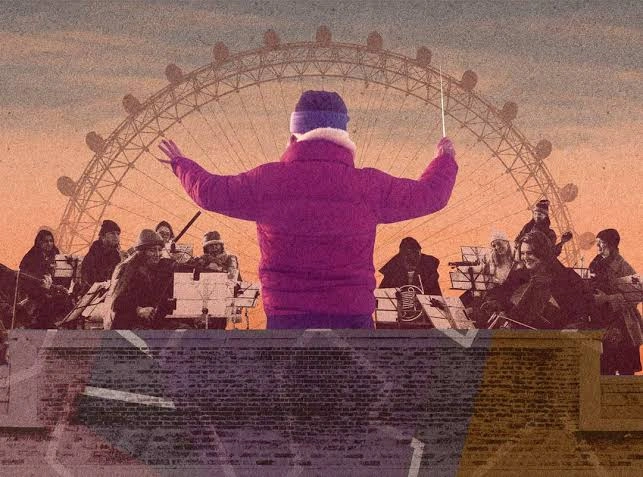

The orchestra waits on a rooftop in winter coats, suspended between the London skyline and the lives unfolding below. Its presence gives Robin Norton-Hale’s La Bohème a strange, mournful geography. Puccini’s music seems to descend upon Hackney from somewhere beyond the characters, carrying the knowledge of an ending they are still young enough to ignore.
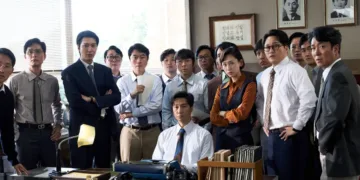
Adapted from Norton-Hale’s Olivier Award-winning OperaUpClose production, the film moves the story from 19th-century Paris to present-day East London. Rodolfo is an aspiring novelist sharing a flat with painter Marcello, musician Schaunard, and the intellectual Colline.
Their poverty is expressed through unpaid rent, a cold apartment, cheap food, and improvised schemes. Then a power cut brings Rodolfo into the darkness with his neighbour Mimì, a Ukrainian cleaner whose persistent cough already sounds like fate clearing its throat.
The English libretto folds laptops, pubs, slang, and profanity into classical singing. At times, the combination produces an awkward collision. Mundane references can sound stranded inside Puccini’s melodic grandeur, as though two centuries have met in the same room and neither knows where to sit. Yet the translation also removes a barrier. The emotions arrive without subtitles standing between the voice and the face.
Two Loves, Two Kinds of Ruin
Matthew McKinney and Lucy Hall make Rodolfo and Mimì’s first meeting feel tentative rather than ordained. Their search for her missing key takes place in near darkness, with the camera close enough to catch every hesitation. When Rodolfo begins “Che gelida manina,” Mimì’s expression shifts before she answers him. Attraction appears as apprehension, a small fear that happiness may already carry its price.
McKinney gives Rodolfo youthful warmth, particularly in his early scenes with his flatmates, where the men joke, steal food, and perform confidence for one another. His singing possesses the ardour the role requires, yet his strongest moments are quieter. When Rodolfo later explains Mimì’s condition to Marcello, his jealousy is exposed as a crude disguise for helplessness. He cannot cure her, support her, or bear to watch her decline. So he turns fear into rejection.
Hall’s performance grows inward as Mimì weakens. During the third-act exchange, she listens unseen while irritation gives way to terror. Her face understands the truth before her voice responds. The camera grants her a silence unavailable on stage, and that silence carries the weight of a body becoming foreign to itself.
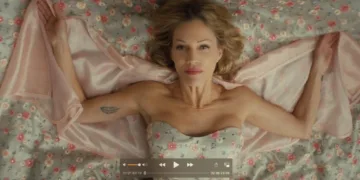
Marcello and Musetta offer a louder reflection of the same loneliness. Benson Wilson gives Marcello a broad physical confidence that crumbles whenever Musetta refuses to remain possessed. Julia Mariko seizes the pub sequence by climbing onto tables and turning her aria into public provocation. Later, after an argument, Musetta storms away, lights a cigarette, and breaks down. The gesture lasts only moments, yet it reveals the sorrow beneath her theatrical defiance. She performs freedom because dependence frightens her.
Opera at Breathing Distance
Norton-Hale understands that cinema cannot compete with grand opera through reduced scale, so she pursues proximity. Jack Edwards’ cinematography remains near the singers, favouring middle shots and close-ups that transform arias into private disclosures. The viewer watches breath gather, eyes shift, and mouths tighten around emotions too large for speech.
This intimacy occasionally becomes stillness. Operatic singing places demands on the body, and several scenes leave performers standing in rooms while the camera searches for movement that is not there. Musetta’s pub performance escapes this problem through physical play, while Schaunard’s bizarre job serenading a parrot gains energy from being shown rather than recounted.
The city supplies its own uneasy accompaniment. Sirens, radios, drills, and vacuum cleaners intrude upon the score, giving the lovers no sanctuary from ordinary life. The rooftop ensemble, conducted by Alice Farnham, becomes a visible witness to their decline. Its fourteen musicians produce a sound rich enough to carry Puccini’s ache while retaining the fragility of a chamber performance.
The singers performed live on set against the previously recorded orchestra, and the effort matters. Voices belong to the rooms where they are heard. They contain movement, strain, and the slight roughness of physical space. The film’s emotional credibility often comes from this union of polished music and mortal breath.
The Poverty Problem
The move to modern Hackney creates wounds the adaptation cannot close. Rodolfo and his friends speak of deprivation while living in a flat that looks suspiciously comfortable for artists unable to pay rent. Burning manuscript pages for warmth feels theatrical in a home with electricity, laptops, and smoke detectors. The image survives from Puccini, but its logic does not.
Mimì’s illness creates a deeper rupture. Tuberculosis in contemporary London demands questions the story avoids. Why has she not received sustained treatment? Why do her friends wait until her final collapse before calling emergency services? Musetta selling her earrings to obtain medicine carries tragic force in the original setting; here, it feels like a relic placed inside a health system the film prefers not to acknowledge.
These contradictions weaken the social world around the lovers. Hackney appears curiously clean and narrow, its diversity reduced, its gentrification left unexamined. The film wants bohemian poverty without confronting the economics of the neighbourhood it has chosen. Cold rooms and empty wallets become romantic signs rather than convincing conditions. Yet death has never required perfect logic to enter a room.
When Mimì returns to the flat, Hall strips the performance of decorative suffering. Friends search for money, warmth, medicine, anything that might delay the inevitable. Their movements grow smaller as hope contracts. Afterward, the rooftop musicians pack away their instruments while Rodolfo remains alone below. The music leaves before grief does.
La Bohème is a modern-day feature film adaptation of Puccini’s classic opera, which premiered in UK cinemas on March 6, 2026. Set against the backdrop of 21st-century East London, the film follows a group of struggling young artists navigating love, poverty, and tragedy. Viewers can watch the film through select theatrical releases and independent cinema screenings.
Full Credits
Title: La Bohème
Distributor: Finite Films & TV
Release date: March 6, 2026
Running time: 95 minutes
Director: Robin Norton-Hale
Writers: Robin Norton-Hale, Giacomo Puccini, Luigi Illica, Giuseppe Giacosa, Henri Murger
Producers and Executive Producers: Amy Gardner, Paula Crickard
Cast: Matthew McKinney, Lucy Hall, Benson Wilson, Julia Mariko, Mark Nathan, Edward Jowle, Pauls Putnins, Nicholas Morris
- Composer: Giacomo Puccini
The Review
La Bohème
This La Bohème finds tenderness in faces rather than spectacle. Close framing turns Rodolfo and Mimì’s first meeting into a private tremor, while the rooftop orchestra makes Puccini’s music feel suspended above a cold, indifferent city. The modern setting weakens the logic of illness, poverty, and delayed medical help, yet Lucy Hall and Matthew McKinney preserve the tragedy’s human pulse. By the time the musicians pack away and Rodolfo remains alone, the adaptation has reached the silence waiting beneath every love song.
PROS
- Intimate close-up direction
- Moving central performances
- Expressive rooftop orchestra
- Strong modern English libretto
- Memorable pub sequence
CONS
- Unconvincing portrayal of poverty
- Illness strains modern plausibility
- Several physically static scenes
- Uneven portrait of Hackney