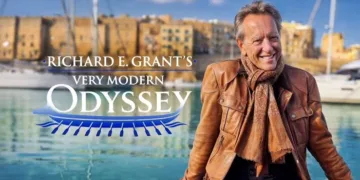


























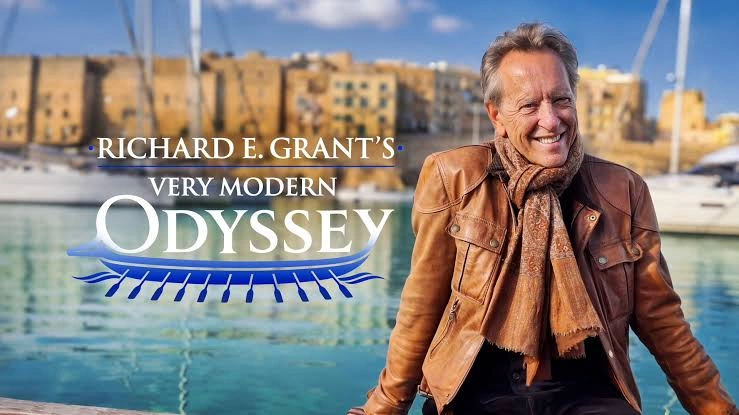

Television has found a dependable way to domesticate history: give a famous person a linen wardrobe, place them beside an ancient ruin, and wait for wonder to happen. Richard E. Grant’s Very Modern Odyssey follows that formula with unusual warmth, sending its host through Mediterranean locations loosely connected to Homer’s poem. Malta, Sicily, Tunisia, Turkey, Corfu, and Ithaca become stops on a four-part itinerary shaped by archaeology, architecture, food, and Grant’s seemingly inexhaustible capacity for delight.
The series makes no serious claim that it can reconstruct Odysseus’s route. Grant readily admits that Homer’s geography belongs partly to imagination, which frees the programme from pretending every cave and coastline carries an authenticated mythical event. This modesty is welcome. Celebrity travel television often presents speculation with the confidence of a museum plaque.
Yet the looseness creates its own problem. Homer’s poem contains war, displacement, sexual coercion, divine punishment, homesickness, and the destruction of entire communities. The programme frequently exchanges that material for comfortable hotels and scenic lunches. Television has discovered a way to turn ten years of suffering into a pleasant Mediterranean break.
A Host in Permanent Rapture
Grant’s presence keeps the format from becoming anonymous. He arrives at Malta’s Grand Harbour already operating at full emotional volume, gesturing toward the waterfront and treating the view like a personal revelation. His reactions could easily feel manufactured, but the camera repeatedly catches something too unguarded for polished presenter behaviour.
At a Michelin-starred restaurant in Valletta, he tastes butter-basted pigeon with sage and rosemary, erupts into approval, and asks chef Clint to marry him. The moment has little connection to Odysseus, unless Homer neglected a chapter about fine dining, yet it shows why Grant works so well in this setting. He meets food, stonework, and historical trivia with the same theatrical gratitude.
His visit to St John’s Co-Cathedral gives that enthusiasm greater substance. Grant walks beneath the gilded Baroque decoration, studies the marble floor covering the tombs of hundreds of knights, and declares that the building “out-Sistines the Sistine Chapel.” The phrase is ridiculous and oddly precise. Faced with Caravaggio’s depiction of the execution of John the Baptist, his performance quietens. He speaks about sacrifice, danger, and the impulse to seek help before facing terror.
That scene gains emotional weight from Grant’s experience of bereavement. The series never turns his widowhood into a narrative device, yet his response to rituals of death and survival carries a gravity missing from the restaurant visits. His voice catches. The presenter briefly gives way to the person.
Myth Reduced to Location
The programme is strongest when it acknowledges the uncertainty surrounding Homer’s world. On Gozo, Grant visits a cave associated with Calypso, the nymph who detained Odysseus for seven years. No evidence can establish the connection, and the series does not pretend otherwise. Grant still finds the place affecting, almost crying as he looks out across the coast. Myth works here as emotional geography rather than verified history.
Elsewhere, that approach produces thin television. The magical force of The Odyssey cannot be recovered by visiting a beach, a tile workshop, or a hotel once favoured by Queen Elizabeth. Grant may trace a possible path through the Mediterranean, but the Cyclops, Circe, the Sirens, and Scylla remain stubbornly unavailable for interviews.
The absence would matter less if the programme used these modern locations to examine the societies occupying them. Malta’s colonial history appears briefly during Grant’s stop at the Phoenicia hotel, then slips away beneath nostalgia for royal glamour. The Mediterranean refugee crisis enters through a historian’s comment near Troy rather than through sustained attention to the region’s present conditions. Climate pressure and political instability are named, then left sitting politely at the edge of the frame.
This is where the series exposes television’s familiar division between cultural accessibility and cultural inquiry. Homer is welcomed as a prestigious brand, while the harder implications of his poem receive limited airtime. Ancient displacement is fascinating. Contemporary displacement might disturb the holiday mood.
Troy and the Limits of Gentleness
At the Bronze Age ruins of Troy, the series comes closest to confronting the violence beneath its itinerary. The site is presented as the probable location of a real conflict later transformed into epic legend. Grant reads from Homer among the ruins, his weathered voice giving the lines the sound of memory carried across centuries.
The programme describes the Trojan Horse as a military masterstroke, accepting the heroic tradition without pressing against it. Such language turns deception and mass killing into strategic cleverness. Recent popular interpretations of the story have encouraged audiences to reconsider Troy from the perspective of those inside the walls, yet this series remains attached to the victorious version.
Grant’s curiosity keeps the episode humane. He listens closely to local historians and responds sincerely when one connects Homer’s poem to refugees, environmental crisis, and political disorder. The exchange hints at a richer programme, one that might ask who gets remembered as a traveller, who gets labelled an invader, and whose suffering becomes mythology.
The production itself carried traces of physical endurance: cancelled flights, missing camera equipment, long ferry journeys, and a 29-hour stretch involving planes and minibuses. These difficulties lend Grant’s comments about survival a small comic echo, yet the series never mistakes inconvenience for Odyssean hardship. Its hero returns each evening to clean sheets and room service. Homer would have killed for the booking agent.
Richard E. Grant’s Very Modern Odyssey premiered on Channel 4 on August 2, 2026, and is available for streaming via the Channel 4 platform. The documentary series follows the charismatic actor as he travels across the Mediterranean to explore the timeless locations and literary landscapes that inspired Homer’s epic poem.
Full Credits
Title: Richard E. Grant’s Very Modern Odyssey
Distributor: Channel 4
Release date: August 2, 2026
Running time: 60 minutes
Cast: Richard E. Grant, Carol Drinkwater
The Review
Richard E. Grant’s Very Modern Odyssey
Richard E. Grant’s Very Modern Odyssey turns Homer into genial Sunday-night television, trading textual depth for churches, meals, ruins, and one host’s inexhaustible delight. Grant gives the series warmth, especially when St John’s Co-Cathedral and Calypso’s supposed cave move him beyond polished presenter patter. Yet the programme rarely connects modern Mediterranean life to the displacement, violence, and political instability it briefly invokes. Television has rediscovered Homer, then sent him on a luxury minibreak. Grant remains wonderful company, which carries the series farther than its analysis ever travels.
PROS
- Grant’s infectious curiosity
- Beautiful Mediterranean locations
- Sincere encounters with history
- Accessible treatment of Homeric myth
CONS
- Limited literary analysis
- Loose connection to the poem
- Social themes left underexplored
- Familiar celebrity-travel format