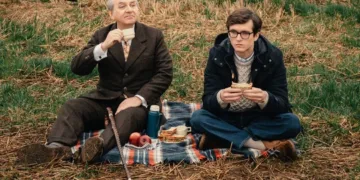





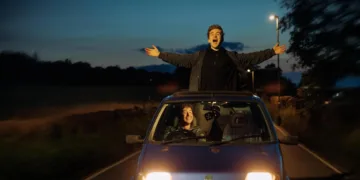







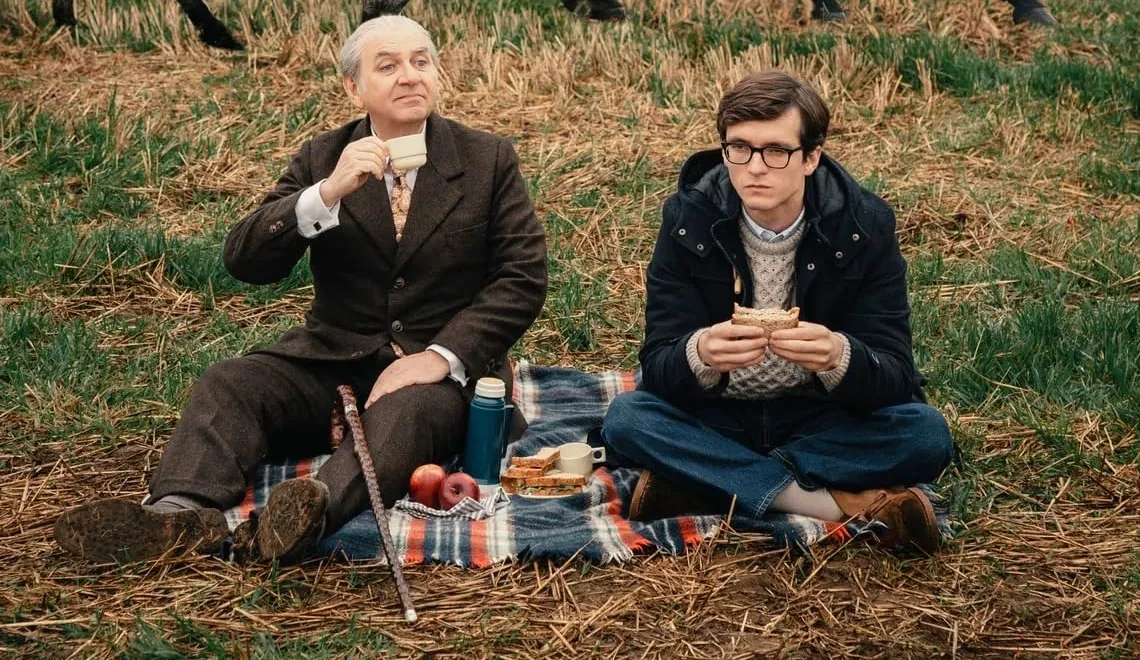

Jay Parini arrives at St Andrews in 1971 carrying the kind of ambition that has no practical shape yet. He wants to become a poet, which his academic surroundings regard with roughly the same enthusiasm they might reserve for an unexploded shell. His supervisor, Alastair Reid, prefers scholarship to aspiration. Parini, meanwhile, is haunted by cassette recordings from his younger brother Billy, serving in Vietnam after a decision Parini fears he helped encourage. Then Jorge Luis Borges enters his life.
Marc Turtletaub’s Borges and Me, adapted from Parini’s embellished memoir, understands the strange imbalance of this encounter. Parini barely appreciates the literary giant placed in his care. Borges, 72 and blind, depends upon this uncertain young man to move through Scotland. One is searching desperately for someone who can teach him how to become a writer. The other has already become so thoroughly identified with writing that separating the man from the reputation has grown difficult.
The Man Performing Borges
Luis Gnecco plays Borges as someone perpetually halfway between sage and troublesome child. He tells the nervous Parini to speak louder because he is blind, licks the leather binding of an Encyclopedia Britannica because some books ought to be tasted, then urinates outside while his unwilling companion suffers the social consequences. Gnecco gives each act a faint ceremonial quality, as though Borges has spent decades learning how eccentricity can become its own language.
There is calculation inside the charm. Borges has learned to rely upon translators, hosts and strangers, and his blindness makes that reliance unavoidable. His fame complicates it further. People do not merely help him. They submit to the privilege of helping him.
Gnecco understands this without turning Borges cruel. His upward gaze never becomes an actorly shortcut for blindness. His dependence can seem manipulative in one scene, painfully exposed in the next. When Borges asks Parini about his romantic life, the conversation briefly strips away the practiced aphorisms. Regret appears. So does loneliness.
Also Read





The title points toward Borges’ own “Borges and I,” a piece concerned with the distance between private self and public author. Turtletaub keeps returning to that divide through Gnecco’s performance. Borges seems to be acting as Borges because perhaps, after so many years, there is no clean way to stop.
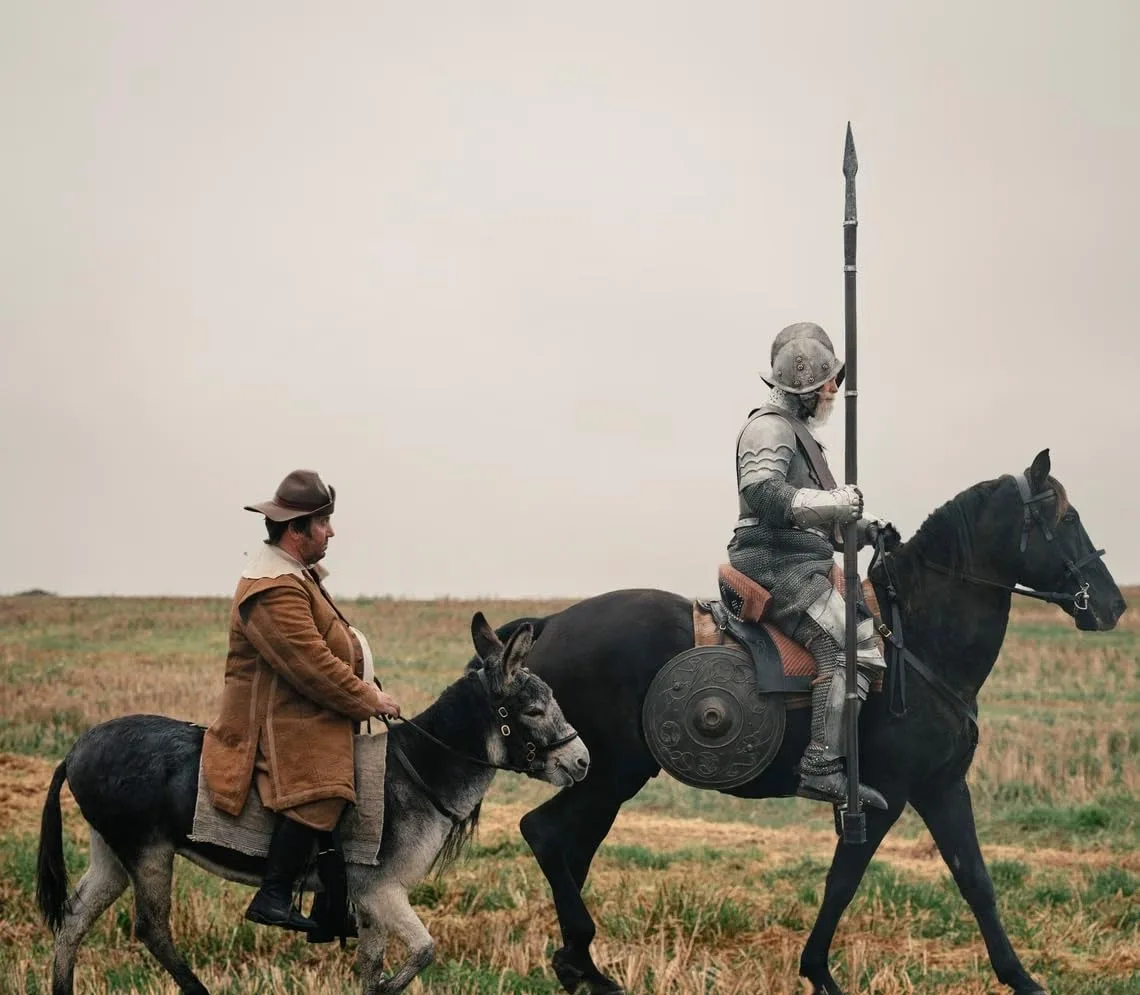
Parini becomes his Sancho Panza, a comparison the film eventually makes literal through visions of Don Quixote and his companion. The joke contains something melancholy. Borges can summon imaginary figures from literature with ease. Ordinary intimacy proves harder.
Poets on the Road
Blindness gives the Scottish road trip its most beautiful premise. Borges asks Parini to describe the Highlands to him, turning landscape into language before it can become experience. The arrangement should place the film comfortably inside Borges’ own fascination with unstable reality. Sometimes it does. Sometimes it produces Borges falling into Loch Ness.
The sequence has a cheerful absurdity. Borges wants to be rowed onto the water so he can commune with the presence of the monster, falls in, is rescued, then appears comfortably drying himself later. Since Parini’s memoir openly plays with invention, implausibility belongs to the material. Still, the scene exposes a persistent tension. The film likes the idea of reality becoming fiction, yet its filmmaking rarely becomes strange enough to make that transformation feel dangerous.
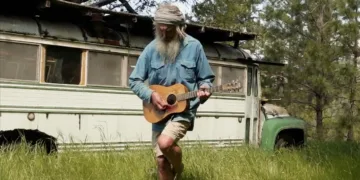
Peter Mullan’s George Mackay Brown supplies a quieter variation on literary mythology. Parini travels toward Orkney intending to interview the reclusive poet for his doctoral work. Brown speaks of beer, admits that he lives excessively inside his own head, and calls a poem the next best thing to silence. Mullan barely pushes. His restraint makes Brown feel resistant to the grand mythology surrounding writers.
Borges and Brown never meet, which initially feels like a peculiar dramatic refusal. It becomes oddly appropriate. Parini is moving through incompatible models of authorship rather than collecting masters for one neat lesson. Reid represents literature examined from a university desk. Brown distrusts artistic mythology. Borges behaves as if literature and existence are already hopelessly entangled.
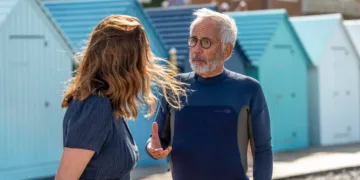
The film loses some of its pulse when Borges disappears for a stretch and Parini grows close to a poetry-loving hotel worker played by Freya Mavor. Their connection has warmth, yet removing Gnecco leaves a noticeable hollow space. Perhaps absence is the first lesson Borges teaches without intending to.
Ghosts at Culloden
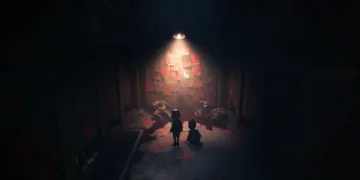
The visit to Culloden battlefield finally allows Turtletaub’s direction to think in something approaching Borges’ language. Parini brings Borges to the site of the 1746 battle, and the dead seem to rise through imagination. History ceases to behave like a completed event. The battlefield becomes memory, story and present tense at once.
It is a brief rupture in a film that often prefers discussing metaphysical ideas to embodying them. Here, the boundary softens. Borges cannot see the field before him, yet he appears to perceive something Parini cannot. Sight becomes the less interesting form of vision.
That distinction has been waiting beneath the road trip all along. Parini keeps looking for someone who can explain how a writer is made. Borges offers no usable curriculum. He urinates beside libraries, chases monsters he cannot see, invokes fictional knights and listens for armies buried beneath Scottish soil. The lesson, if it can be called one, arrives as a ghost story. A writer may begin by seeing what is there. Borges is interested in what remains after seeing has failed.
Borges and Me is a 2026 film that portrays a road trip through Scotland in 1971, where American writer Jay Parini is tasked with escorting the blind Argentinian literary giant Jorge Luis Borges to Orkney. The story depicts their shared journey, delving into themes of mentorship and creativity while balancing the distinctive outlooks of Borges and the poet George Mackay Brown.
Full Credits
Title: Borges and Me
Release date: 2026
Running time: 105 minutes
Director: Marc Turtletaub
Writers: Jay Parini, Marc Turtletaub
Cast: F. Murray Abraham, Jack Davenport, James Norton, Bill Paterson, Calam Lynch
The Review
Borges and Me
Borges and Me finds its deepest feeling in the distance between the person and the legend. Luis Gnecco gives Borges mischief, vanity, dependency and a quiet loneliness that emerges whenever the performance of genius briefly slips. The Scottish road trip sometimes wanders with less purpose, especially once Borges disappears from Parini’s side, yet Culloden finally gives the film an image worthy of his imagination: history becoming present through belief. It is an affectionate, thoughtful literary film that occasionally describes wonder where it should create it.
PROS
- Luis Gnecco’s layered Borges
- Warm Parini-Borges chemistry
- Peter Mullan’s understated turn
- Memorable Culloden sequence
- Playful literary ideas
CONS
- Midpoint loses momentum
- Borges vanishes for too long
- Loch Ness episode strains credibility
- Literary imagination often stays verbal