





























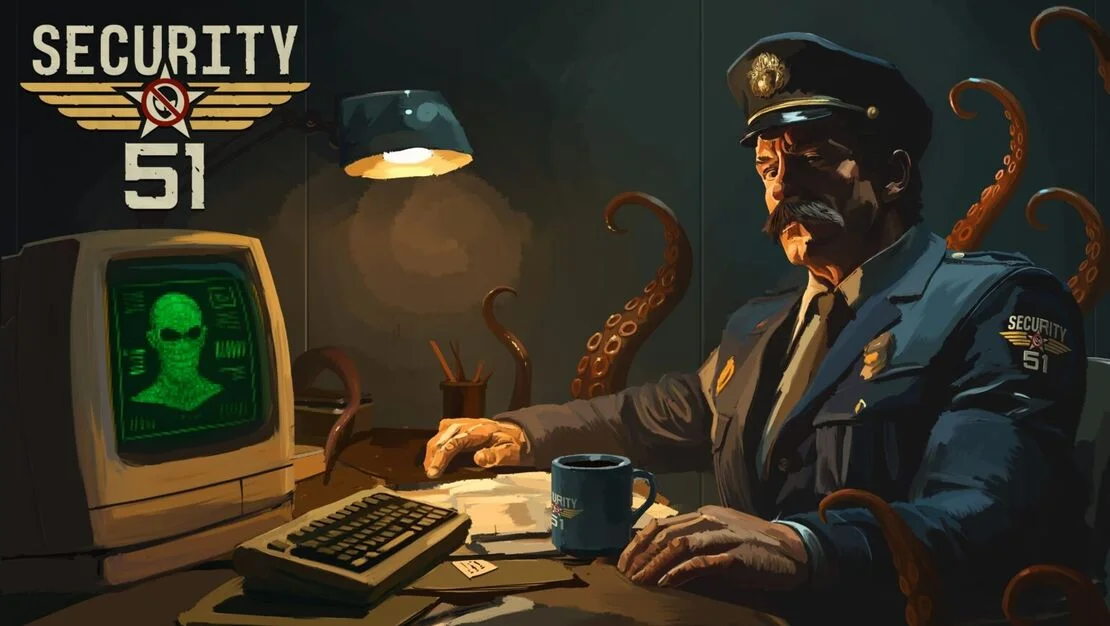

Checkpoint games usually become harder by asking you to remember increasingly ridiculous quantities of information. Security 51 takes a smarter route. One day might require an X-ray scan, a blood-type check, and confirmation of a name and employee number. The next might throw most of that away and replace it with a personality test plus a fresh directive from management. The workload stays readable while the variables keep changing.
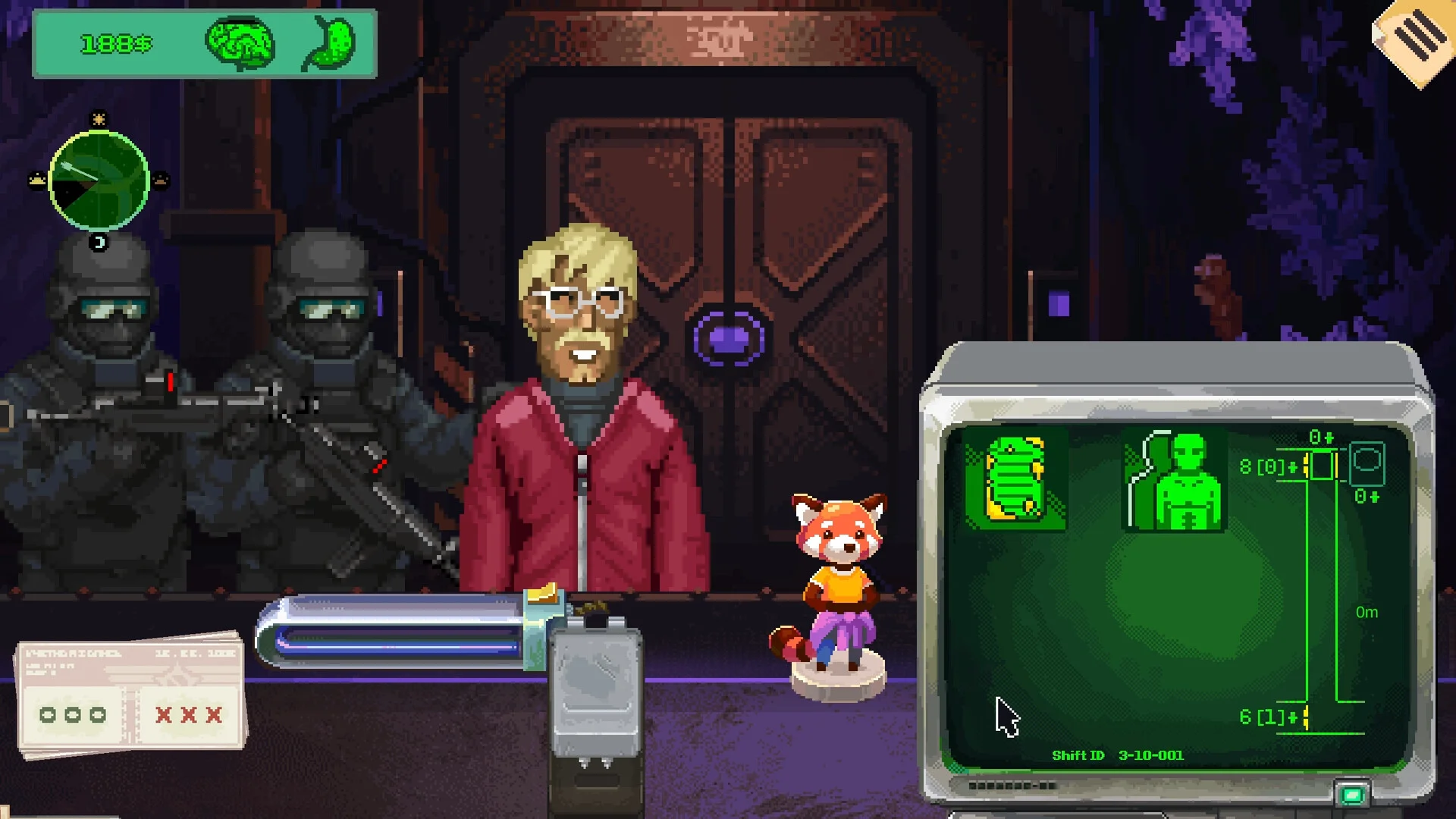
That approach immediately distinguishes Alawar’s Area 51 bureaucracy simulator from the harsher descendants of Papers, Please. You play a security guard stationed beside an elevator descending into a classified underground facility, deciding who enters, who leaves, who gets detained, and who gets introduced to the armed response team. The paperwork is familiar.
The employee with two hearts is less so. Very quickly, the job expands from checking identification into screening people for infections, mutations, abnormal organs, strange temperatures, and whatever new catastrophe the facility has created this week.
Four Rules Are Plenty
The best design decision in Security 51 is its refusal to confuse quantity with complexity. Most shifts revolve around three or four requirements. That sounds simple until those requirements begin changing every day. An X-ray machine can reveal unusual bones or organs.
Blood tests introduce another layer of verification. Thermal equipment catches suspicious body temperatures. Other procedures look for mutations or psychological irregularities. Daily orders then complicate those systems with exceptions: somebody matching one condition may have to be admitted regardless of another problem, while another characteristic can trigger immediate extermination.
Compared with checkpoint games that hide failure inside a microscopic typo on page four of a manual, this structure feels refreshingly clean. You still need to pay attention, yet the challenge comes from learning a different combination of tools rather than dragging yesterday’s entire checklist into tomorrow.
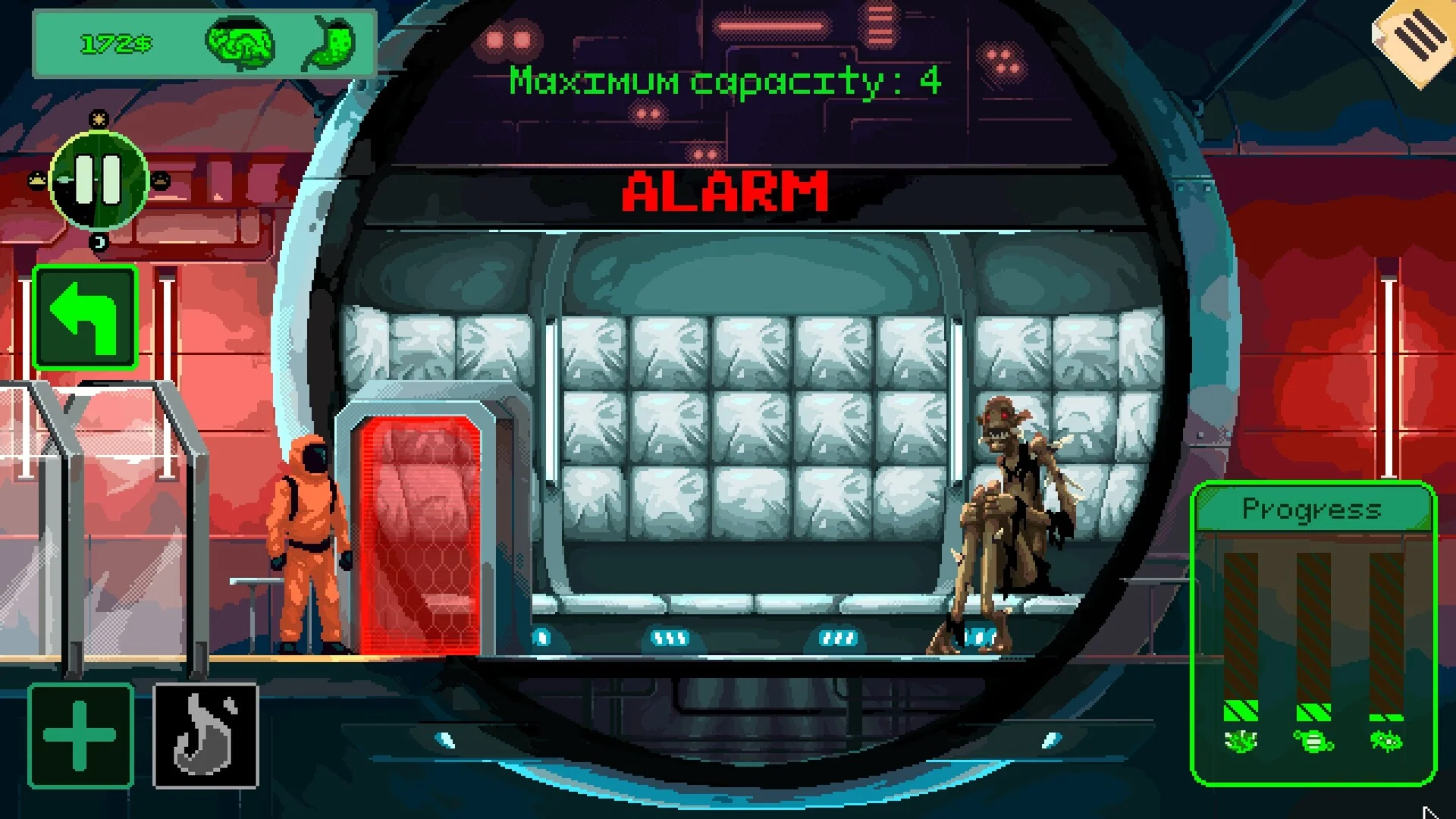
The responsibilities keep spreading. Employees returning from the lower levels need inspection for contamination. Detained subjects can be placed inside isolation cells and subjected to experiments, including the wonderfully scientific procedure of exposing somebody to a rubber duck. Research generated through these activities feeds into attempts to counter the current threat.
There are difficulty spikes once enough protocols accumulate, but Security 51 rarely turns its desk into homework. For players raised on the genre’s nastier examples, that may make the roughly 29-day first run feel forgiving. For everyone else, it makes four hours of document checking surprisingly easy to keep playing.
The Apocalypse Has Branches
The broader campaign gives that daily routine an amusing cyclical structure. The first phase asks you to develop technology capable of stopping an unknown threat. The second makes you confront a new disaster connected to what you created. Survive long enough and saving humanity eventually unlocks a time-loop structure, allowing another run through alternate routes.
There are consequences attached to performance. Failed checks can contribute to infection, research mistakes can damage attempts at finding solutions, and earlier decisions may return later as larger security problems. Yet this is where Security 51 compares poorly with the games whose framework it inherits.
Papers, Please made a stamped passport meaningful because the person holding it could become part of a human story. Security 51 rarely gives its visitors that opportunity. There is no substantial home segment, no family waiting after the shift, and almost no supporting cast beyond the superior who teaches you how the job works. The person being scanned is usually a puzzle before they are a character.
That creates a peculiar imbalance. The simulation remembers enough of your mistakes to punish them, but the fiction rarely gives those mistakes emotional texture. Watching an infection meter rise matters mechanically. Remembering the individual responsible for that rise would have mattered differently.
Alternate apocalypse routes suffer from a related problem. Threats and visual details change, yet the underlying work can remain close enough that another playthrough depends heavily on how much you enjoy the inspection loop itself.
Monsters Behind the Glass
Fortunately, staring at that checkpoint is rarely unpleasant. The pixel art is excellent at turning small abnormalities into unsettling discoveries. Skin distortions, impossible anatomy, infected employees, and other cosmic oddities become increasingly grotesque without compromising the visual readability needed for inspection.
Short day-opening animations reveal a playful side too. The guard stacks a Jenga tower, mishandles coffee, falls from his chair, and generally behaves like someone trying to survive the world’s strangest dead-end job. These scenes are brief and skippable, which is exactly the right amount of personality for recurring interludes.
The soundscape supports the confinement: elevator machinery, scanner noises, industrial ambience, and dark electronic music keep the underground facility oppressive while leaving enough space for concentration.
Some secondary systems never justify their presence quite so well. Hunger and sanity can kill you if either reaches zero, yet inexpensive supplies make both easy to maintain. Tool upgrades demand substantial portions of several days’ salary for benefits that can feel tiny, particularly when tomorrow’s protocols might require another device entirely.
The newspaper is the clearest missed opportunity. A daily paper sitting beside a desk in a world facing alien infection should be an elegant way to show consequences beyond the bunker. Instead, its headlines can feel disconnected from the crisis and from the choices made during previous shifts.
Security 51 keeps finding clever things for your hands to do. Scan this body. Compare that badge. Detain this anomaly. Test that prisoner. The machinery is consistently entertaining. The people caught inside it deserved the same attention.
The Review
Security 51
Security 51 understands why checkpoint games work mechanically, then leaves part of their narrative power sitting outside the bunker. Its rotating protocols, X-rays, blood tests, anomaly scans, containment experiments, and shifting threats keep each workday fresher than the increasingly dense rulebooks used by many Papers, Please descendants. The weaker link is consequence. Infection systems and research paths react to mistakes, yet individual people rarely become memorable enough for those decisions to sting. Strong pixel art and a compact campaign make the loop easy to enjoy, even when the world around it feels thinner than the machinery running it.
PROS
- Constantly changing inspection rules
- Excellent pixel-art anomalies
- Manageable mechanical complexity
- Strong checkpoint atmosphere
- Compact first playthrough
CONS
- Thin character interaction
- Limited emotional consequences
- Underused newspaper system
- Weak hunger and sanity pressure
- Expensive, minor upgrades