




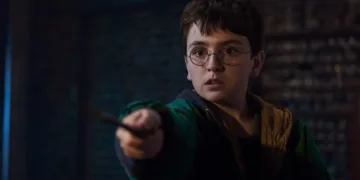
















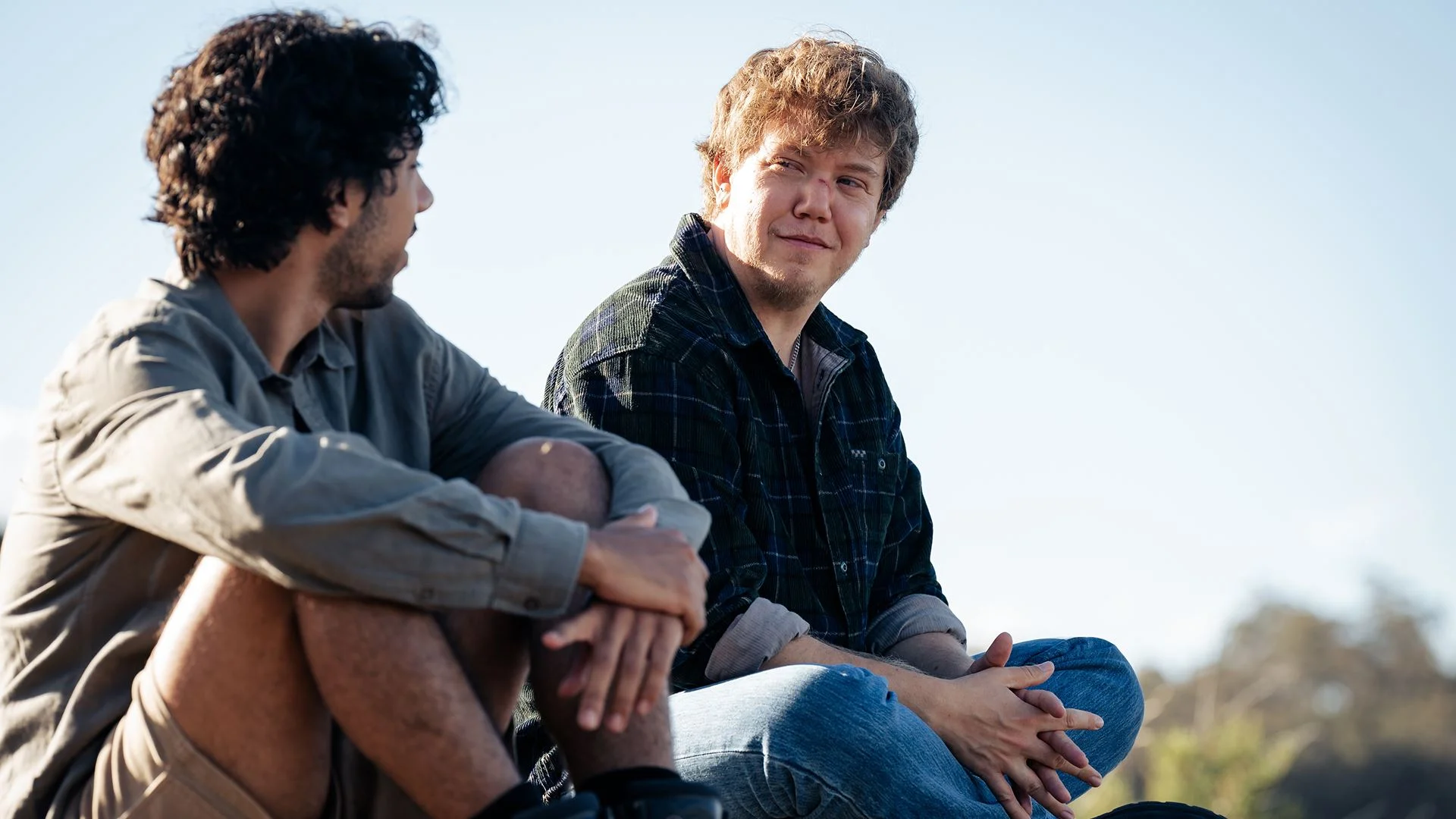

Jake returns to regional Victoria carrying a strange privilege: his dying father finally seems ready to love him, provided he remains someone else. Harvey Zielinski builds Sweet Milk Lake around that wound. Jake has come to see Lee after years of estrangement, yet when Lee mistakes him for his twin brother Sam, Jake lets the error survive. One hesitation becomes an entire borrowed life.
The deception matters because Jake has already spent the film being told who he should be. At dinner in Melbourne, his mother deadnames him while Sam pushes the possibility of joining his real estate business. Later, outside Lee’s house, Mark recognizes the face but attaches the wrong history to it. Jake barely has time to decide what he wants before other people have decided for him.
Zielinski, who also writes and directs, plays Jake, Sam, and Jake’s increasingly confident imitation of Sam. The distinctions are carried through posture and rhythm. Jake initially folds inward during conversations, while his version of Sam takes up space with an ease that seems intoxicating. The tragedy is quiet: pretending gives Jake access to a masculinity he should never have needed permission to inhabit.
Borrowed Masculinity
Fishing, cliff diving, beers, video games and a fight outside the pub gradually turn Jake’s lie into something emotionally dangerous. These activities once belonged to Sam’s history with Lee and Mark. Jake now enters them like someone discovering rooms inside his own childhood that were locked when he lived there.
The lake sequence is especially revealing. Michael Lincoln photographs the landscape with an openness absent from Jake’s family interiors, and the dive offers a brief release from explanation. Jake can simply move through the water. No one asks him to account for his body, his name or his past. Then Mark starts remembering too much.
David Howell gives Mark a comic instability from his first appearance, wandering around in his underwear and smoking before enthusiastically welcoming the man he believes is his old friend. That humor acquires teeth once he notices holes in Jake’s memories of Sam. A barbecue involving archery carries the same nervous duality. Men laugh, drink and perform familiarity while the possibility of violence remains somewhere inside the frame.
The premise sometimes asks for an uncomfortable amount of credulity. An entire community accepting Jake as Sam without greater scrutiny weakens the pressure that the film otherwise constructs so carefully. Yet the emotional logic remains persuasive because Jake begins enjoying the mistake. His disguise becomes less about fooling Lee and closer to testing another version of existence.
What Lee Cannot See
Kieran Darcy-Smith gives Lee his best moments when illness strips away the habits that once protected him from remorse. During one conversation, he admits that he left, regretted leaving, and then discovered he had “ran out of time” to repair what followed. He believes he is confessing to Sam. Jake listens as the son who was never meant to hear it.
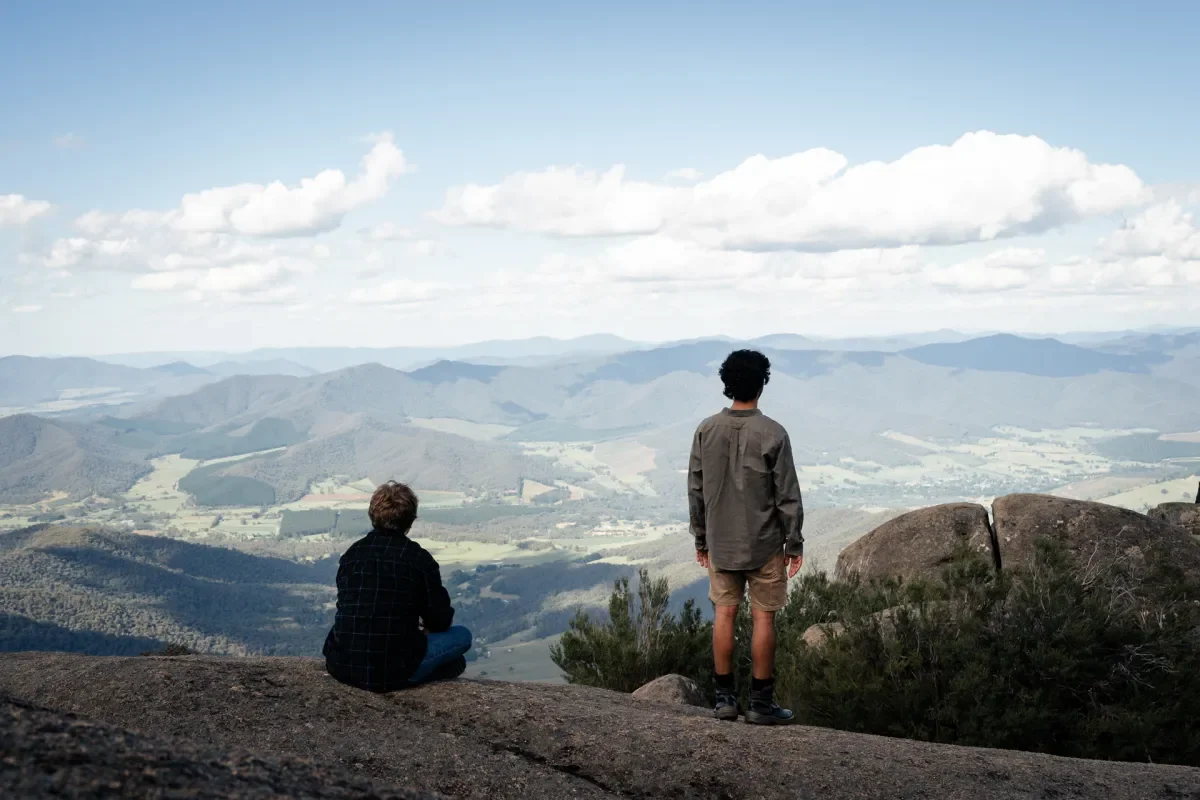
That displacement gives ordinary dialogue an almost unbearable sadness. Lee tells Jake that his two children “couldn’t be more different,” unaware that he is speaking to the very child whose difference he failed to know. The line does not require dramatic music or an explanatory reaction. Zielinski lets the misunderstanding remain between them like an empty chair neither man acknowledges.
Some supporting characters receive far less patience. Jake’s mother appears briefly as a blunt source of rejection, and her movement toward acceptance lacks the careful progression afforded to Lee. Certain later turns lean toward soapier emotional machinery when the film is strongest in smaller acts of avoidance, regret and accidental tenderness.
Lee’s approaching death gives every conversation a clock. Jake can reveal himself and risk destroying what has appeared between them, or preserve a relationship founded on mistaken identity. Neither possibility offers anything resembling clean mercy.
Toby and the Fear of Being Known
Hunter Page-Lochard’s Toby enters with an energy Jake cannot counterfeit. After a closeted hookup fails to arrive, he and Jake share wine beside the motel pool. Toby flirts freely, complains about false performances, and gradually draws Jake toward a kind of intimacy that does not belong to Sam.
Their later encounter in Jake’s room brings the film’s anxieties into the body. Attraction is obvious, yet Jake stops when undressing would require a form of disclosure he is not ready to give. Zielinski holds on the discomfort instead of turning the scene into a speech about identity. Desire and fear occupy the same bed.
This is also where the film’s central device becomes ethically uneasy. Trans stories have long been burdened with narratives that frame disclosure as a debt owed to others, with danger waiting behind the unpaid account. Sweet Milk Lake brushes against that history whenever suspense depends on Jake being discovered. The later threat of violence makes that inheritance impossible to ignore.
Still, Zielinski repeatedly finds gentler images outside that machinery. Rain catches the streetlights around Jake’s bloodied face. Toby watches him with concern rather than interrogation. The regional landscape remains vast around a man whose life has been made painfully small by other people’s definitions.
Jake came home because his father was dying. What he finds is another kind of disappearance: the terrifying ease with which people can love the face before them while failing to see the person living behind it.
Sweet Milk Lake premiered at the Melbourne International Film Festival on August 8, 2026, and is scheduled for a national theatrical release in Australia via CinemaPlus. The Australian drama follows a soft-spoken trans man who visits his terminally ill estranged father, only to be mistaken for his cisgender twin brother, prompting him to embrace the lie to experience a boyhood he was previously denied.
Full Credits
Title: Sweet Milk Lake
Distributor: CinemaPlus
Release date: August 8, 2026
Rating: MA 15+ / Unclassified 15+
Running time: 1 hour 34 minutes
Director: Harvey Zielinski, Rhys Graham
Writers: Harvey Zielinski
Producers and Executive Producers: Philippa Campey, Molly O’Connor, Harvey Zielinski, Rosie Lourde
Cast: Harvey Zielinski, Hunter Page-Lochard, Kieran Darcy-Smith, Nic Cassim, Mia Morrissey, Ngaire Pigram, David Howell, Belinda McClory
Director of Photography (Cinematographer): Michael Lincoln
Editors: Maria Papoutsis
Composer: Chiara Costanza
The Review
Sweet Milk Lake
Sweet Milk Lake finds its deepest ache in recognition withheld. Jake is seen constantly, yet rarely as himself, and Harvey Zielinski turns that contradiction into scenes of tenderness, humor, fear, and quiet cruelty. The mistaken-identity conceit occasionally strains credibility, while several supporting characters feel thinner than the emotions surrounding them. Still, the motel intimacy with Toby, Lee’s regretful confession, and Jake’s uneasy return to male rituals give the film a lingering sadness. Here, home is familiar ground occupied by strangers who remember the wrong person.
PROS
- Zielinski’s layered lead performance
- Tender Jake and Toby chemistry
- Strong regional Victorian imagery
- Quietly painful father-son scenes
- Effective tonal shifts
CONS
- Uneven supporting characters
- Some forced humor
- Credibility issues around mistaken identity
- Familiar disclosure tension