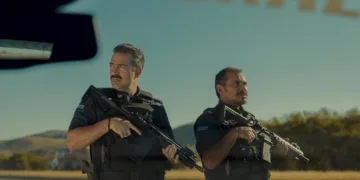






























A routine stolen-car stop becomes absurdly dangerous the moment Arturo Carmona and Héctor Rosales realize who is sitting in front of them. Joaquín Guzmán Loera, El Chapo, has escaped a Marine operation and somehow landed in the custody of two federal officers who were expecting an ordinary patrol. Their problem is no longer making an arrest. It is surviving long enough to hand him over.
Chava Cartas builds Facing El Chapo around that remarkable episode from El Chapo’s January 2016 recapture, with Bernardo Esquinca and Héctor de Mauleón’s screenplay concentrating on Carmona and Rosales rather than turning the drug lord into the protagonist. Alfonso Herrera plays Carmona, Noé Hernández is Rosales, and Héctor Kotsifakis takes on El Chapo.
That perspective is a smart choice. The famous criminal already arrives with a reputation large enough to fill the room. The officers are the ones who need establishing, because every decision depends on what these relatively ordinary men are prepared to risk. The film’s frustrating habit is giving those decisions less room to breathe than they deserve.
Money, Loyalty and Two Underwritten Cops
Carmona’s home life initially looks like the screenplay’s route into its moral conflict. His wife, Isaura, is pregnant with their third child, bills are piling up, and he accepts additional night work because the family needs money. Then El Chapo enters the picture with access to the kind of wealth that could erase those problems instantly. The setup practically begs the film to make corruption feel seductive. It rarely does.
Herrera plays Carmona with admirable restraint, especially once the arrest turns his financial problems into potential leverage. He keeps the officer serious and controlled rather than announcing every fear through dialogue or visible panic. The script gives him limited material beneath that surface, though. We know Carmona loves his family, worries about money and believes in doing his job. Once El Chapo’s offer appears, those pieces should collide. Instead, the temptation passes surprisingly quickly.
Rosales initially gives the story a sharper uncertainty. He is new to the area and has only recently been partnered with Carmona, so their early friction carries an obvious question: can Carmona trust the man beside him once cartel money and cartel threats arrive?
Hernández makes that suspicion work through the guarded relationship between the officers. They are learning each other’s limits while dealing with a prisoner who specializes in finding weaknesses. Once Rosales’ loyalty becomes clear, the screenplay largely closes that door. A thriller about compromised institutions suddenly becomes very sure about its heroes. That certainty costs it pressure.
El Chapo in a Hotel
The strangest detail in the story is also its best suspense device. Carmona and Rosales end up holding El Chapo at a hotel while waiting for military support. It sounds like something a screenwriter would invent after rejecting several sensible options. It happened.
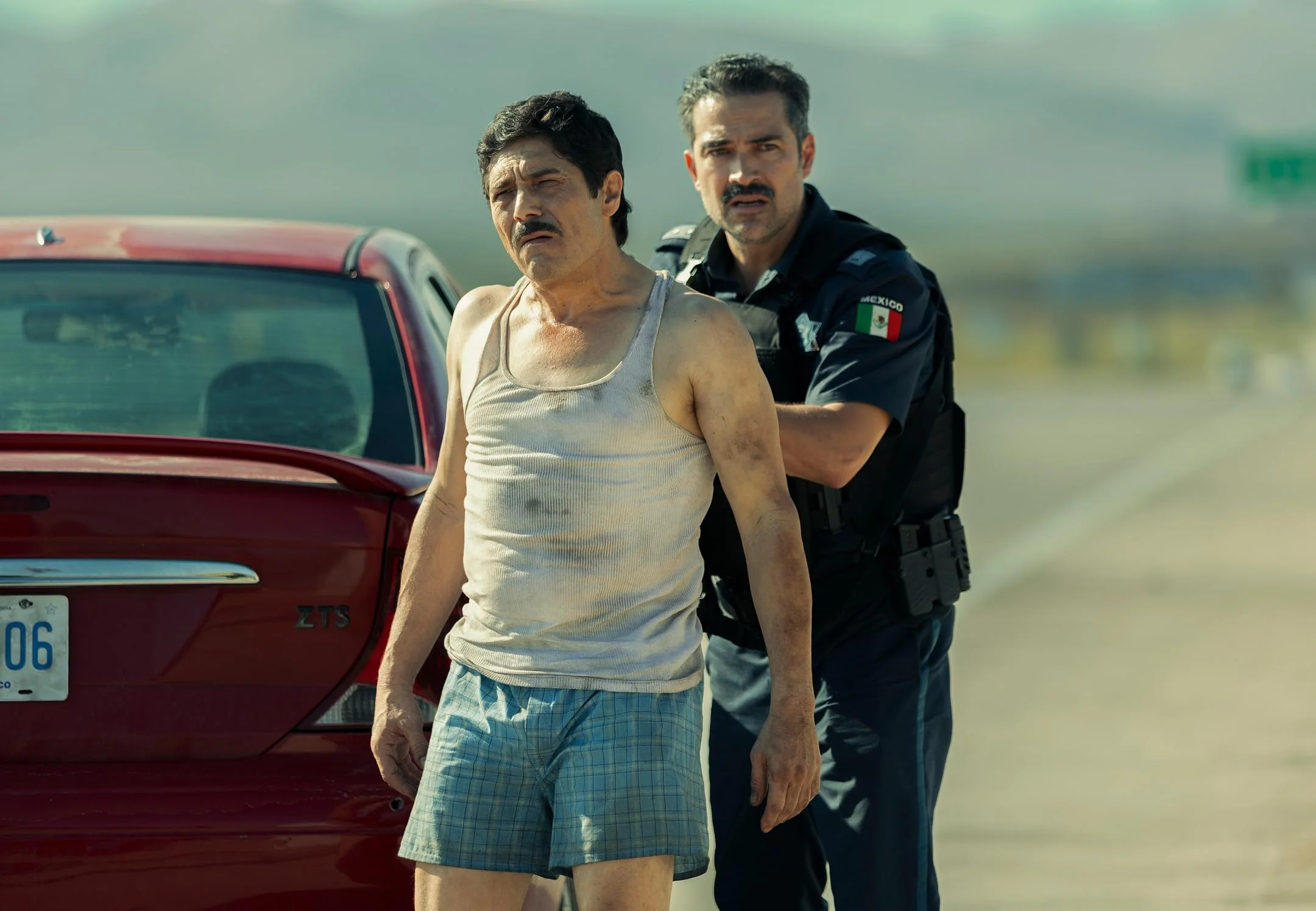
Cartas understands why the location is useful. A conventional police facility would provide walls, procedure and some expectation of institutional control. The hotel gives the officers almost none of that security. They have an internationally notorious prisoner in temporary custody while reports suggest dozens of vehicles may already be searching for him.
Kotsifakis is particularly effective here because he does not play El Chapo as an invincible crime-movie emperor. His primary weapon is certainty. He threatens Carmona and Rosales with the knowledge that his organization can reach beyond the immediate room and into their lives. Then that certainty cracks.
Those flashes of fear are important. El Chapo knows his name commands obedience, yet being famous does not make him bulletproof. Kotsifakis lets the threat and vulnerability coexist, especially as Carmona refuses to surrender control.
The film could push the surrounding danger much harder. Arturo’s response to the potential threat against his family feels oddly limited for a man who knows the reach of the cartel he has just humiliated. The reported vehicles searching for El Chapo should make every passing car, phone call or delay feel poisonous. Instead, the cartel network often exists as information spoken about rather than a presence squeezing the hotel from outside.
Restraint Has a Price
Cartas resists the obvious temptation to transform the story into a running gun battle. I like that instinct. Cartel members are dangerous because violence remains possible, rather than because somebody needs to fire a weapon every few minutes.
The Marine operation that sends El Chapo into Carmona and Rosales’ path shows how effective that grounded approach can be. A massive manhunt abruptly narrows into two officers trying to control one prisoner while backup remains frustratingly distant. Scale contracts, and the danger becomes personal.
The problem is escalation. Suspense depends on changing the pressure, even when very little physical action occurs. A new piece of information can tighten a scene. So can a failed phone call, a compromised ally, a narrowing escape route or a temptation that becomes harder to refuse. Facing El Chapo has several of those ingredients, yet it often introduces them without allowing them to reshape the situation.
The early family material suffers from the same issue. Spending time with Isaura and the children makes sense because El Chapo’s threats need something personal to target. The film then struggles to convert that setup into sustained anxiety once Carmona has the prisoner.
By the later confrontation and transfer, Cartas has created a believable sense that one wrong decision could end catastrophically. The tension works best whenever the film trusts the peculiar facts of the case: two tired officers, an infamous prisoner, an improvised holding location and help that cannot arrive quickly enough. Every time the screenplay reaches for extra drama without deepening those pressures, reality proves to be the better thriller.
Facing El Chapo (originally titled La captura) premiered globally on Netflix on August 21, 2026. Based on true events surrounding Operation Black Swan, the Mexican crime thriller follows two federal police officers who execute a routine traffic stop on a stolen vehicle, only to find themselves face-to-face with the world’s most notorious drug kingpin, Joaquin “El Chapo” Guzmán.
Where to Watch Facing El Chapo (2026) Online


Full Credits
Title: Facing El Chapo
Distributor: Netflix
Release date: August 21, 2026
Rating: TV-MA
Running time: 1 hour 32 minutes
Director: Chava Cartas
Writers: Bernardo Esquinca
Producers and Executive Producers: Francisco González Compeán, Chava Cartas
Cast: Alfonso Herrera, Noé Hernández, Héctor Kotsifakis, Paola Fernández, Juan Pablo Cruz García
The Review
Facing El Chapo
Facing El Chapo has the ingredients for a nerve-shredding thriller: two ordinary officers, an infamous cartel leader in custody, delayed backup, and the possibility that his people are closing in. Chava Cartas wisely keeps the violence restrained, and Héctor Kotsifakis makes El Chapo’s threats feel dangerous without turning him into a movie monster. The trouble is escalation. Arturo’s debts, Rosales’ uncertain loyalty, and the approaching cartel all promise conflicts the screenplay resolves too quickly. The strange hotel detour remains the film’s strongest pressure cooker.
PROS
- Strong central true-story premise
- Restrained, grounded direction
- Kotsifakis’ controlled intimidation
- Convincing early partner friction
- Effective hotel setup
CONS
- Thin characterization for Arturo
- Moral temptation fades quickly
- Cartel threat feels underused
- Uneven suspense escalation
- Slow early pacing