























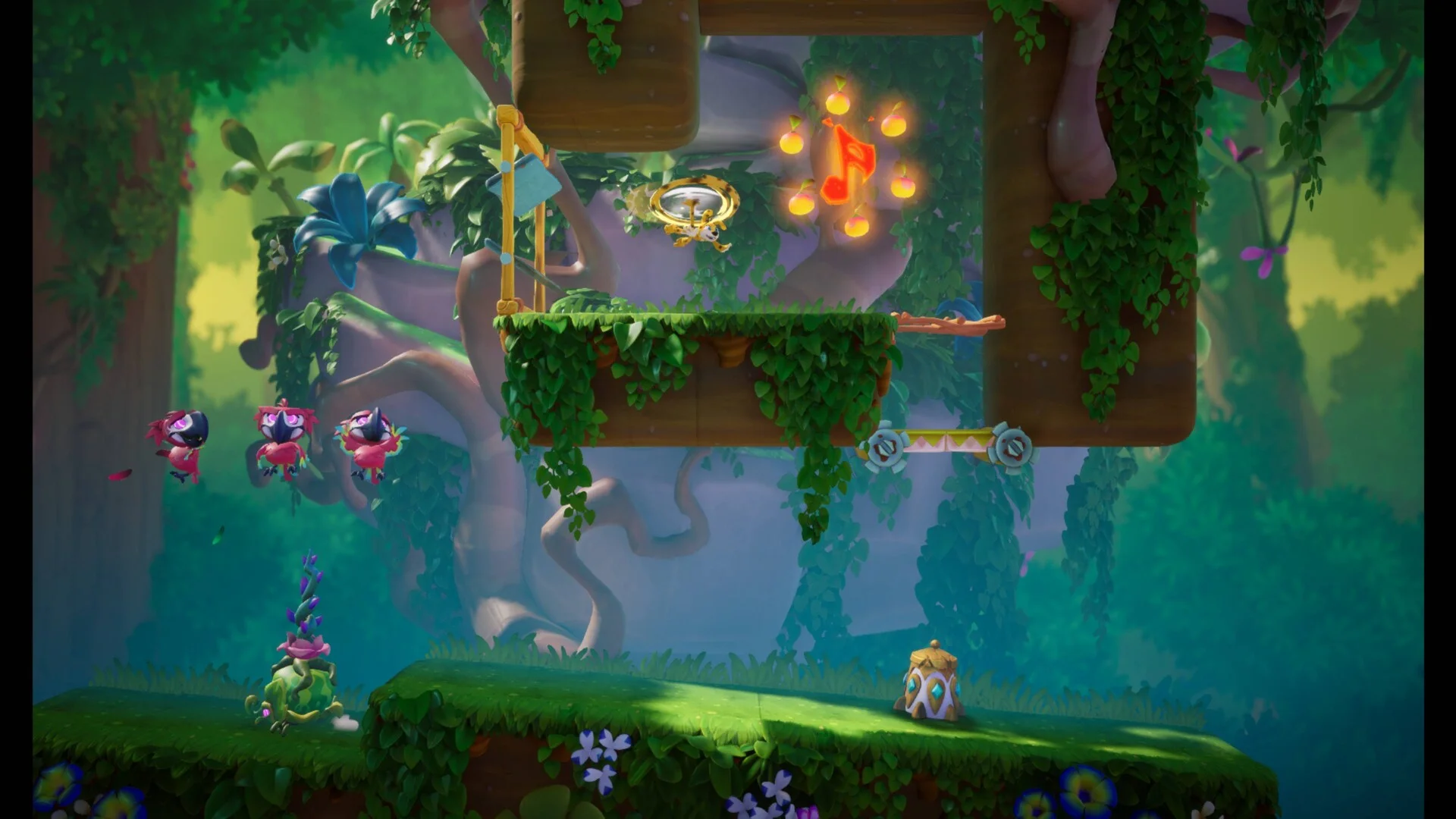

Marsupilami: Hoobadventure succeeded because it understood the appeal of a good 2D platformer without trying to disguise its influences. Its sequel takes the smarter route: keep that foundation, then give the player better reasons to move through it.
Marsupilami 2: Salsa Palombia again sends the Belgian comic-book creature and his friends across Palombia, this time after the Mummy Queen places the land under a musical curse. The story appears when required, then gets out of the way. Punch, Hope, and Twister are the real reason this sequel feels different. Every stage provides two of them, and switching between the pair happens instantly.
There is plenty of familiar DNA here. Barrel-like launches recall Donkey Kong Country, forward momentum carries a little Sonic, and the dense collectible placement has shades of Rayman. The sequel rarely invents a new platforming language. It gets considerable mileage from speaking those old languages fluently.
Swap, Roll, Swing
The biggest improvement over Hoobadventure comes from character-specific movement. Twister can dash through the air and hover during a descent. Hope gains extra height from her jump. Punch curls into a ball, allowing him to bounce across enemies and hazardous surfaces. Those abilities sound basic in isolation. Their value appears when a level asks you to connect them.
A typical sequence might begin with a roll to build speed, continue into a jump toward a vine, then require an airborne character swap so the second Marsupilami can stretch the landing. Since switching happens immediately, the system preserves momentum instead of turning each character ability into a separate puzzle room. You are rarely stopping to select the correct tool. You are incorporating that tool into the movement you already started.
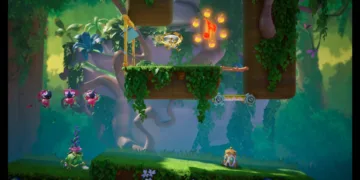
The levels understand this strength. Birds fire you across huge gaps much like the barrels of Donkey Kong Country, while later areas introduce electrified trains, cars that function as trampolines, ice rails, disappearing boats, collapsing buildings, and sections where remaining stationary in the cold causes damage.
One sequence has you racing electrical currents before doors close. Another places trains beneath the platforming route, forcing you to read their timing while maintaining forward speed. Enemy variety does not develop at the same rate. Many encounters exist primarily to interrupt a run or provide another surface to bounce from. The terrain becomes the meaningful opponent.
Fruit, Notes, Dojos, Repeat
That movement system also exposes the sequel’s most persistent problem. The stages are enjoyable to cross once. Completing everything inside them can feel like work. Musical notes gate boss battles, while collected fruit opens extra stages that create further opportunities to find notes. The requirement for reaching bosses is relatively forgiving, with roughly 40 notes needed in an area rather than every available one. Fruit is everywhere, sometimes numbering above 500 in a single stage.
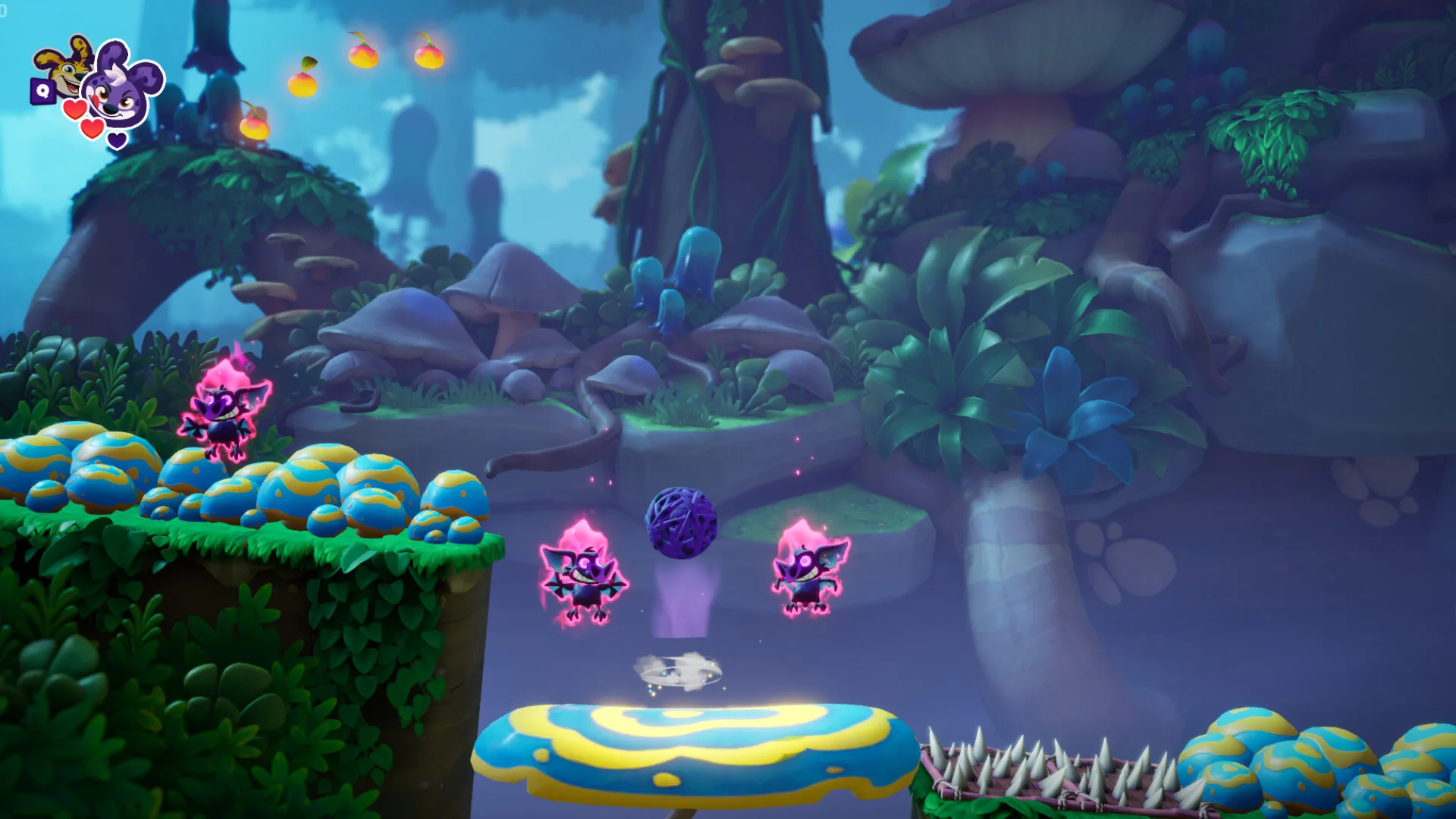
Then come hidden rooms, dojo entrances, optional notes, replay targets, and other secrets. The level design supports exploration, yet the stages are long enough that returning to clean up a missed collectible can turn a pleasant run into an inspection.
Salsa mode is a much better argument for replaying them. Here, previously completed stages become speed challenges in which collecting fruit maintains a multiplier. Hesitate or leave too large a gap between pickups and the multiplier disappears. Suddenly the same geometry serves another purpose. Routes that were previously about careful discovery become tests of efficient movement, and the rolling, jumping, and character swapping gain an urgency closer to old-school Sonic.
The dojos isolate individual skills in smaller challenges. Some ask you to defeat every enemy, collect specific objects, break targets under a timer, or simply survive. Later cups string several dojo trials together. These concise challenges fit the mechanics better than another trip through a lengthy main stage.
Difficulty creates a stranger comparison with the first game. Standard levels remain approachable on normal, helped by generous checkpoints and selectable easy, normal, and hard settings. Bosses can spike sharply above that baseline, particularly the second major fight. Being able to switch difficulty at any point prevents a single encounter from becoming a wall, yet the disparity suggests the boss tuning and stage tuning were developed according to different expectations.
Co-op adds another useful wrinkle. Two players control separate Marsupilamis simultaneously, letting both character abilities operate without constant swapping. Wide spaces usually accommodate this well, though busier sequences can become crowded. Competitive dojo variations expand the idea further with survival contests, object-holding matches, ball-scoring games, and territory challenges.
Palombia in Motion
The sequel also looks considerably livelier once its worlds begin changing around the player. Tropical jungles give way to urban streets, snowy mountainsides, and a carnival-like environment after dark. The strongest sequences pair those visual identities with mechanical changes: trains become moving hazards in the city, ice changes traversal in the mountains, and the carnival gives the game room for roller-coaster spectacle.
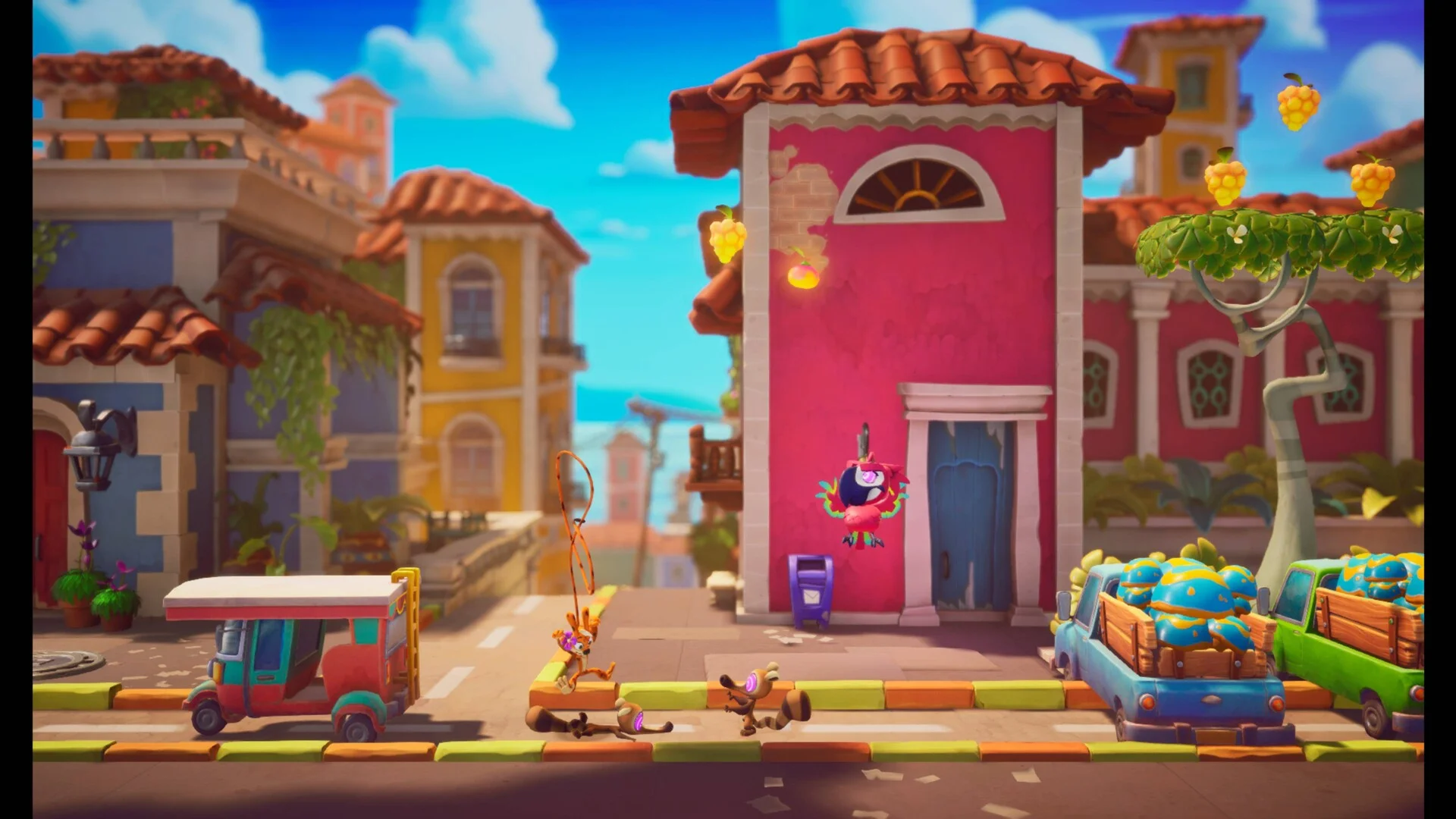
The musical curse provides some personality to the bosses, which adopt styles linked to rock, jazz, electro, and disco. The soundtrack works best during moments where it responds directly to the action rather than sitting behind it.
Platform choice matters visually. Xbox Series X performance has been reported as smooth, while the Switch version, including when played on Switch 2 hardware, suffers from lower resolution and frame rate. Busy, zoomed-out scenes can make characters, breakable floors, and hazards harder to separate from the scenery.
That weakness is particularly unfortunate for a sequel whose best improvement is precision in motion. Hoobadventure established that this series could imitate excellent platformers competently. Salsa Palombia gets closer to understanding why their movement feels so satisfying.
The Review
Marsupilami 2: Salsa Palombia
Marsupilami 2: Salsa Palombia takes the foundation of Hoobadventure and improves the part that mattered most: movement. Punch, Hope, and Twister give stages a flexible rhythm, with character swaps turning rolls, jumps, vines, and aerial tricks into satisfying chains. Salsa mode makes particularly good use of that speed. Long stages, collectible overload, and abrupt boss difficulty spikes keep it from matching the cleanest mascot platformers, while Switch presentation introduces extra visual problems. This is still a confident sequel that understands where its predecessor had room to grow.
PROS
- Fluid character switching
- Excellent momentum-driven platforming
- Varied environmental challenges
- Strong Salsa mode
- Fun cooperative play
CONS
- Excessive collectible hunting
- Uneven boss difficulty
- Limited enemy variety
- Weaker visual clarity on Switch