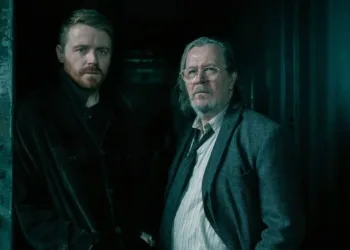



























Yves dressing for an office job he no longer has is the film’s most revealing image because the deception works on two levels at once. He is lying to his children, certainly, but Louis Garrel plays the ritual as something closer to self-preservation. The suit lets Yves inhabit the silhouette of the man he was before redundancy hollowed out his authority.
Olivier Nakache and Éric Toledano place that crisis inside a 1985 Paris suburb where 12-year-old Vincent (Simon Boublil) is preparing for his bar mitzvah, obsessing over classmate Anne-Karine, and trying to decode parents who seem determined to communicate exclusively through argument. His mother Sandrine (Camille Cottin) keeps the household functioning while taking a computer course that might improve her career. Yves watches the balance of power shift in real time.
The film presents these tensions through warm, accessible comedy rather than visual severity. That softness sometimes protects characters from the harsher implications of their behavior. Yet the domestic setting carries its own quiet geometry: Yves retreats, Sandrine moves forward, and Vincent occupies the unstable space between them.
The Weight of Small Disasters
Vincent’s world has its own hierarchy of catastrophe. Anne-Karine barely remembers his name. His Torah passage refuses to settle in his head. He wants the right jacket. Then an adult videotape rented with friends escapes their control and winds up hidden inside a chess box that reaches his rabbi.
Boublil understands that none of these situations should be played with a wink. Vincent treats each problem like a genuine threat to civilization, which is precisely why the comedy works. His expression while scrambling around the missing tape has the contained panic of someone discovering that adulthood might consist largely of hiding evidence.
His bar mitzvah gives the film firmer ground. When Vincent questions how he can be French, Jewish, African, and connected to Arab roots, identity becomes something lived rather than recited. The scene gains force from his age. He is being asked to declare entry into adulthood while still trying to understand the categories adults have handed him.
The episodic plotting is less successful with Arnaud, his older brother. Arnaud’s Cure bootlegs and cultivated teenage indifference give Vincent an object of admiration, yet the character remains largely defined by posture and music. The film can observe adolescent embarrassment with precision. It has less patience for adolescent opacity.
Marriage Under Fluorescent Light
The strongest scenes belong to Sandrine and Yves because their arguments expose a social transition the children can sense without understanding. Sandrine works, studies computers, cooks, and keeps the family moving. Yves hides unemployment behind routine, then bristles as her professional confidence grows.
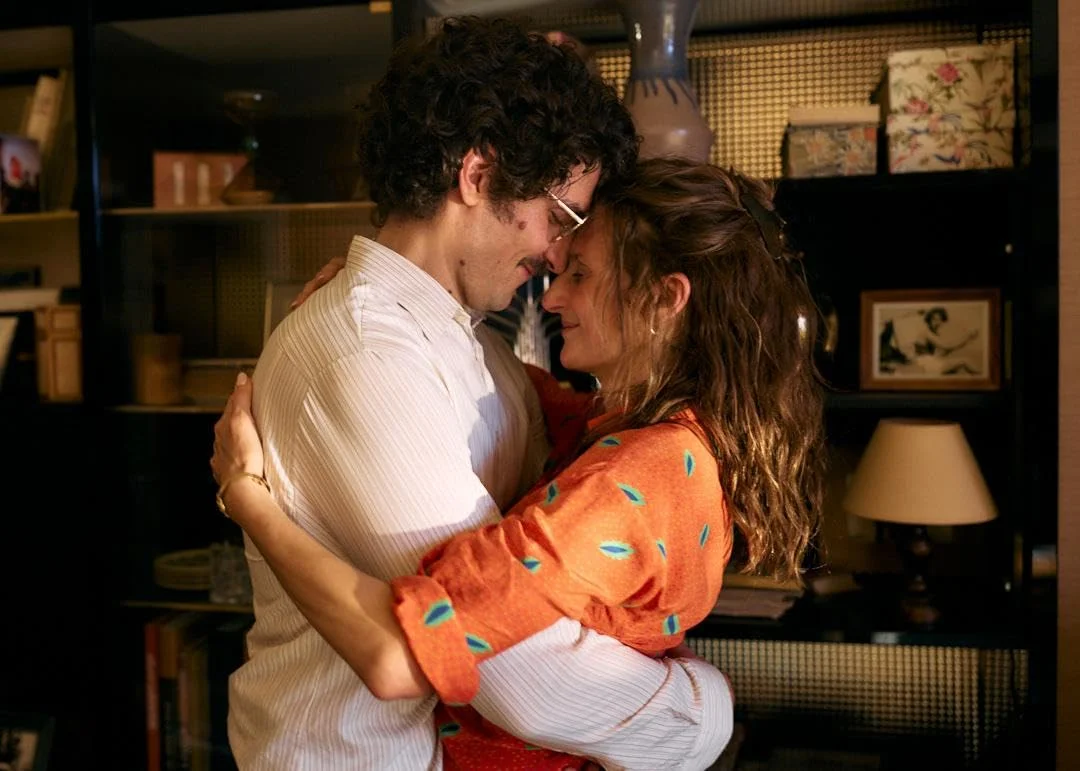
Garrel makes Yves likable enough to complicate judgment. His charm remains intact while his usefulness collapses. Watch what happens when building caretaker Etienne enters the equation. Pierre Lottin plays him with the irritating competence of a man who can repair what Yves cannot, and his interest in Sandrine turns every practical household task into a referendum on masculine worth.
Cottin gives Sandrine sharper edges. Her frustration lands hardest when domestic labor piles onto professional responsibility, because the performance refuses to turn exhaustion into saintliness. Her exchanges with Garrel have speed, familiarity, and the tiny cruelties that couples develop after years of knowing exactly where to press.
Their marriage contains the film’s richest ambiguity. Yves is frightened rather than simply lazy. Sandrine is justified without being endlessly patient. Etienne functions less as a romantic rival than as a visual reminder of competence standing outside the apartment door. That triangle deserves even greater attention than it receives.
The Future in a Box
The enormous IBM computer arriving in the family home is funny because it looks absurdly cumbersome, yet its presence changes the room. Sandrine sees opportunity inside it. Yves, by implication, represents a labor order already beginning to wobble.
Nakache and Toledano build the period through concrete objects and sounds rather than treating 1985 as decorative wallpaper. Video shops matter because the videotape plot depends on them. Free radio and pop music shape the environment Vincent and Arnaud inhabit. Imagination’s “Just an Illusion,” The Pointer Sisters, Francis Cabrel, and New Wave tracks supply a soundtrack to a household caught between inherited roles and emerging possibilities.
The filmmaking stays polished and theatrical, favoring broad comic timing over expressive visual disruption. That choice suits scenes such as the misplaced porn tape, where escalation depends on who has the cassette and who might discover it next. It serves the marriage less well. Yves’s unemployment and Sandrine’s changing position carry enough unease to support harder framing, longer silences, or greater spatial tension than the film permits itself.
Still, the sentimental instinct does not erase the social observation. Vincent watches adults renegotiate work, gender, ethnicity, religion, and authority while assuming his biggest problem is getting Anne-Karine to notice him. From his height, perhaps it is.
The film’s most perceptive gesture arrives when his parents begin listening instead of managing. No grand revelation follows. A boy speaks, two adults finally hear him, and the family’s balance shifts by a few degrees. Sometimes that is how a household avoids detonation.
Just an Illusion was released in French cinemas in April 2026 before expanding internationally. Set in the mid-1980s, the comedy-drama follows a thirteen-year-old French teenager navigating family friction, sibling rivalries, and adolescent daydreams.
Full Credits
Title: Just an Illusion
Distributor: Gaumont, MetFilm
Release date: April 15, 2026 (France) / September 11, 2026 (United Kingdom)
Rating: 12A
Running time: 1 hour 59 minutes
Director: Olivier Nakache, Éric Toledano
Writers: Olivier Nakache, Éric Toledano, Nathalie Hertzberg
Producers and Executive Producers: Olivier Nakache, Éric Toledano, Nicolas Duval Adassovsky, Hervé Ruet
Cast: Louis Garrel, Camille Cottin, Simon Boublil, Pierre Lottin, Alexis Rosenstiehl, Rony Kramer, Giorgia Sinicorni, Augusto Fornari
Director of Photography (Cinematographer): Augustin Barbaroux
Editors: Dorian Rigal-Ansous
Composer: Rob Turner
The Review
Just an Illusion
Just an Illusion finds its sharpest tension in a father dressing each morning for a job he no longer has and a mother studying computers while keeping the household afloat. Vincent’s crushes, bar mitzvah anxiety, and disastrous videotape caper carry real comic warmth, yet Yves and Sandrine repeatedly steal the frame. Louis Garrel and Camille Cottin turn unemployment, pride, and changing gender roles into a marriage that feels genuinely unstable. The film sometimes cushions those fractures with nostalgia, but the IBM computer sitting inside the family home says plenty about which way history is moving.
PROS
- Garrel and Cottin’s volatile chemistry
- Yves’s unemployment deception
- Specific, lived-in 1985 setting
- Boublil’s natural comic performance
- Strong cultural identity thread
CONS
- Parents outshine Vincent’s storyline
- Arnaud remains thinly developed
- Episodic plotting loses momentum
- Sentiment softens sharper conflicts