

















Trust is an awkward kind of power because it does not feel like power until someone asks you to spend it. Fred Heckman has accumulated years of it. His listeners know his voice, Indianapolis knows his face, advertisers want his authority attached to their copy. Then Tony Kiritsis calls him from the middle of a hostage crisis, and suddenly every ounce of that accumulated faith becomes usable currency. A journalist who has spent his career describing events is pulled inside one, and American Hostage is at its best when it understands how frightening that transition really is.
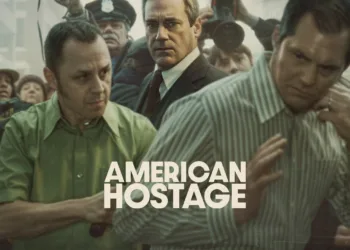
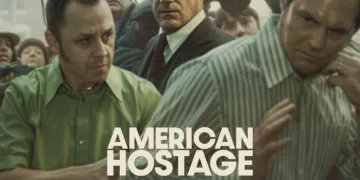
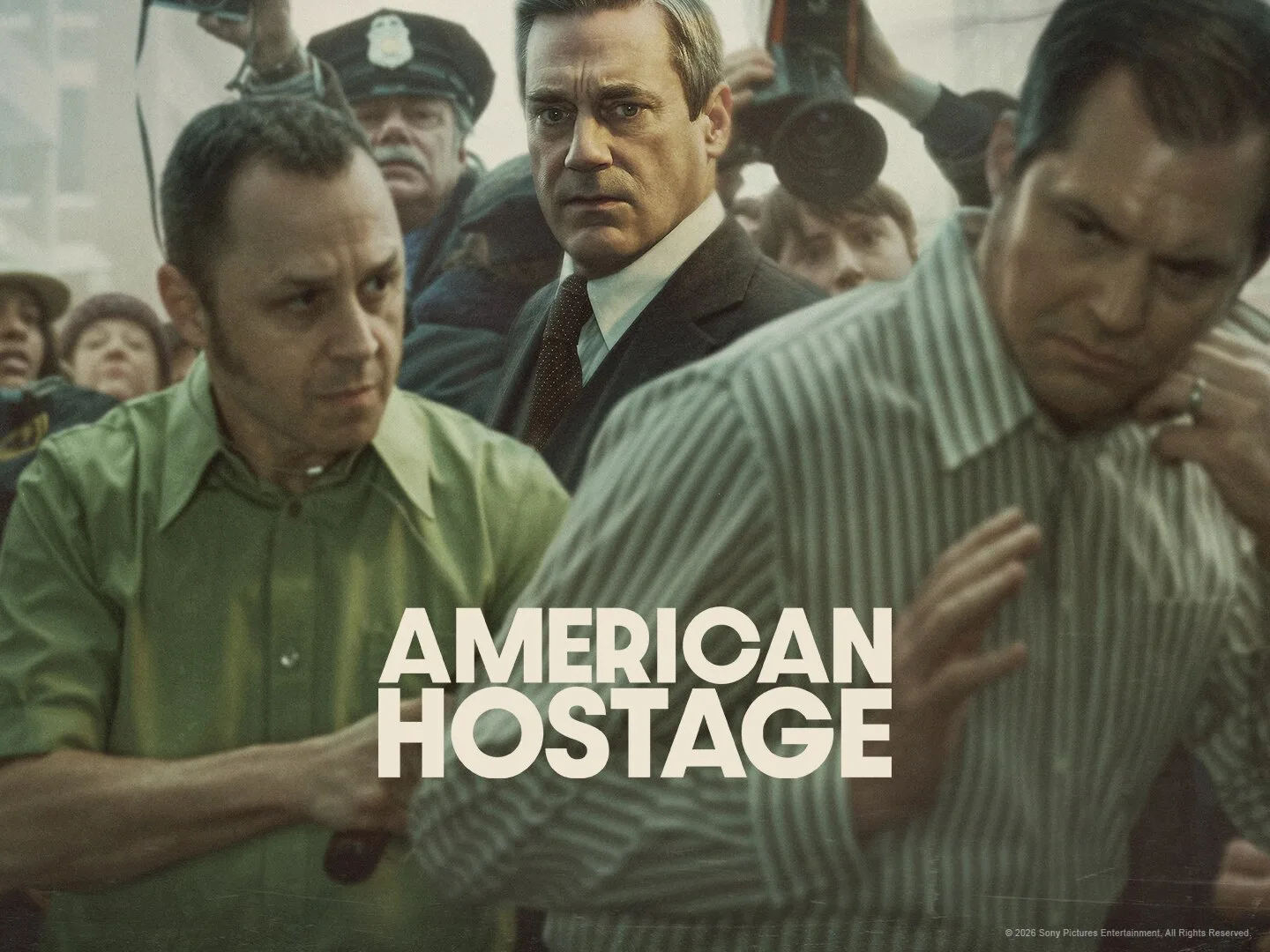
The eight-part MGM+ series revisits the 1977 case in which Kiritsis, played here by Giovanni Ribisi, kidnapped mortgage broker Richard “Dick” Hall and attached a shotgun to Hall with a dead man’s line. Tony believes Meridian Mortgage has deliberately trapped him in a financial arrangement designed to strip him of his property. He wants the world to hear his accusation, so he turns to Fred, played by Jon Hamm, the local radio newsman he trusts to tell the truth. What initially sounds like an interview rapidly becomes something stranger. Fred is reporter, messenger, unofficial negotiator and, eventually, participant.
That distinction matters because the hostage itself is only one form of captivity here. Dick cannot leave Tony’s apartment. Fred can, yet the moment Tony chooses him, he becomes trapped by his own reputation. Every decision carries two possible betrayals. Cooperate with law enforcement and he risks deceiving the man whose confidence keeps Dick alive. Give Tony unrestricted airtime and he risks surrendering journalism to a gunman who understands the value of an audience. The series keeps placing Fred in that narrow space where professional ethics and ordinary human responsibility stop agreeing with each other.
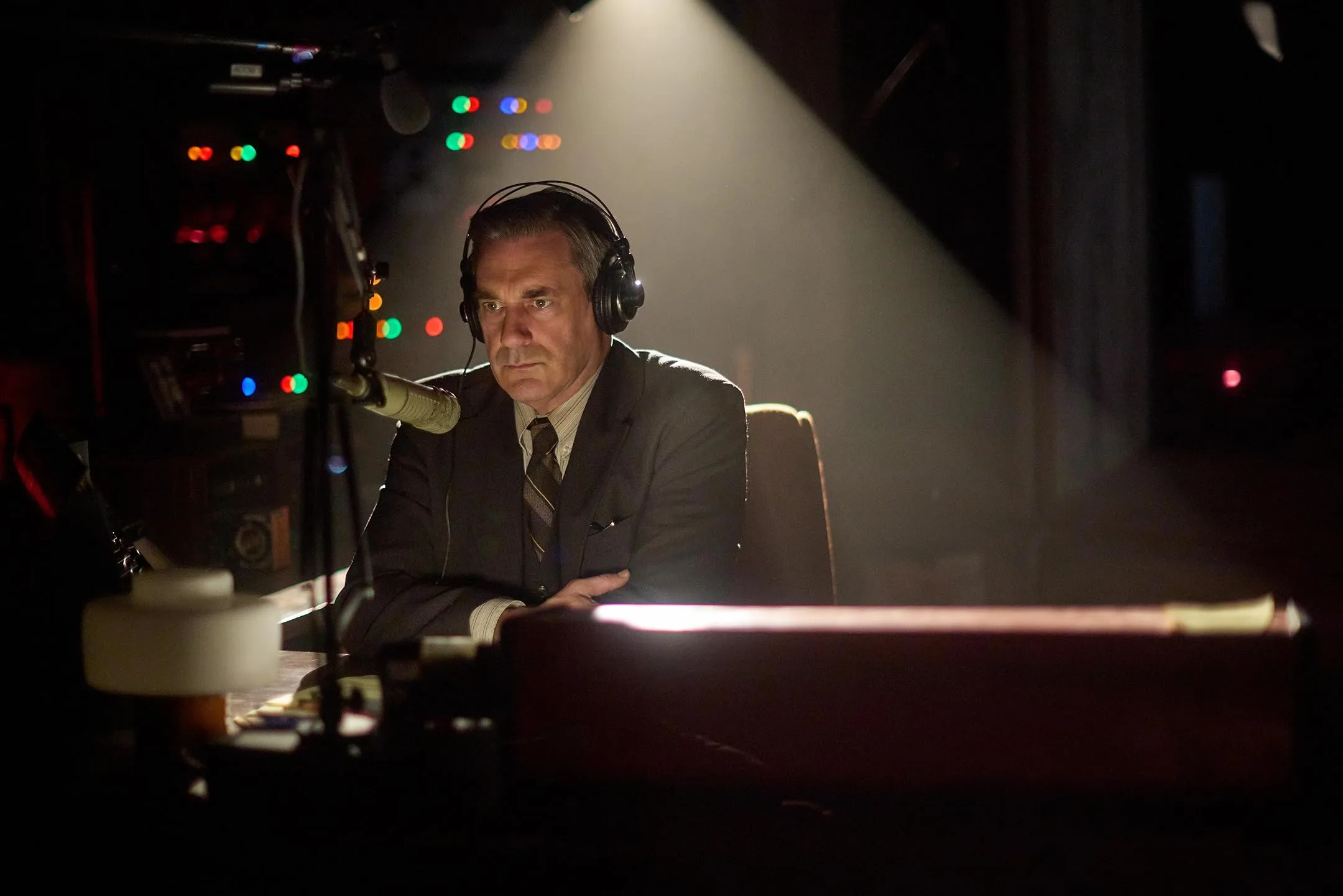
Hamm plays the conflict with an appropriate stillness. Fred’s profession requires composure, and Hamm lets that composure become progressively heavier. He has the voice of a man accustomed to calming rooms, but the face begins telling another story. The confidence remains audible after certainty has disappeared. Episode 6, which reaches backward into Fred’s family history and draws parallels among the fathers who shaped Fred, Tony and Dick, gives Hamm some of his strongest material because it lets the polished broadcaster exist outside the machinery of the crisis. His authority begins to look inherited, constructed, perhaps even fragile.
Ribisi works from the opposite direction. His Tony is restless where Fred is controlled, hunched where Fred is immaculate, emotionally exposed where Fred has spent years learning how to conceal uncertainty. Ribisi can make Tony absurd, threatening and heartbreakingly wounded within the same conversation. That instability is necessary. Tony’s grievance has substance: he believes Meridian knowingly engineered a financial arrangement that would end with the company taking his property, and allegations of similar treatment involving other clients give his anger social weight. Yet Dick remains at the other end of the shotgun. That image is the correction whenever Tony begins sounding too much like a folk hero.
The people listening on the radio do not always make that correction, and their growing affection for Tony becomes one of the show’s darker observations. Fred’s humane reporting allows listeners to encounter a person rather than a police category, which is admirable until empathy begins dissolving moral proportion. Tony becomes a vessel for frustrations extending far beyond his own mortgage. Corporate power, inaccessible wealth and the humiliation of being unable to make institutions hear you gather around him until one armed man starts representing everyone who feels cheated. There is something bleak in how easily violence acquires romance once enough people recognize the grievance behind it. American Hostage does not need to endorse Tony for that process to become disturbing. It merely has to show people cheering.
The 1977 setting deepens this idea because Tony cannot address the public by himself. He needs a gatekeeper. The radio station is full of switches, buttons, telephone lines and physical controls, objects that make information feel processed rather than instantaneous. Someone has to decide which voice reaches the air. Someone has to cut the microphone. The production design gives those spaces a lived-in heaviness, with equipment that looks touched rather than displayed and rooms that feel like workplaces instead of historical exhibits.
Those details matter because this is a drama about mediation. Tony speaks, Fred chooses how that speech enters public life, law enforcement tries to influence Fred, and station management notices that catastrophe has excellent ratings. Joe Cobden’s Jerry Morris brings some black comedy to that last part. While Fred and his colleagues worry about responsibility, Jerry can see the commercial possibilities of suddenly having half the city listening. The joke works because it is unpleasantly plausible. A man’s life is tied to a shotgun, but somewhere nearby someone is thinking about audience share.
The series becomes less sure of itself when it moves too far from that central machinery. Mireille Enos gives Barbara Heckman weight as Fred’s public role begins intruding on their marriage, while Kat Cunning gives Dick’s wife Ibby a painful awareness of what it means to watch strangers consume her husband’s terror as news. William Jackson Harper gives Ben Hairston enough moral firmness to challenge Fred without becoming a portable conscience. Jonathan Tucker’s FBI agent Cormac McNally supplies another form of certainty, the institutional confidence that human behavior can be classified quickly enough to control it.
Yet the series has eight hours to distribute, and that abundance becomes a problem. Some supporting arcs arrive with greater promise than resolution. Fantasy sequences become increasingly intrusive. Dick himself, despite living at the physical center of the crisis, is often given too little dramatic agency while Ribisi carries long stretches inside Tony’s apartment.
The hostage situation also reaches a structural plateau. Once Tony’s central grievance is understood, additional calls and threats cannot continually deepen it. Waiting is part of hostage negotiation, and some repetition communicates exhaustion effectively. At other points the series seems to be waiting because eight episodes require it to continue waiting. The irony is difficult to miss: its strongest later episode gains energy by looking away from the standoff.
Still, that excess does not erase what the format allows the series to examine. A tighter thriller could reproduce the fear of Tony’s shotgun. Eight episodes have room to examine the strange ecosystem forming around it: police officers, lawyers, reporters, spouses, executives and listeners, each discovering that a crisis can become an opportunity, a cause, a career decision or a piece of entertainment depending on where one happens to stand.
Fred enters the story believing journalism can maintain a clean distance from events, but Tony destroys that distance simply by choosing him. By the final stretch, the question is no longer how Fred should report the hostage crisis. It is what remains of impartiality after a reporter discovers that his words may determine who lives through the night. The microphone is still sitting there, waiting for someone to switch it on, but American Hostage has made the simple act of doing so feel frighteningly heavy.
American Hostage premieres on MGM+ on September 20, 2026. Based on the acclaimed podcast of the same name and inspired by terrifying true events, this eight-episode crime thriller anthology series follows beloved Indianapolis radio journalist Fred Heckman, who finds himself thrust into the middle of an unhinged 63-hour hostage crisis when gunman Tony Kiritsis demands to conduct a live radio interview while holding his hostage at gunpoint with a dead man’s trigger.
Where to Watch American Hostage Online
Full Credits
Title: American Hostage
Distributor: MGM+
Release date: September 20, 2026
Rating: TV-MA
Running time: 45–55 minutes per episode
Director: Adam Arkin, Nina Lopez-Corrado
Writers: Shawn Ryan, Eileen Myers, Sharon Hoffman, Imogen Browder, Mike Skerrett, Tanya Barfield, Charlie Haddaway, Abby St. Clair, Stacy McDonald
Producers and Executive Producers: Shawn Ryan, Eileen Myers, Jon Hamm, Connie Tavel, Marney Hochman, Sharon Hoffman, Shawn Christensen, Gabriel Mason, Adam Arkin, Nina Lopez-Corrado
Cast: Jon Hamm, Giovanni Ribisi, Mireille Enos, William Jackson Harper, Kristoffer Polaha, Jonathan Tucker, Kat Cunning
Director of Photography (Cinematographer): Steven Ackerman
Editors: Dan Briccetti, Jordan Goldman
Composer: Sean Callery
The Review
American Hostage
American Hostage finds its strongest tension away from the shotgun, in the slow erosion of Fred Heckman’s certainty about what journalism asks of him. Jon Hamm’s restraint and Giovanni Ribisi’s volatility give the series a compelling moral center, while its radio-station setting turns mediation itself into drama. Eight episodes prove too generous, leaving several subplots, fantasy passages and stretches of waiting without enough pressure. Still, the series understands something unsettling about public sympathy: once grievance becomes spectacle, violence can begin acquiring the shape of righteousness.
PROS
- Excellent work from Jon Hamm and Giovanni Ribisi
- Strong examination of journalistic ethics
- Convincing 1970s radio-station atmosphere
- Sharp treatment of public sympathy and institutional distrust
CONS
- Eight episodes stretch the hostage crisis thin
- Several supporting arcs remain underdeveloped
- Fantasy sequences disrupt the dramatic focus
- Dick receives too little dramatic agency