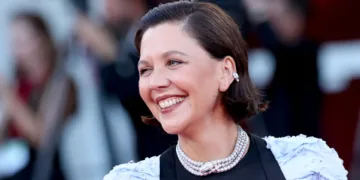























Venice Film Festival jury president Maggie Gyllenhaal pushed back Saturday against the suggestion that her jury awarded the Golden Lion to “Woman Unknown” because it was the only main competition film directed solely by a woman, telling reporters after the closing ceremony that the film earned its win on merit alone.
Gyllenhaal had opened her time as jury president by criticizing the scarcity of women filmmakers in this year’s competition lineup, calling it a systemic problem rooted in unequal access to financing. When May el-Toukhy’s “Woman Unknown” went on to claim the festival’s top prize, the outcome invited an obvious question, and a journalist at the closing press conference asked directly whether the jury’s choice amounted to a political statement.
Gyllenhaal rejected the framing. She said she anticipated the question and pointed out that plenty of films made by women fail to impress her, just as plenty made by men do, adding that her vote carries the same weight as any other juror’s in decisions that involve lengthy discussion. She said she was tired of returning to the same conversation but wanted, in that moment, simply to celebrate a well-crafted film she described as hitting “like a laser beam.”
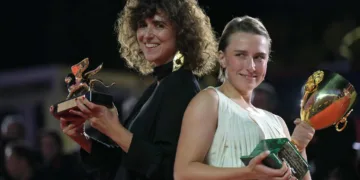
“Woman Unknown,” set in Denmark in the aftermath of Nazi occupation, follows a housemaid engaged to her wealthy employer while concealing a wartime relationship with a German soldier. Its star, Mathilde Arcel, also won the festival’s best actress prize in her first lead role, a rare double honor for a single film that Gyllenhaal said the jury felt comfortable awarding because the vote for Arcel was unanimous.
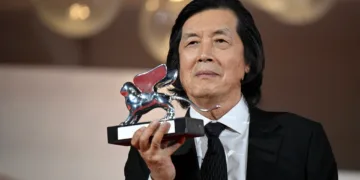
The panel Gyllenhaal presided over included directors Kaouther Ben Hania, Johnnie To, Shahrbanoo Sadat, and Xavier Giannoli, along with composer Daniel Blumberg and academic Francesco Casetti. Other prizes went to Lee Chang-dong’s “Possible Love” for the Silver Lion grand jury award, John Malkovich for best actor in “Wild Horse Nine,” and the Gaza documentary “NAZA,” which received the special jury prize after drawing one of the festival’s longest standing ovations. Festival organizers noted that “NAZA” was added to the competition lineup shortly before the festival began, a detail artistic director Alberto Barbera raised when the gender question first surfaced earlier in the festival.