








• Latest
  • Trending
Until the Day Ends Review

Until the Day Ends Review: Romance in the Glare of Political Violence

Jeremy Thomas

Jeremy Thomas, Oscar-Winning Producer of “The Last Emperor” and “Crash,” Dies at 77

20 minutes ago
Maggie Gyllenhaal

Maggie Gyllenhaal Denies Gender Played Role in “Woman Unknown” Golden Lion Win

22 minutes ago
Mia Wasikowska Agata the Writer

Mia Wasikowska Leads Kuba Dorabialski’s Bold Venice Debut “Agata the Writer”

29 minutes ago
Possible Love

Venice Wins for Malkovich, “Possible Love” and “NAZA” Reshape Early Oscar Race

32 minutes ago
Seth Rogen Babies

Seth Rogen Says Wife’s TIFF Film “Babies” Is His Most Personal Role Yet

36 minutes ago
Woman Unknown

“Woman Unknown” Takes Venice’s Golden Lion as Gaza Documentary “Naza” Wins Special Prize

39 minutes ago
Pierce Brosnan

Pierce Brosnan Predicts an Unknown Actor Will Land Next James Bond Role

44 minutes ago
Taylor Frankie Paul

Taylor Frankie Paul Says She’s Stayed “Single and Celibate” Since Bachelorette Cancellation

47 minutes ago
Diablo Netflix

Netflix and Blizzard Confirm “Diablo” Animated Series Is in Development

51 minutes ago
Sandra Bullock

Sandra Bullock Details Rejecting Predatory Auditions Early in Her Career

53 minutes ago
I Play Rocky

Peter Farrelly’s “I Play Rocky” Scores TIFF Standing Ovation, Eyes Oscar Run

56 minutes ago
Black Sunflowers

Sean Penn Backs Ukrainian Youth Documentary “Black Sunflowers” at TIFF Premiere

59 minutes ago
  • Home
  • Privacy Policy
  • Terms and Conditions
  • Gazettely Review Guidelines
Sunday, September 13, 2026
GAZETTELY
  • Home
  • Movie and TV News
    Jeremy Thomas

    Jeremy Thomas, Oscar-Winning Producer of “The Last Emperor” and “Crash,” Dies at 77

    Maggie Gyllenhaal

    Maggie Gyllenhaal Denies Gender Played Role in “Woman Unknown” Golden Lion Win

    Mia Wasikowska Agata the Writer

    Mia Wasikowska Leads Kuba Dorabialski’s Bold Venice Debut “Agata the Writer”

    Possible Love

    Venice Wins for Malkovich, “Possible Love” and “NAZA” Reshape Early Oscar Race

    Seth Rogen Babies

    Seth Rogen Says Wife’s TIFF Film “Babies” Is His Most Personal Role Yet

    Woman Unknown

    “Woman Unknown” Takes Venice’s Golden Lion as Gaza Documentary “Naza” Wins Special Prize

    Pierce Brosnan

    Pierce Brosnan Predicts an Unknown Actor Will Land Next James Bond Role

    Taylor Frankie Paul

    Taylor Frankie Paul Says She’s Stayed “Single and Celibate” Since Bachelorette Cancellation

    Diablo Netflix

    Netflix and Blizzard Confirm “Diablo” Animated Series Is in Development

  • Movie and TV Reviews
    Until the Day Ends Review

    Until the Day Ends Review: Romance in the Glare of Political Violence

    American Hostage Review

    American Hostage Review: A Hostage Crisis Traps the Reporter Too

    Agatha Christie's Tommy & Tuppence Review

    Agatha Christie’s Tommy & Tuppence Review: Two Great Detectives Need Sharper Mysteries

    The Perfect Lie Review

    The Perfect Lie Review: The Dinner Club Knows How to Keep a Secret

    The Drop A Snowfall Saga Review

    The Drop: A Snowfall Saga Review: West Coast Hip-Hop Gives the Franchise Fresh Energy

    Marble Hall Murders Review 1

    Marble Hall Murders Review: Susan Ryeland Returns to a Denser Case

    Possible Love Review

    Possible Love Review: Lee Chang-dong Turns Covetousness Into Social Anatomy

    The Debut Review

    The Debut Review: Julianne Moore Finds Herself and Becomes Everyone Else’s Problem

    The Fix Review

    The Fix Review: Gunfire Cuts Cleaner Than the Politics

  • Game Reviews
    Marvels Wolverine Review

    Marvel’s Wolverine Review: A Great Logan Trapped in a Limited Action Game

    NHL 27 Review

    NHL 27 Review: EA Has the Right Ideas, Mostly

    Welcome to Elderfield Review

    Welcome to Elderfield Review: Roll the Dice and Tend the Crops

    Barbarian Saga: The Beastmaster Review

    Barbarian Saga: The Beastmaster Review: Great Transformations, Rough Execution

    Apidya' Special Review

    Apidya’ Special Review: One Cult Classic Still Has Plenty of Sting

    Bus Simulator 27 Review

    Bus Simulator 27 Review: A Management Sim Waiting for Mechanical Repairs

    SPRAWL zero Review

    SPRAWL zero Review: Disposable Guns, Permanent Fun

    HOT WHEELS Infinite Rush Review

    HOT WHEELS Infinite Rush Review: Four Islands of Plastic Chaos

    Halloween: The Game Review

    Halloween: The Game Review: Haddonfield Has a Great Idea and Terrible Neighbors

  • The Bests
No Result
View All Result
  • Home
  • Movie and TV News
    Jeremy Thomas

    Jeremy Thomas, Oscar-Winning Producer of “The Last Emperor” and “Crash,” Dies at 77

    Maggie Gyllenhaal

    Maggie Gyllenhaal Denies Gender Played Role in “Woman Unknown” Golden Lion Win

    Mia Wasikowska Agata the Writer

    Mia Wasikowska Leads Kuba Dorabialski’s Bold Venice Debut “Agata the Writer”

    Possible Love

    Venice Wins for Malkovich, “Possible Love” and “NAZA” Reshape Early Oscar Race

    Seth Rogen Babies

    Seth Rogen Says Wife’s TIFF Film “Babies” Is His Most Personal Role Yet

    Woman Unknown

    “Woman Unknown” Takes Venice’s Golden Lion as Gaza Documentary “Naza” Wins Special Prize

    Pierce Brosnan

    Pierce Brosnan Predicts an Unknown Actor Will Land Next James Bond Role

    Taylor Frankie Paul

    Taylor Frankie Paul Says She’s Stayed “Single and Celibate” Since Bachelorette Cancellation

    Diablo Netflix

    Netflix and Blizzard Confirm “Diablo” Animated Series Is in Development

  • Movie and TV Reviews
    Until the Day Ends Review

    Until the Day Ends Review: Romance in the Glare of Political Violence

    American Hostage Review

    American Hostage Review: A Hostage Crisis Traps the Reporter Too

    Agatha Christie's Tommy & Tuppence Review

    Agatha Christie’s Tommy & Tuppence Review: Two Great Detectives Need Sharper Mysteries

    The Perfect Lie Review

    The Perfect Lie Review: The Dinner Club Knows How to Keep a Secret

    The Drop A Snowfall Saga Review

    The Drop: A Snowfall Saga Review: West Coast Hip-Hop Gives the Franchise Fresh Energy

    Marble Hall Murders Review 1

    Marble Hall Murders Review: Susan Ryeland Returns to a Denser Case

    Possible Love Review

    Possible Love Review: Lee Chang-dong Turns Covetousness Into Social Anatomy

    The Debut Review

    The Debut Review: Julianne Moore Finds Herself and Becomes Everyone Else’s Problem

    The Fix Review

    The Fix Review: Gunfire Cuts Cleaner Than the Politics

  • Game Reviews
    Marvels Wolverine Review

    Marvel’s Wolverine Review: A Great Logan Trapped in a Limited Action Game

    NHL 27 Review

    NHL 27 Review: EA Has the Right Ideas, Mostly

    Welcome to Elderfield Review

    Welcome to Elderfield Review: Roll the Dice and Tend the Crops

    Barbarian Saga: The Beastmaster Review

    Barbarian Saga: The Beastmaster Review: Great Transformations, Rough Execution

    Apidya' Special Review

    Apidya’ Special Review: One Cult Classic Still Has Plenty of Sting

    Bus Simulator 27 Review

    Bus Simulator 27 Review: A Management Sim Waiting for Mechanical Repairs

    SPRAWL zero Review

    SPRAWL zero Review: Disposable Guns, Permanent Fun

    HOT WHEELS Infinite Rush Review

    HOT WHEELS Infinite Rush Review: Four Islands of Plastic Chaos

    Halloween: The Game Review

    Halloween: The Game Review: Haddonfield Has a Great Idea and Terrible Neighbors

  • The Bests
No Result
View All Result
GAZETTELY
No Result
View All Result
Until the Day Ends Review

Jeremy Thomas, Oscar-Winning Producer of "The Last Emperor" and "Crash," Dies at 77

Home Entertainment Movies

Until the Day Ends Review: Romance in the Glare of Political Violence

Marcus Thorne by Marcus Thorne
38 seconds ago
in Entertainment, Movies, Reviews
Reading Time: 5 mins read
A A
0
Share on FacebookShare on TwitterShare on PinterestShare on WhatsAppShare on TelegramSummarize with ChatGPTSummarize with Perplexity

Politics in Jelena Maksimović’s Until the Day Ends rarely settles into speeches or manifestos. It moves through bodies, rooms, affiliations, and, most strikingly, a paving stone passed from hand to hand during a protest until the question of ownership becomes almost meaningless. Lena holds it. Others carry it. Stefan throws it. A policeman falls. A camera records Lena with the object, and suddenly political responsibility has acquired the visual grammar of mistaken identity.

That sequence is the film’s clearest statement of intent because Maksimović treats political division as something both ideological and physical. Twenty-year-old Lena is part of Belgrade’s student protest movement, occupying a university amid demonstrations rooted in anger at government corruption and the deaths caused by the Novi Sad railway-station canopy collapse.

Stefan moves among right-wing loyalists and skinheads while insisting that he is apolitical. The claim sounds ridiculous to Lena, and reasonably so. Spending your evenings beside extremists does tend to weaken the neutrality defence.

Yet Stefan’s vagueness matters. He is surrounded by political identity without appearing to possess much of his own, while Lena’s convictions are far firmer. Maksimović uses that imbalance to prevent their attraction from becoming immediately absurd. Stefan can move toward Lena because his loyalties were never especially deep. Lena has further to travel, which gives their connection its friction.

Their first interactions establish that distance without turning hostility into melodrama. Lena returns from the occupied university to discover that her brother Milan has sold her piano to Stefan to settle a debt. Milan sneers at her activism, Stefan absorbs Lena’s mockery, and the social boundaries separating these young people prove strangely porous. Lena may regard Stefan and his friends as idiots, yet she can still smoke with him. Political hostility already shares space with familiarity. Then the protest transforms proximity into culpability.

Maksimović and cinematographer Paul Spengemann follow the paving stone through the crowd with such velocity that perception itself becomes unreliable. The shot is technically ostentatious, but the ostentation has purpose. Violence moves faster than moral certainty. By the time anyone understands what happened, Stefan has injured a policeman and Lena has become the face preserved by the recording. The camera has captured evidence while missing truth.

That distinction sits comfortably inside a film fascinated by seeing and misseeing. Spengemann frequently pushes bodies behind glass, reflections, flare, shadows, and restless camera movement. Faces rarely occupy uncontested visual space. Belgrade itself feels fractured into partial views.

The heavy lens flare can become exhausting, occasionally suggesting a cinematographer unwilling to let a clean image survive unmolested, but the underlying visual logic remains persuasive. These characters live in a political atmosphere where every affiliation casts suspicion across whatever stands beside it.

Maksimović’s documentary background gives the protest material an immediacy that occasionally clashes with this expressive camera. The occupation, the streets, the crowds, and the mostly non-professional performers create the sensation of events being caught rather than staged.

Then a circular pan, coloured light, or flamboyant optical effect announces construction with equal force. That tension becomes part of the film’s personality. Its realism is never pure observation. It keeps contaminating itself with romanticism. The most obvious contamination is Lena and Stefan themselves.

Until the Day Ends Review

After police scatter protesters and counterprotesters, the two flee together, and the film slowly exchanges political confrontation for an awkward nocturnal intimacy. Their connection avoids most expected romantic gestures. There is little conventional physical fulfilment, and their time together keeps getting disrupted by argument, danger, strangers, and uncertainty. Even their ride out of the city comes courtesy of a priest delivering a reactionary sermon against an impressive catalogue of perceived evils, from migrants to television cartoons. Serbia’s ideological noise follows them down the road.

The lack of romantic neatness saves the relationship. Maksimović does not provide a tidy fantasy in which affection dissolves political difference. Lena and Stefan are drawn together because crisis has stripped away some of the identities surrounding them, not because those identities have ceased to matter.

Andrija Krivokapić makes Stefan’s uncertainty readable without turning him into an innocent accidentally misplaced among fascists. Lena Trifunović has the more difficult task. Her Lena is politically assured but personally unsettled, and Trifunović’s stare often conveys resistance even when the character has stopped arguing.

That force occasionally exceeds the credibility of the scene around her. At a far-right hangout, Lena’s defiance is enough to command a room of hostile young men who seem suddenly mesmerised by her nerve. The moment wants charisma to function like armour. It almost does, largely because Trifunović has the presence to sell the fantasy for several seconds. The realism still bends.

The weakness points toward a wider limitation. Stefan receives ambiguity; several men around him remain crude representations of reactionary aggression. The protest movement, meanwhile, provides danger, urgency, and ethical orientation without receiving much detailed political examination. Maksimović appears less interested in explaining contemporary Serbia than in watching young people form identities inside its fractures. That focus produces a stronger drama, though it narrows the film’s political reach. The streets carry history. The screenplay prefers the people running through them.

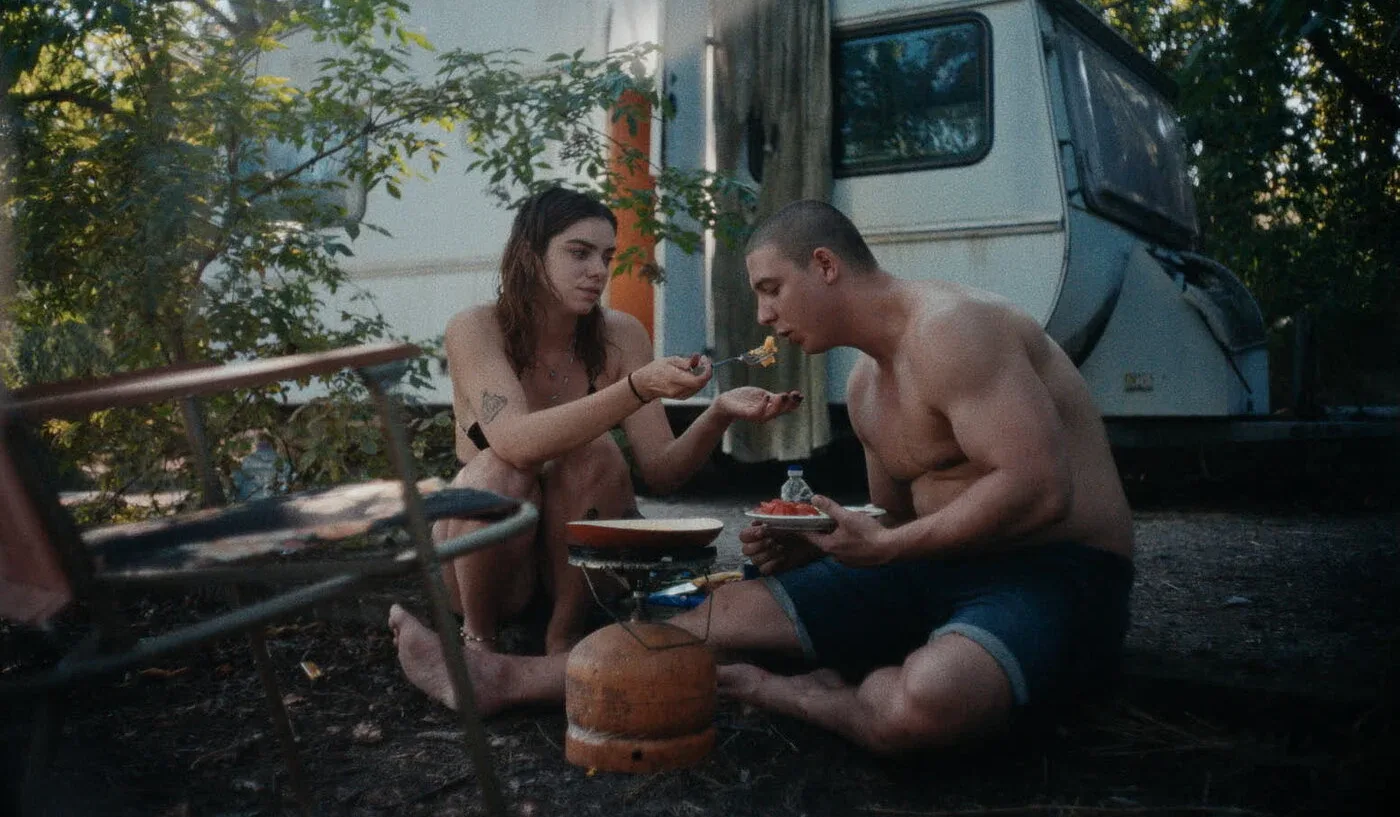
Once Lena and Stefan leave Belgrade, the visual scheme begins to loosen. Darkness recedes. Light returns. Their surroundings become less claustrophobic, and the camera’s relationship with them feels less combative. It would be easy to read that transition as simple optimism, yet the film remains too unsettled for such certainty. Nothing about their flight has repaired the political world they left behind, and nothing establishes that their attraction can survive outside the temporary suspension created by danger.

Maksimović eventually abandons strict naturalism for a sustained final image that reaches toward generational hope. The gesture risks feeling imposed on a film whose strongest passages have thrived on contradiction. Still, the image refuses the comfort of a solved romance or a solved country. What remains is a younger generation standing in uncertain light, carrying histories it did not create and choices it has barely begun to understand.

Until the Day Ends had its world premiere at the 83rd Venice International Film Festival on September 10, 2026. Set against the backdrop of Serbian anti-corruption protests, the coming-of-age drama follows two young people on opposing sides as they flee Belgrade.

Full Credits

  • Title: Until the Day Ends

  • Distributor: Heretic

  • Release date: September 10, 2026 (Venice International Film Festival)

  • Running time: 1 hour 31 minutes

  • Director: Jelena Maksimović

  • Writers: Jelena Maksimović, Olga Dimitrijević, Ivan Salatić

  • Producers and Executive Producers: Jelena Angelovski

  • Cast: Lena Trifunović, Andrija Krivokapić, Irina Hotomski, Stefan Tarabić, Nataša Čakardić, Miodrag Dragičević

  • Director of Photography (Cinematographer): Paul Spengemann

  • Editors: Jan Klemsche

The Review

Until the Day Ends

8 Score

Until the Day Ends is strongest when political identity becomes something visible, unstable, and dangerous: a stone crossing hands, a body caught in the wrong frame, a city fractured by glass and flare. Maksimović occasionally lets visual bravado and romantic symbolism bend the realism too far, and the politics surrounding Lena and Stefan remain less developed than their attraction. Still, the film’s restless camera, Trifunović’s commanding presence, and refusal of easy reconciliation give its hope real tension.

PROS

  • Striking visual language
  • Excellent cobblestone sequence
  • Strong central chemistry
  • Trifunović’s intense performance
  • Politically charged atmosphere

CONS

  • Excessive lens flare
  • Secondary extremists feel broad
  • Political context remains underexplored
  • Some heightened moments strain credibility

Review Breakdown

  • Overall 0
Tags: 2026 Venice Film Festival83rd Venice International Film FestivalAndrija KrivokapićDramaFeaturedHereticIrina HotomskiJelena MaksimovićLena TrifunovićMiodrag DragičevićNataša ČakardićRomanceStefan TarabićUntil the Day Ends
Previous Post

Jeremy Thomas, Oscar-Winning Producer of “The Last Emperor” and “Crash,” Dies at 77

0 0 votes
Article Rating
Subscribe
Connect with
Login
I allow to create an account
When you login first time using a Social Login button, we collect your account public profile information shared by Social Login provider, based on your privacy settings. We also get your email address to automatically create an account for you in our website. Once your account is created, you'll be logged-in to this account.
DisagreeAgree
Notify of
guest
Connect with
I allow to create an account
When you login first time using a Social Login button, we collect your account public profile information shared by Social Login provider, based on your privacy settings. We also get your email address to automatically create an account for you in our website. Once your account is created, you'll be logged-in to this account.
DisagreeAgree
guest
0 Comments
Oldest
Newest Most Voted

Try AI Movie Recommender

Gazettely AI Movie Recommender

This Week's Top Reads

  • Is This Seat Taken? Review

    Is This Seat Taken? Review: A Satisfying Mental Workout

    1294 shares
    Share 0 Tweet 0
  • Fauda Season 5 Review: Revenge Crosses the Mediterranean

    1 shares
    Share 0 Tweet 0
  • A Tale of Two Cities Review: Dickens Rewritten for Prestige TV

    0 shares
    Share 0 Tweet 0
  • You Can See Everything Review: Three Hours Inside a Manufactured Reality

    0 shares
    Share 0 Tweet 0
  • Trust Review: Squandered Potential and an Incoherent Plot

    6 shares
    Share 0 Tweet 0
  • The Grand Tour Review: The Keys Change Hands

    0 shares
    Share 0 Tweet 0
  • Last Seen Review: A Missing-Girl Thriller With Better Questions

    1 shares
    Share 0 Tweet 0

Must Read Articles

Marvels Wolverine Review
PlayStation

Marvel’s Wolverine Review: A Great Logan Trapped in a Limited Action Game

8 hours ago
American Hostage Review
TV Shows

American Hostage Review: A Hostage Crisis Traps the Reporter Too

9 hours ago
NHL 27 Review
Games

NHL 27 Review: EA Has the Right Ideas, Mostly

11 hours ago
The Drop A Snowfall Saga Review
TV Shows

The Drop: A Snowfall Saga Review: West Coast Hip-Hop Gives the Franchise Fresh Energy

12 hours ago
The Debut Review
Movies

The Debut Review: Julianne Moore Finds Herself and Becomes Everyone Else’s Problem

1 day ago
Loading poll ...
Coming Soon
Which of Alfred Hitchcock's 1960s thrillers is your all-time favorite?

Gazettely is your go-to destination for all things gaming, movies, and TV. With fresh reviews, trending articles, and editor picks, we help you stay informed and entertained.

© 2021-2026 All Rights Reserved for Gazettely

What’s Inside

  • Movie & TV Reviews
  • Game Reviews
  • Featured Articles
  • Latest News
  • Editorial Picks

Quick Links

  • Home
  • About US
  • Contact Us
  • Advertise with Us
  • Review Guidelines

Follow Us

Facebook X-twitter Youtube Instagram
No Result
View All Result
  • Gazettely | Movie, TV & Game Reviews, News, and Rankings
  • Movies
  • Entertainment News
  • Movie and TV Reviews
  • TV Shows
  • Game News
  • Game Reviews
  • Contact Us

© 2024 All Rights Reserved for Gazettely

wpDiscuz
0
0
Would love your thoughts, please comment.x
()
x
| Reply