


























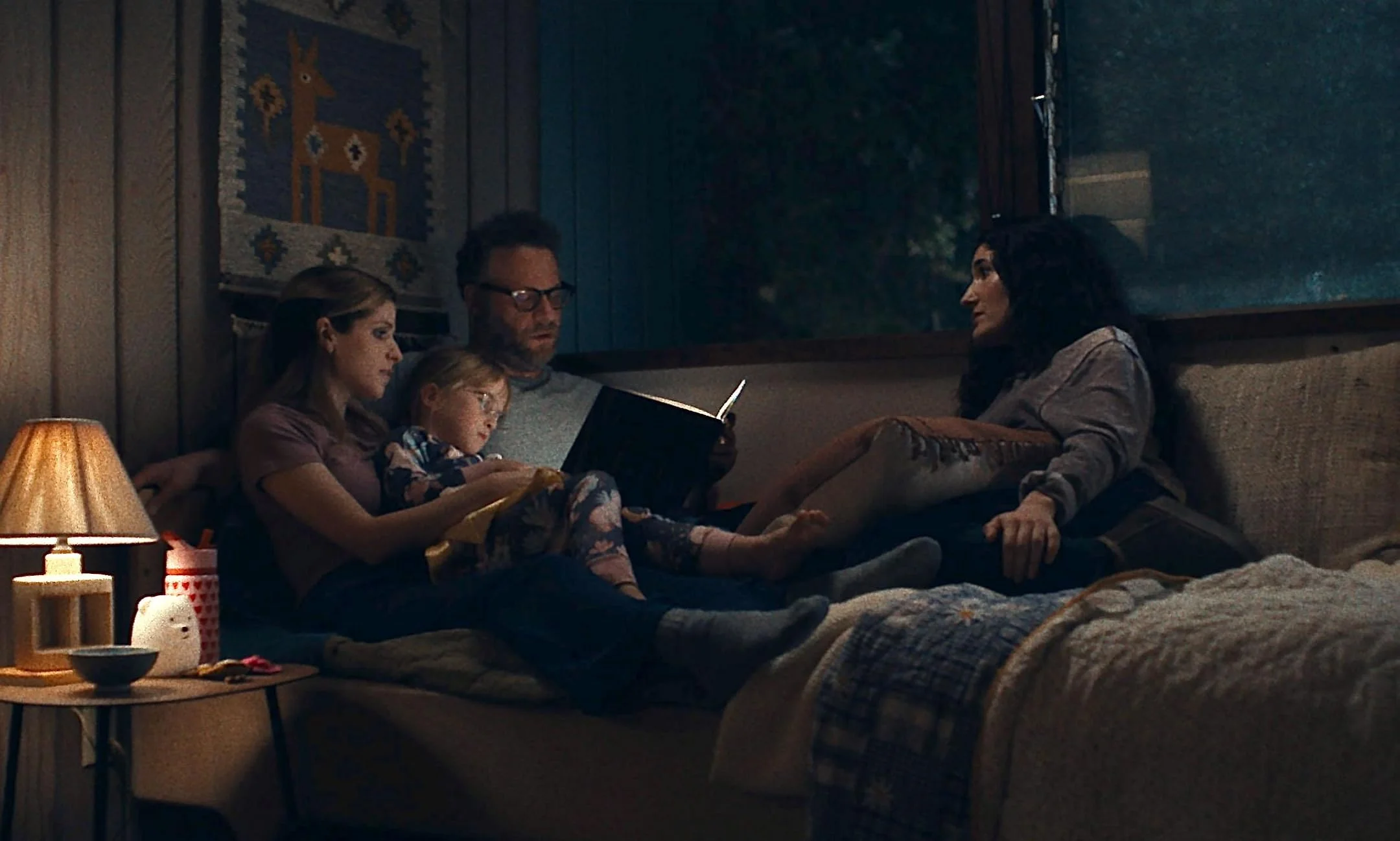

A culture can congratulate itself on expanding women’s choices while still treating one choice as the default. Lauren Miller Rogen’s Babies understands that contradiction with unusual clarity. Annie and Aaron have spent seventeen years building a happy marriage, yet their decision to remain childless is treated by friends and acquaintances as unfinished business, a temporary condition awaiting correction. The question they keep hearing sounds casual: are you going to have kids? Beneath it sits a far less innocent assumption. A fulfilled adult life still requires witnesses who resemble you.
Annie, played by Anna Kendrick, has absorbed enough of that assumption to begin doubting herself. At a Fourth of July pool party crowded with children and parents, she watches fathers jump into the water while Aaron remains at the grill. Her inner monologue catalogues the attractions and irritations of parenthood with anxious precision. Cute children inspire tenderness, screaming ones produce immediate retreat. Freedom looks wonderful until everyone else seems to have joined a club whose membership she has declined.
Miller Rogen is sharpest when she treats this uncertainty as socially produced rather than privately discovered. Annie’s life is not empty. Her marriage works. She has professional ambitions. She has intimate friendships. Yet the culture around her keeps translating satisfaction into lack, insisting that happiness without children must contain some secret deficit.
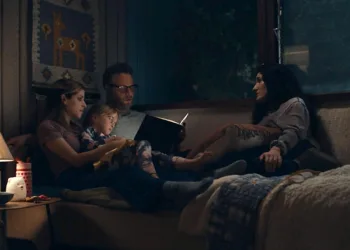
The film then gives Annie and Aaron the experiment everyone around them appears to want. Their friend Eliza leaves her husband Luke and moves into their home with her young daughter Eve. Suddenly the hypothetical becomes domestic routine. Smoking weed requires strategic relocation. Toilet training becomes a household concern. Aaron discovers that he enjoys Eve’s company. Annie gets to watch the man she loves behaving with a child in ways that make parenthood easier to imagine.
Eve is not a nightmare inserted to justify Annie’s existing position. She is affectionate, funny and genuinely welcome. That choice protects the film from one of the easiest forms of dishonesty available to a story like this. Babies does not need children to be intolerable before childlessness can become legitimate.
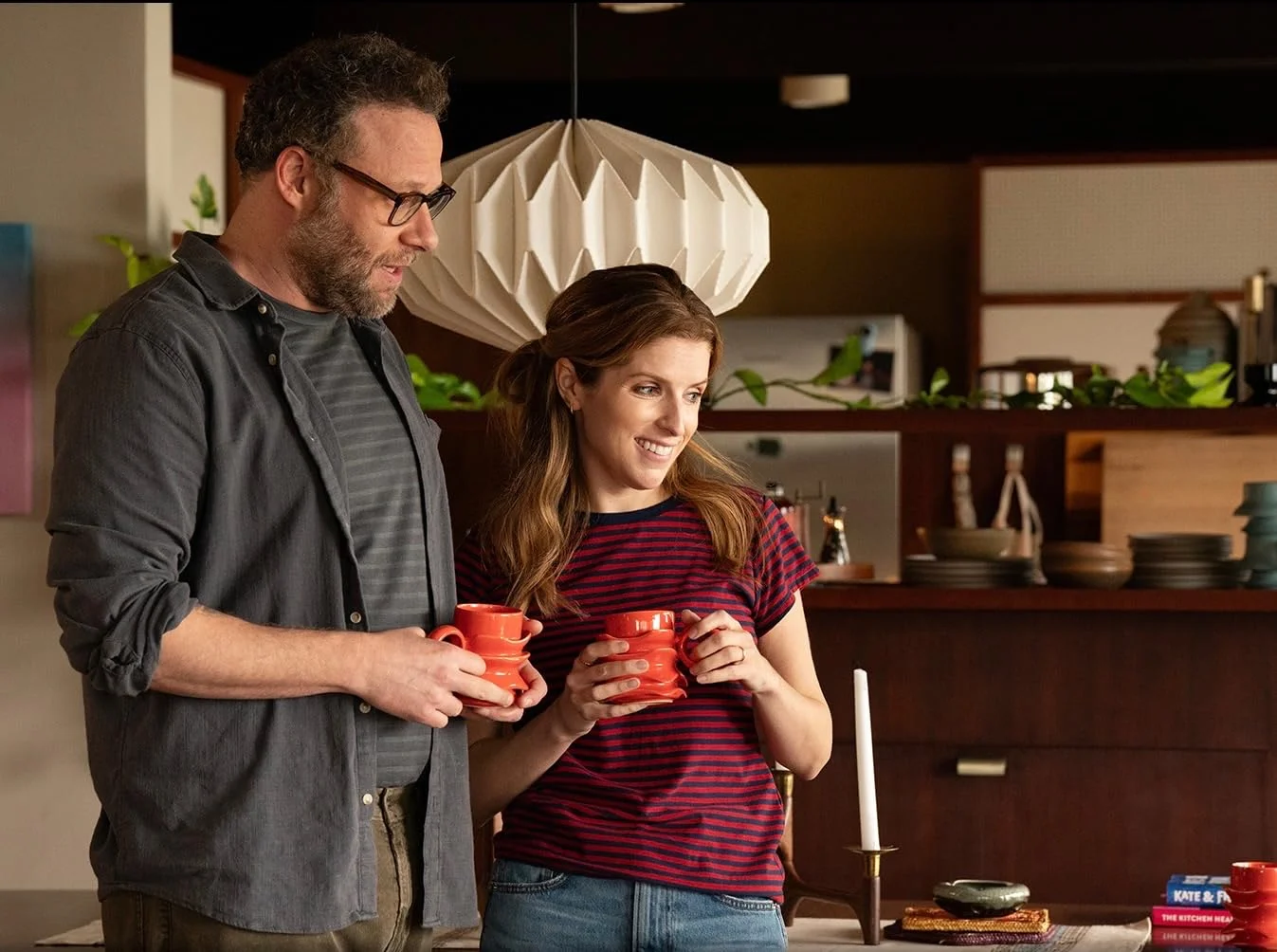
Kendrick and Seth Rogen make that argument easier to believe because Annie and Aaron already feel complete together. Their exchanges have the looseness of people who stopped performing romance for one another years ago without losing affection.
Rogen’s relaxed presence suits Aaron, whose openness to parenthood never turns into pressure. He understands that the physical and social consequences would fall differently on Annie, so he leaves much of the decision with her. It is considerate, though consideration has its own burden here. Annie receives freedom and the responsibility of deciding what their future means.
The richer conflict belongs to Annie and Becky. Becky is pregnant with her third child while trying to open an art gallery with Annie, and her family repeatedly demands the attention that professional ambition requires too. The film refuses to turn either woman into an ideological prop. Becky is an accomplished artist whose children matter deeply to her. Annie cares about her friends and their families while still resenting how parenthood rearranges friendships, schedules and priorities around itself.
That tension gives the baby-shower sequence its force. Drunk and exhausted by women treating motherhood as the final credential of adulthood, Annie begins asking the questions polite conversation usually suppresses. What happens to a woman’s body? What happens to a marriage? What kind of world is a child being brought into? Her outburst works because these concerns have already appeared in smaller frustrations, glances and compromises. The film has shown the social script before Annie finally reads it aloud.
This is also where Miller Rogen occasionally weakens her own case. Babies has enough faith in its subject to consider several sides, yet it does not always have equal faith in the audience. Annie’s voiceover can explain feelings that Kendrick has already made visible. Some conversations arrive with the tidiness of arguments prepared in advance. Later scenes sometimes underline ideas that the relationships have communicated perfectly well through behavior.
The crowded ensemble creates a similar tension. Eliza is rebuilding her life after leaving Luke. Becky and Ethan are raising several children at different ages. Annie and Becky are chasing a gallery. Annie’s father Michael cares for a wife with Alzheimer’s while tentatively considering companionship elsewhere. Each thread belongs to the film’s larger question about the lives people build after the expected script stops being useful. Taken together, though, they can make Babies feel episodic, as if several adjacent stories are competing for enough room to become fully dramatic.
The Alzheimer’s material is the most revealing example. David Strathairn brings warmth and sadness to Michael, and Annie’s fear of inheriting her mother’s illness expands the parenting debate into something darker. A child can provide connection, but having one also creates another person who may someday have to witness your decline. Parenthood offers no escape from mortality. Childlessness offers none either.
That idea keeps Babies from collapsing into a cheerful defense of one lifestyle against another. Annie and Aaron enjoy freedoms that parents surrender: privacy, spontaneity, sex without locked doors, control over their own time. Becky’s family and Annie’s growing attachment to Eve demonstrate pleasures that those freedoms cannot reproduce. The film’s real target is the hierarchy that declares one arrangement mature and another provisional.
Its softer moments understand this better than its speeches. Aaron staying home with Eve, Becky interrupting work because her daughter needs her, Michael considering a life that does not fit the role assigned to an aging husband, Annie realizing that loving children does not automatically mean wanting one of her own. These scenes dismantle the idea that adulthood has a single correct shape without turning that dismantling into contempt for people who choose the conventional one.
The closing monologue states the case with little ambiguity, perhaps less than the film needs. By then, the argument has already been made through bedrooms, pool parties, gallery plans, disrupted friendships and a child temporarily occupying a house that had been designed for two adults. Miller Rogen sometimes explains what her own film has already demonstrated. Still, the generosity behind that insistence is difficult to dismiss.
Babies asks society to stop treating reproduction as proof of seriousness and to recognize that family can be built through friendship, marriage, caregiving and chosen obligation as readily as biology. For a film preoccupied with one of life’s largest decisions, its most humane insight is wonderfully undramatic: a person does not owe the world the life everyone else expected her to want.
Babies had its world premiere at the Toronto International Film Festival on September 12, 2026. The comedy film follows an undecided, long-term couple whose perspective on parenthood shifts when a friend temporarily moves in with her baby.
Where to Watch Babies (2026) Online
Full Credits
Title: Babies
Distributor: AGC Studios, Monarch Media, Lylas Pictures, Babies Film
Release date: September 12, 2026 (Toronto International Film Festival)
Running time: 1 hour 36 minutes (96 minutes)
Director: Lauren Miller Rogen
Writers: Lauren Miller Rogen
Producers and Executive Producers: Lauren Miller Rogen, Jennifer W. Ray, Stuart Ford, Steve Barnett, Vicky Patel, Alan Powell, Zach Garrett, Miguel A. Palos Jr., Sophie Hoegh
Cast: Anna Kendrick, Seth Rogen, Issa Rae, Dan Stevens, David Strathairn, Sharon Stone, Zach Cherry, Ed Helms, Ashley Park, Kate Berlant
Director of Photography (Cinematographer): Edu Grau
Editors: Joi McMillon
Composer: Nami Melumad
The Review
Babies
Babies treats childlessness as a legitimate adult choice without diminishing the rewards of parenthood. Anna Kendrick and Seth Rogen give its central marriage warmth and credibility, while Annie’s friendships expose how social expectations can disguise themselves as concern. Lauren Miller Rogen occasionally overexplains ideas that her characters have already made clear, and the crowded ensemble loosens the structure. Still, its generosity survives those weaknesses. The film’s sharpest insight is simple: fulfillment does not require everyone to build the same kind of family.
PROS
- Kendrick and Rogen’s convincing chemistry
- Sharp examination of social pressure around motherhood
- Fair treatment of parenthood and childlessness
- Strong Annie-Becky conflict
CONS
- Voiceover sometimes explains too much
- Crowded ensemble weakens focus
- Some thematic conversations feel overly explicit