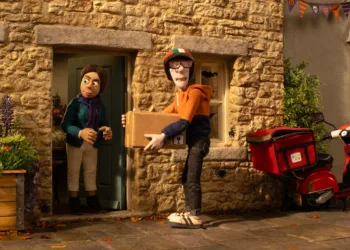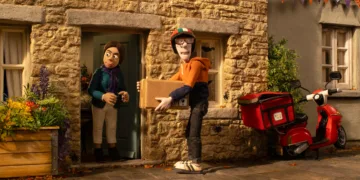














Aardman has always understood that fear becomes funny when the body betrays it. Eyes widen, limbs stiffen, a mouth hangs open half a second too long. Shaun the Sheep: The Beast of Mossy Bottom builds an entire Halloween adventure from that primitive language. Nobody needs to explain that something has gone wrong. A sheep stares. A farmer panics. A village reaches for pitchforks. The joke arrives before language could improve it.
That simplicity is deceptive. Shaun’s third feature places its familiar characters inside the grammar of old monster movies, then strips that grammar of menace without stripping it of shape. Fog rolls through Mossy Bottom. A creature wanders the countryside. Villagers prepare themselves for confrontation. A veterinarian studies mysterious fur. A windmill waits somewhere in the distance because, apparently, certain architectural obligations come with becoming a monster. The creature, naturally, is the Farmer.
Before the transformation, his problem is painfully ordinary. He likes the local veterinarian and cannot gather the confidence to invite her to the Halloween Hoedown. His disappearing hair has become part of the anxiety. The embarrassment is small, even childish, and the film treats it with unusual tenderness. Then Shaun accidentally turns that insecurity into biology.
The disaster begins elsewhere. The Farmer destroys the flock’s carefully grown pumpkins, leaving Shaun desperate to replace them before Halloween. A children’s science book inspires an improvised laboratory, and the resulting growth formula works with horrifying efficiency. Pumpkins swell. The surplus mixture finds its way into an old hair-growth bottle. The Farmer applies it to his scalp, and his wish is granted with the sadistic precision of a fairy tale.
Hair spreads everywhere. Attempts to shave it fail. Duct tape produces screams worthy of a creature feature. Wet concrete eventually gives him enormous feet, completing a silhouette that the people of Mossy Bottom read as evidence of some unknown beast. The transformation is ridiculous, yet there is something strangely melancholy in watching the Farmer disappear beneath the cure he thought would make him presentable. That melancholy never threatens the comedy. It gives the comedy somewhere to stand.
The film understands the old monster story better than its softness might suggest. The creature is frightening primarily because everyone looking at it is mistaken. The Farmer has not become cruel or violent. He is still embarrassed, still lonely, still trying to solve the problem without being seen. The village encounters an outline and invents a monster to occupy it. Children can laugh at the misunderstanding. Adults may recognize the mechanism.
Aardman does not linger on that idea solemnly. Solemnity would kill this flock within minutes. Instead, physical comedy carries almost everything. Shaun conducts experiments with rubber gloves designed for fingers he does not possess, their empty ends flapping around his hooves. A dog X-ray reveals a set of keys. A large sheep uses its own wool to wipe a blackboard clean. The Beast attempts to disappear among artificial monsters in a Halloween shop, seeking safety by pretending to be exactly what everyone already thinks he is.
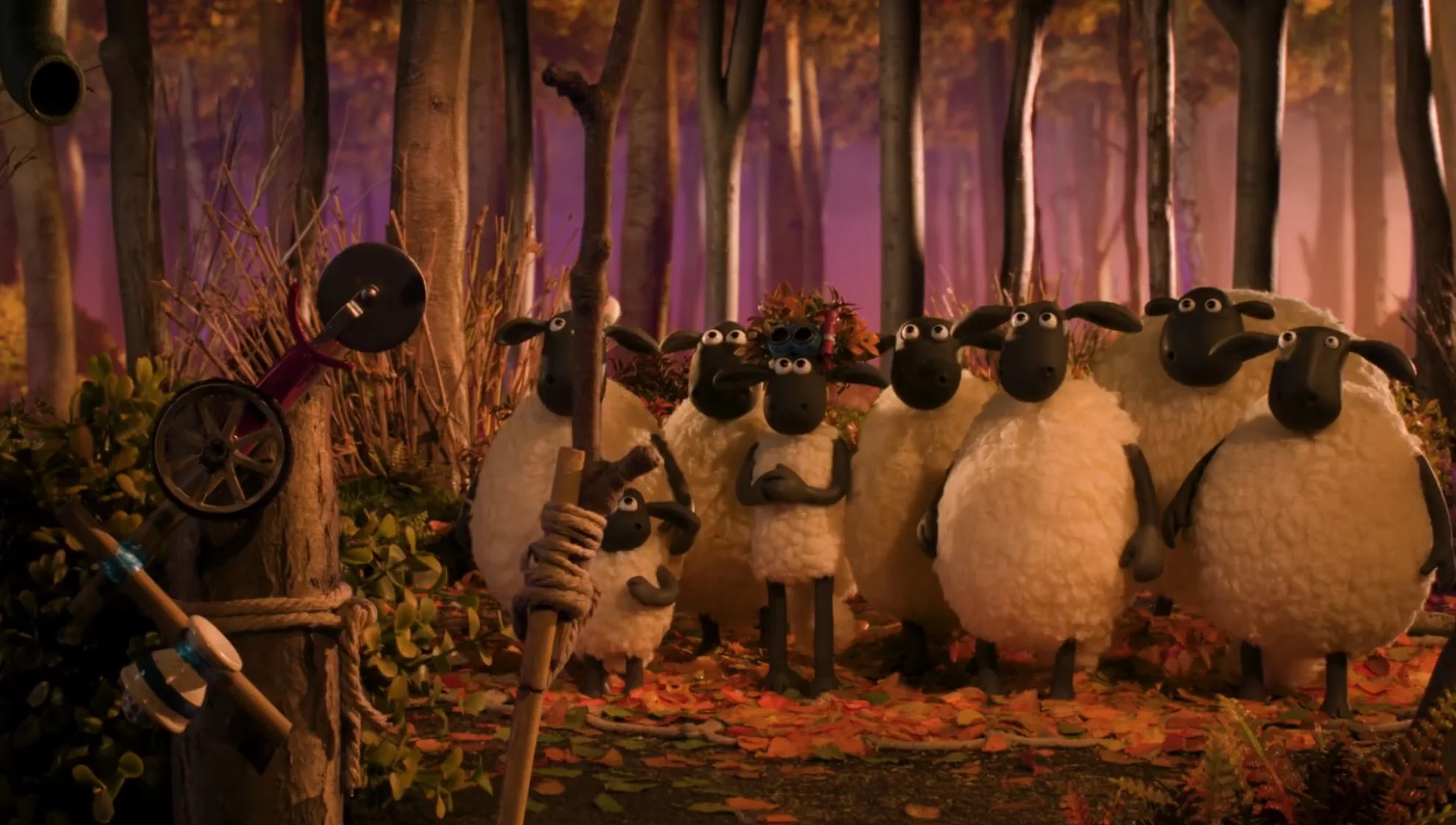
These jokes work because the characters communicate largely through movement, bleats, grunts and expressions. A glance becomes punctuation. A pause becomes explanation. Panic is communicated through posture. Even a background worm can join the emotional weather when chaos passes overhead and the poor creature registers what the humans have missed. Silence gives the animation a peculiar honesty. Nothing can hide behind chatter.
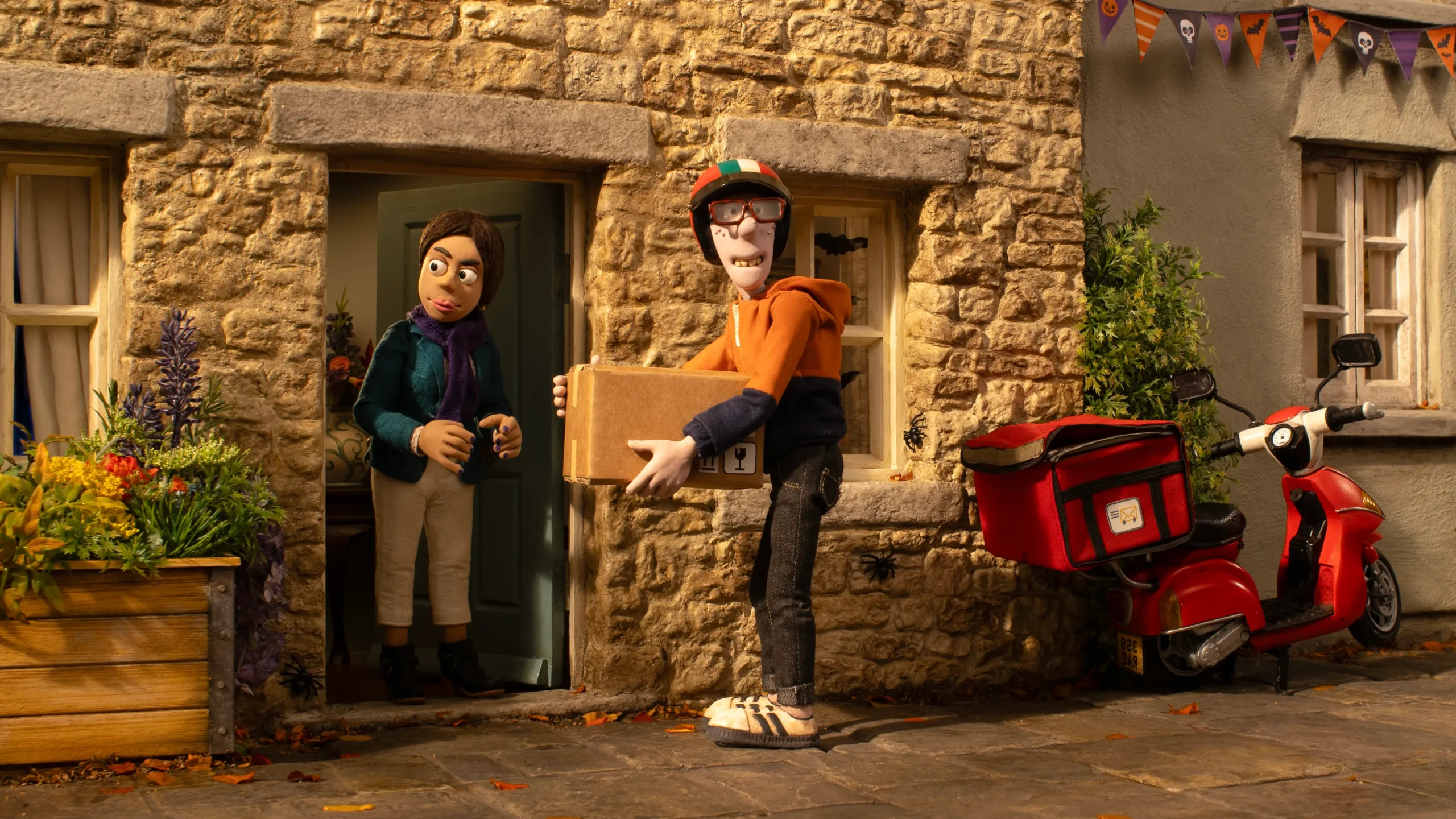
That matters especially in the Farmer’s transformation. Hair is a difficult material for stop-motion because every shift risks exposing the hand behind the illusion. Here the thick fur becomes part of the creature’s physical presence without turning visually unstable. The handmade quality remains visible without becoming distracting. Aardman’s puppets have always seemed alive partly because they are obviously objects. Their textures remind us that somebody touched them into motion, frame by frame, and that tactile presence suits this monster story beautifully. Horror has rarely looked so soft.
The film enjoys its references without relying on recognition. A Psycho-style shower joke replaces Bernard Herrmann’s shrieking strings with the sound of sheep flossing. Bitzer howls beneath the moon like a werewolf. An angry mob reaches instinctively for the visual language of Frankenstein. You can miss every reference and still understand every joke.
That accessibility is both the film’s great strength and the source of its mild limitation. The Beast of Mossy Bottom knows precisely how far it wants to wander from safety. The spooky imagery has texture, but little danger. The monster remains lovable. The chase remains playful. Darkness settles over Mossy Bottom without becoming oppressive.
There are moments when the film could have pushed the horror vocabulary further. The premise invites greater strangeness than it finally permits. A few stretches also expose the familiarity of the Shaun formula: accident, escalation, pursuit, repair. Aardman executes that rhythm with such confidence that repetition rarely becomes irritation, though the machinery is easier to see now.
Still, familiarity feels unusually appropriate here. Halloween itself is built from repetition. We carve the same faces into pumpkins, tell the same ghost stories, resurrect the same monsters, then pretend surprise when they return.
The Farmer’s story understands that ritual in miniature. He wants to change himself before asking another person to see him. Instead he becomes unrecognizable, and the film spends much of its running time bringing him back into view. Beneath the fur, cement feet, screaming villagers and laboratory mishaps is a gentle idea about humiliation: sometimes the thing we hide becomes the costume everyone notices. And then a sheep makes another terrible decision with science.
Shaun the Sheep: The Beast of Mossy Bottom is scheduled for theatrical and platform release on September 18, 2026, with distribution handled by Sky UK, GKIDS, and StudioCanal. The stop-motion animated comedy follows Shaun as he attempts to fix a ruined pumpkin patch ahead of Halloween, inadvertently causing the Farmer to go missing while a mysterious beast roams the nearby woods.
Where to Watch Shaun the Sheep: The Beast of Mossy Bottom (2026) Online
Full Credits
Title: Shaun the Sheep: The Beast of Mossy Bottom
Distributor: Sky UK, GKIDS, StudioCanal
Release date: September 18, 2026
Rating: G
Director: Steve Cox, Matthew Walker
Writers: Mark Burton, Giles Pilbrow
Producers and Executive Producers: Richard Starzak, Paul Kewley, Mark Burton, Carla Shelley, Peter Lord, David Sproxton
Cast: Justin Fletcher, John Sparkes, Kate Harbour, Dani Dyer, Roman Kemp, Nina Sosanya, Paul Whitehouse
Director of Photography (Cinematographer): Charles Copping
Editors: Sim Evan-Jones
Composer: Natalie Holt
The Review
Shaun the Sheep: The Beast of Mossy Bottom
Shaun the Sheep: The Beast of Mossy Bottom turns classic monster-movie imagery into something soft, tactile and quietly melancholy without losing the physical comedy that defines the series. The Farmer’s transformation gives the silliness an emotional pulse, while Aardman’s stop-motion detail keeps even familiar franchise rhythms pleasurable. The horror could have grown stranger, and a few stretches expose the machinery beneath Shaun’s formula, but the film remains precise, warm and very funny.
PROS
- Excellent visual comedy
- Beautiful tactile stop-motion
- Gentle monster-movie melancholy
- Clever horror references
- Strong silent characterization
CONS
- Familiar franchise structure
- Horror rarely becomes truly strange
- Some pacing loses sharpness