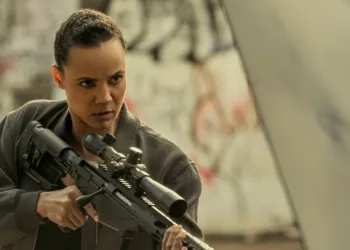





























The first warning arrives in the form of horses. Tessa Ensler looks at the polished barristers around her and imagines thoroughbreds, people bred for the institution in a way she never was. Susanna White then gives us actual horses in slow motion. The metaphor had already done its work. The image arrives anyway, as if the film fears we might have missed the point. That instinct follows Prima Facie everywhere.
Suzie Miller’s adaptation of her acclaimed one-woman play expands Tessa’s world far beyond theatrical monologue. Cynthia Erivo’s Tessa is a gifted criminal defense barrister at the Old Bailey, working among colleagues who carry privilege with the ease of inherited furniture. She came through Cambridge on scholarship. Her mother June, played by Noma Dumezweni, cleans for a living, while her brother Johnny, played by Toheeb Jimoh, works construction. Tessa has earned access to a world that many around her seem born expecting.
The courtroom is where she converts that insecurity into command. She knows how far to push a witness, when to retreat, which inconsistency will fracture a story. Sexual-assault cases are part of the job. The morality of a client’s conduct is secondary to the machinery of defense. Law has rules, and Tessa is very good at them.
White initially shoots this confidence with energy. Tessa moves through the Old Bailey as someone who has mastered a hostile room. Erivo adds another tension beneath the professional assurance. Tessa is commanding because she has learned that hesitation costs her differently than it costs her wealthier colleagues. Her confidence feels constructed, maintained, polished daily. The film rarely allows that performance to remain sufficient.
Miller preserves much of Tessa’s internal narration from the play, even though cinema has now made visible the people and events that narration once had to summon. The result is a strange doubling. We see Tessa assess a courtroom, then hear her assess it. We watch desire develop between her and fellow barrister Julian Brooks, played by Daniel Ings, while her thoughts clarify desire that Erivo has already communicated physically. Images explain dialogue. Voiceover explains images. The filmmaking keeps placing interpretive subtitles over its own drama.
This becomes especially frustrating because Erivo is so good at holding competing states in the same expression. During Tessa’s early relationship with Julian, she relaxes just enough for the change to register. He is wealthy, charming and professionally secure, a man whose sense of belonging has never required Tessa’s vigilance. Their attraction pushes the film briefly toward glossy workplace romance. Then Julian rapes her.
White tries to render the assault through subjective rupture. Focus blurs. Sound pounds. Broken glass flashes against darkness. The intention is clear: ordinary perception has collapsed, so cinematic form collapses with it. Yet the effect is curiously distancing. The glass is too explicit an emblem, another piece of imagery announcing fracture when Erivo’s face is already showing us what has broken.
The camera becomes far stronger when it stops announcing itself. At the police station, close framing gives Tessa almost nowhere to hide. Her training begins working against her immediately. She knows she has showered. She knows she deleted a message. She knows she had been drinking. She knows prior consensual sex with Julian will shape the case. Each realization reaches her twice, once as a traumatized woman and again as the barrister who has used precisely these details against other women.
This is where Prima Facie finds its most difficult idea. Tessa does not need to discover that the legal system can dismantle an accuser. She has performed that dismantling herself. What changes is the distance between professional knowledge and embodied knowledge. A principle she understood from behind counsel’s table acquires a different meaning once her own memory, conduct and credibility become exhibits.
The screenplay occasionally flattens that distinction. It pushes Tessa toward revelations that someone with her experience should already possess, turning a brutal shift in perspective into something closer to a lesson. The stronger drama sits elsewhere, in the possibility that expertise offers no protection when the institution begins examining you.
Class sharpens that vulnerability. The film gives Tessa a family life the stage version could describe only through her, and those additions make her professional ascent feel tangible. June’s work as a cleaner sits in direct contrast with the legal establishment Tessa has entered. Tessa notices service workers whom colleagues seem capable of overlooking completely. Julian, meanwhile, inhabits privilege without needing to discuss it.
Race is present less securely. Casting Erivo makes Tessa’s difference visible in rooms filled with institutional confidence, yet the screenplay rarely allows Blackness to become part of how she or her family understands those rooms. Class receives behavior, history and friction. Race mostly receives visibility. Johnny’s aggressive response after learning of the rape becomes uncomfortable in that vacuum, because the film gives him too little interior life to prevent the characterization from brushing against an old stereotype.
The adaptation’s larger structural problem appears after Tessa reports Julian. Years pass before the trial. That gap removes precisely the period in which her transformation might have accumulated dramatic weight: the professional retreat, the altered family relationships, the daily corrosion of certainty, the long wait while a legal process turns trauma into paperwork.
Instead, Prima Facie arrives at court ready to make its argument. Mike Eley’s close-ups during the trial create a productive sense of intrusion. Tessa, once able to study witnesses from the controlled position of an advocate, is now pinned beneath scrutiny. Her face becomes evidence. Her pauses become evidence. Memory itself becomes contested territory. Simon Russell Beale’s defense barrister applies the institutional pressure Tessa already knows by heart.
Yet the film again refuses to trust silence for long. Voiceover returns. Arguments are verbalized. Erivo receives a major courtroom speech about trauma, memory and a system that expects a violated person to recall experience with the clean consistency of a legal document. She delivers it with force, though the scene carries the weight of material already explained repeatedly.
That is the peculiar failure of Prima Facie. Its subject concerns an institution that mistrusts testimony unless it can be organized into acceptable proof, while the film distrusts its own audience unless every emotional and thematic point has been furnished with explanation.
The irony would be devastating if it seemed intentional. Instead, it exposes the adaptation’s uncertainty about cinema itself. Erivo can communicate shock before a symbol arrives. A close-up can make scrutiny invasive without narration identifying the invasion. A contradiction can remain unresolved long enough to disturb us. Prima Facie keeps presenting evidence after the case has already been made, until persuasion begins to resemble cross-examination.
Prima Facie had its world premiere at the Toronto International Film Festival on September 13, 2026. Adapted from the acclaimed stage play, the drama follows a brilliant defense barrister whose life is upended when she is sexually assaulted by a colleague and forced to navigate the very legal system she once trusted.
Full Credits
Title: Prima Facie
Distributor: Sony Pictures Releasing International
Release date: September 13, 2026 (Toronto International Film Festival)
Running time: 1 hour 46 minutes (106 minutes)
Director: Susanna White
Writers: Suzie Miller
Producers and Executive Producers: Greer Simpkin, David Jowsey, Kevin Loader, Suzie Miller, Susanna White, Solome Williams, Cynthia Erivo
Cast: Cynthia Erivo, Daniel Ings, Simon Russell Beale, Elizabeth Dulau, Noma Dumezweni, Toheeb Jimoh, Harry Treadaway, Sarah Junillon, Elliot Levey
Director of Photography (Cinematographer): Mike Eley
Editors: Justine Wright
Composer: Isobel Waller-Bridge
The Review
Prima Facie
Prima Facie has a fierce argument and a formidable Cynthia Erivo, yet Susanna White’s film repeatedly mistrusts the tools that might have made both devastating. Voiceover explains performances, symbols explain emotions, and the three-year jump removes much of the transformation its courtroom reckoning needs. The police-station sequence shows the stronger film hiding inside it: close framing, restrained acting, and institutional pressure doing the work without instruction. Too often, the adaptation keeps submitting evidence after its case is already clear.
PROS
- Cynthia Erivo’s controlled, layered performance
- Strong police-station sequence
- Effective courtroom close-ups
- Sharp examination of legal credibility
- Class tension has concrete dramatic weight
CONS
- Excessive explanatory voiceover
- Heavy-handed visual symbolism
- Three-year jump weakens Tessa’s transformation
- Race receives limited dramatic development
- Courtroom material often restates established ideas