
















Knowing that Luca Varani is going to die changes almost everything about watching him live. A minor argument feels heavier than it should. An unfinished diploma carries an odd sadness. Looking for an apartment with his girlfriend starts to resemble a glimpse of a future the film knows he will never reach. Edoardo Gabbriellini understands that this knowledge can be stronger than suspense, and The City of the Living spends much of its time asking us to stay with Luca before tragedy turns him into a name attached to a murder.
That choice gives the film its deepest emotional charge. Luca, played with remarkable ease by Emanuele Maria Di Stefano, is 23 and still somewhere between dependence and adulthood. He helps his father Giuseppe with the family’s candy and gift van, attends night school without much enthusiasm, loves his girlfriend Marta badly at times and tenderly at others, gambles away money he ought to save, and keeps imagining that a settled life is just ahead of him. His parents, Giuseppe and Silvana, adore him. Marta keeps returning after their arguments. Luca himself seems convinced that there will always be time to fix whatever he damages.
Di Stefano never plays him like someone walking toward a predetermined ending. That matters. Luca can be affectionate, selfish, restless, cocky and thoughtless without any of those traits becoming a clue to his death. An early disagreement with Marta over something as ordinary as choosing a restaurant tells us plenty about their relationship because the scene is allowed to remain ordinary. Their friction feels like the kind two young people assume they will have years to outgrow.
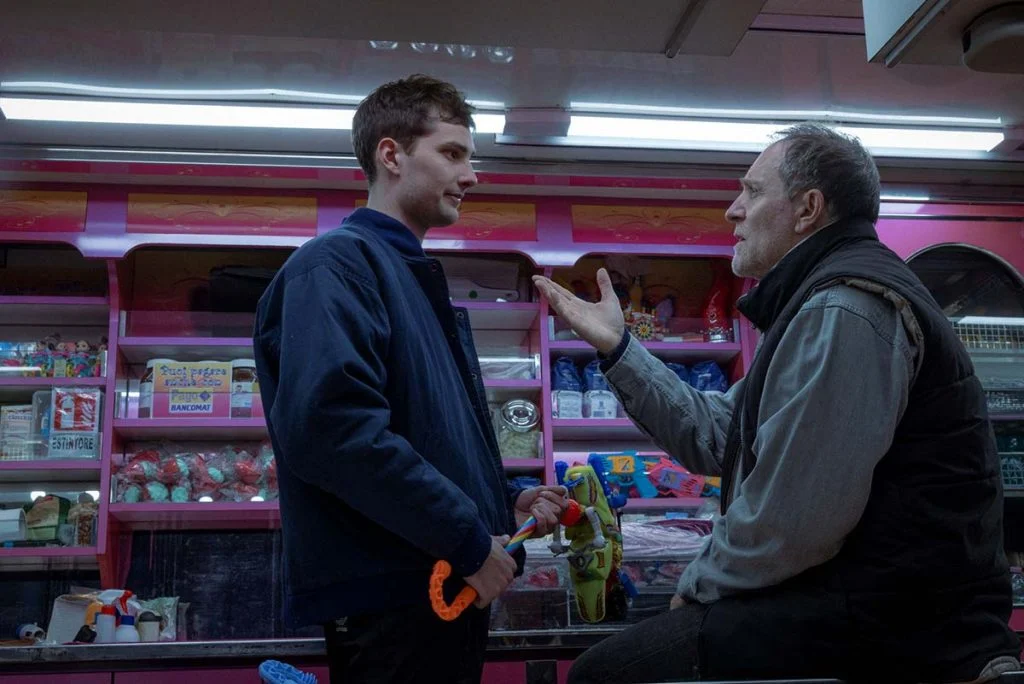
Gabbriellini keeps building Luca from details like these. His drifting away from school, his attempts to find better work and his inability to hold onto money create the feeling of a young man moving without a map. Even his hidden encounters with men arrive less like a dramatic revelation than another expression of that restlessness.
A chance meeting with Andreas near Termini introduces Luca to sex work with wealthy male clients. The money appeals to him partly because it arrives quickly and can support the future he keeps talking about with Marta. Some encounters ask relatively little of him. Others move him deeper into a world he keeps separate from his family and girlfriend. The film refuses to reduce those experiences to a tidy statement about Luca’s identity or frame them as moral decline.
That lack of explanation is often one of the film’s strengths. Luca does not seem interested in categorizing himself for our convenience, and Gabbriellini follows his lead. The downside is that restraint occasionally becomes distance. There are moments when money, sexuality, boredom and risk begin to form a complicated picture of Luca, only for the film to retreat before examining the connection further. Preserving mystery keeps him from becoming a psychological case study, yet curiosity would not necessarily have meant judgment. Sometimes I wanted the film to stay closer to the contradictions it had already uncovered.
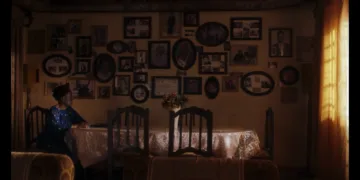
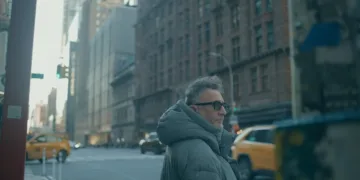
The emotional logic becomes clearer as Luca moves through Rome. He travels between his family’s modest world on the outskirts, night streets, Termini and the private interiors of wealthier men, constantly brushing against other possible versions of his life. Amine Messadi’s cinematography tends toward darkness and understatement rather than turning the city into spectacle. Rome rarely becomes a grand character in itself, but its spaces help express Luca’s drift. He keeps moving through places that promise possibility without giving him direction.
The measured pace can test patience. Gabbriellini is so committed to daily life that stretches of the film risk feeling dramatically weightless. Luca works, argues, wanders, makes plans and changes them. The progression can seem slight because the movie has rejected the usual true-crime machinery that might otherwise provide momentum. Then Luca disappears, and the rhythm reveals what it has been doing.
The film has spent so much time making his presence ordinary that his absence suddenly feels enormous. The routines that appeared loose or repetitive begin to hurt. There will be no next argument with Marta, no better job, no later attempt at school, no apartment that finally becomes theirs. A story that has resisted pushing emotion onto the viewer finds its strongest feeling through subtraction.
Gabbriellini applies the same restraint to Luca’s murder. The violence is largely withheld, and the men responsible occupy very little of the film’s attention. There are no extended interrogations, courtroom theatrics or grim fascination with the perpetrators’ psychology. Instead, the final stretch stays with people forced to understand that Luca is simply gone. Valerio Mastandrea is especially affecting as Giuseppe because his grief never seems arranged for dramatic release. The pain comes through disbelief, as if a parent might still find some administrative error capable of reversing death.
There is a difficult complication in the film’s treatment of the killers. Their sexuality is never offered as a motive, and keeping them at the edge of the story protects Luca from being displaced by fascination with his murderers. Yet their limited characterization also means that queerness, fetish and menace become some of the few traits attached to them.
The intention may be refusal rather than association, but the result can still leave an uncomfortable imbalance, especially in a film otherwise so committed to granting people texture. That tension does not erase the care shown elsewhere, though it complicates the film’s claim to emotional generosity.
The film’s deepest sadness is waiting in the ordinary plans it has spent so much time collecting: school Luca assumes can wait, the apartment he and Marta may rent, another job, another reconciliation. Gabbriellini cannot stop us from knowing what is coming, so he changes the meaning of that knowledge. Luca behaves as people his age often do, assuming time is abundant enough to waste. By the final stretch, every abandoned plan hurts precisely because Luca never knew it was final.
The City of the Living had its world premiere at the 83rd Venice International Film Festival in September 2026. Based on Nicola Lagioia’s real-life crime novel, the Italian drama explores the chilling aftermath and societal shockwaves of a senseless, brutal act of violence in the suburbs of Rome.
Full Credits
Title: The City of the Living
Distributor: Eagle Pictures
Release date: September 4, 2026 (Venice International Film Festival)
Running time: 1 hour 44 minutes (104 minutes)
Director: Edoardo Gabbriellini
Writers: Damiano D’Innocenzo, Fabio D’Innocenzo
Producers and Executive Producers: Not publicly specified
Cast: Emanuele Maria Di Stefano, Gaia Merlonghi, Valerio Mastandrea, Simona Senzacqua, Roberta Mattei
Director of Photography (Cinematographer): Amine Messadi
Editors: Jacopo Ramella Pajrin
The Review
The City of the Living
The City of the Living is strongest when it trusts ordinary life to carry the weight of tragedy. Edoardo Gabbriellini’s restraint sometimes leaves Luca’s contradictions underexplored, and the film’s handling of queer representation creates an uneasy blind spot. Yet Emanuele Maria Di Stefano gives Luca enough warmth, restlessness, and unfinished possibility that his absence lands with real force. By refusing to turn murder into spectacle, the film makes what Luca expected to keep doing feel painfully precious.
PROS
- Di Stefano’s natural, emotionally open performance
- Powerful use of absence and withheld violence
- Strong emotional payoff from everyday detail
- Thoughtful resistance to true-crime sensationalism
CONS
- Restraint sometimes becomes emotional distance
- Some of Luca’s contradictions remain underdeveloped
- Queer representation creates an uncomfortable imbalance