

























A strange thing happens when a person dies: the world does not immediately become a memorial. The buses still run. People still argue about breakfast. Someone still discovers a turtle and wants to show it to a teenager who barely knows how to respond. Jacqueline Lentzou understands this uncomfortable truth, and A Day in the Life of Jo: Chapter Phaedra builds an entire film around it. Loss arrives inside an ordinary day, which might be the most honest place for it to appear.
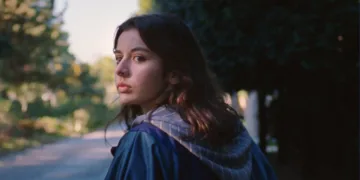
Inspired by the 2008 killing of Alexandros Grigoropoulos in Athens, the film avoids becoming a direct recreation of a tragedy. Lentzou takes the event as a wound rather than a subject to be explained. She changes the victim’s identity, creating Jo, a fifteen-year-old girl whose life feels unfinished in every possible way. She is impulsive, lonely, occasionally cruel, occasionally sweet, and still searching for a version of herself that feels real.
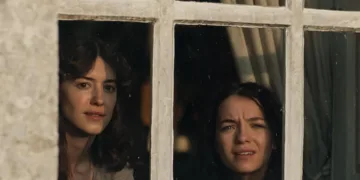
That search gives the film its strange emotional power. Jo’s day could belong to any teenager. She misses the school bus, fights with her mother, spends time with friends, kisses a boyfriend who seems less interesting than he believes himself to be, and drifts through classes with the familiar boredom of someone waiting for life to begin.
The film quietly asks a difficult question: how much meaning exists inside moments we usually ignore? Lentzou’s answer is found through Phaedra, a classmate whose appearance feels almost impossible. When Phaedra sings “The Rose Tattoo” during music class, Jo reacts as if she has discovered a hidden language. The scene is simple, yet it changes the emotional temperature of the entire film. A song becomes a doorway. Another person becomes a revelation.
Phaedra is fascinating because the film refuses to define exactly what she represents. She could be a friend, a first love, a spiritual messenger, or simply the person who allows Jo to recognize something within herself. The mythological names scattered throughout the school suggest that ordinary teenagers are carrying ancient stories without realizing it. Greek mythology is not placed on a pedestal here. It is walking through hallways, sitting in classrooms, and occasionally singing in front of bored students. This is where Lentzou’s film becomes something stranger than a coming-of-age story.
The director treats Jo’s reality as something unstable. The camera floats through neighborhoods and rooms as if physical spaces are memories rather than locations. The sound design often places us closer to Jo’s internal world than her conversations do. Breathing, footsteps, doors, and distant noises create the sensation of living inside a mind trying to understand itself.

The visual language follows the same idea. A scene with Jo’s mother dancing transforms into another space entirely. A camera movement away from a collapsing body becomes a movement toward a basketball court. Light reflections become moments of attention. The film looks at ordinary objects as if they are waiting to reveal a secret. Sometimes this approach feels beautiful. Sometimes it feels like Lentzou is asking the audience to accept a private dream without enough explanation. That tension is part of the film’s identity.
The final act pushes this idea to its limit. The camera’s relationship with the world changes completely, and the film enters a more abstract space of voices, light, and sound. Some viewers will find these passages deeply moving. Others may feel that the film leaves emotional reality behind at the exact moment it needs to hold onto it. I found myself moving between those reactions. The abstraction can feel distant, yet the feeling underneath it remains painfully human.
This contradiction may be the film’s most interesting quality. It wants to transform tragedy into something spiritual, but it never fully escapes the weight of what inspired it. It reaches toward another world while keeping one foot on the ground.
Evita Andriopoulou carries that conflict beautifully. Her performance understands that adolescence is rarely one clear emotion. Jo can be angry one minute and vulnerable the next. She can reject affection and then desperately search for connection. Andriopoulou does not turn Jo into a symbol. She keeps her alive.
That matters because films about death often accidentally make their subjects disappear. They become examples, warnings, or ideas. Lentzou’s greatest achievement is preserving Jo’s messy humanity before the film asks us to think about absence.
A Day in the Life of Jo: Chapter Phaedra is an imperfect film because it believes so deeply in its own mystery. There are moments when its symbols float away from the audience instead of reaching them. Yet there is something rare about a film willing to examine a life through fragments rather than explanations. It understands that a person is built from small gestures, unfinished conversations, and moments that seem meaningless until they are gone.
Perhaps that is why the turtle scene stays behind. A group of children find something fragile and immediately want someone else to see it. Jo does not fully understand the importance of that moment. None of us usually do, until we do.
A Day in the Life of Jo: Chapter Phaedra had its world premiere in the Orizzonti section at the 83rd Venice International Film Festival on September 8, 2026. The coming-of-age drama follows a lonely fifteen-year-old girl named Jo whose mundane routine shifts when a mysterious new classmate named Phaedra awakens deep emotional resonance and genuine connection.
Full Credits
Title: A Day in the Life of Jo: Chapter Phaedra
Distributor: Lucky Number
Release date: September 8, 2026 (Venice International Film Festival)
Running time: 1 hour 30 minutes (90 minutes)
Director: Jacqueline Lentzou
Writers: Jacqueline Lentzou
Cast: Evita Andriopoulou, Eleni Vergeti, Anastasia Gouliamou, Iosif Ali, Ektoras Lygizos
Director of Photography (Cinematographer): Grimm Vandekerckhove
Editors: Gabriel Gonzalez, Jacqueline Lentzou, Nikos Vavouris
Composer: Colin Stetson
The Review
A Day in the Life of Jo: Chapter Phaedra
A Day in the Life of Jo: Chapter Phaedra turns a story shaped by tragedy into a strange meditation on memory, identity, and the fragile details that make a life feel real. Jacqueline Lentzou’s dreamlike approach can sometimes drift into abstraction, but its emotional core remains powerful. Evita Andriopoulou gives Jo a deeply human presence, while the film’s imagery and sound create a world suspended between life and absence.
PROS
- Evocative visual and sound design
- Evita Andriopoulou’s layered performance
- Thoughtful exploration of mortality and identity
- Strong symbolic use of music and myth
CONS
- Abstract final act may divide viewers
- Some symbolism feels intentionally unclear
- Experimental choices occasionally create distance