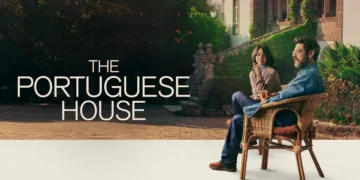


























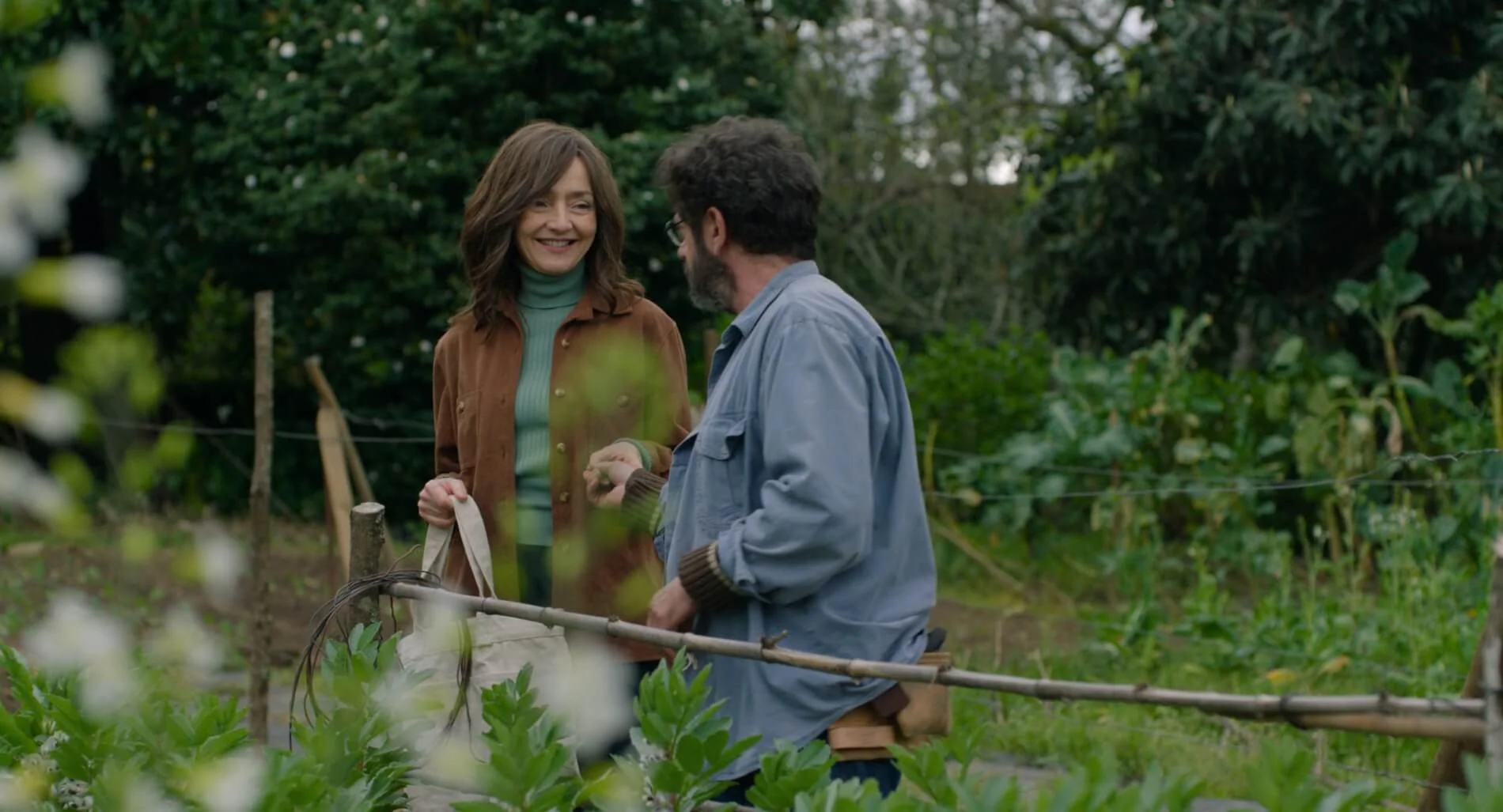
Amália can see that her new gardener does not know his way around the loppers. Fernando’s glasses and careful manner belong easily to a classroom, less easily to the grounds of her Portuguese estate. She seems to suspect that the man calling himself Manuel is someone else, yet she allows him to stay. Their friendship grows inside that decision. A stranger is given the chance to become familiar before he is asked to explain himself.
Avelina Prat gives this arrangement a persuasive warmth in The Portuguese House. Amália, played by Maria de Medeiros, remains watchful without turning every quiet exchange into an interrogation. Manolo Solo lets Fernando settle gradually into the borrowed job; his ease with Amália develops faster than his ease with the tools. Conversation and comfortable silence do much of the work that a confrontation might have done in another film. The pleasure of these scenes rests partly on a question the characters can afford to leave unspoken: who is this man, and what does Amália’s trust ask of her?
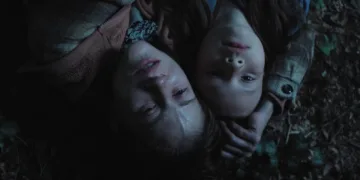
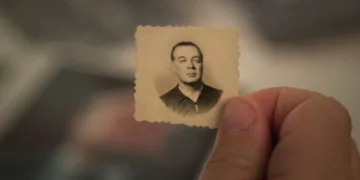
Fernando has come from Madrid after his wife, Milena, disappears. The film shows her preparing to leave, then crumpling the letter she has written to him. That small reversal denies Fernando an explanation, but it also gives Milena a moment of hesitation before her absence becomes his story. She is a Serbian immigrant; he is a geography professor whose knowledge of places offers little help when his own life becomes unfamiliar. In Portugal he meets a gardener named Manuel. Manuel dies suddenly, and Fernando takes his name and the job awaiting him at Amália’s estate.
Prat understands the appeal of such a departure. Fernando has been abandoned, and Solo plays his bewilderment without demanding pity at every turn. Yet Milena’s disappearance and Fernando’s impersonation are not interchangeable acts of escape.
Her crumpled letter leaves a painful gap; his decision places him inside another man’s identity and inside a household prepared to employ that man. The film is alert to the kinship between people who want distance from their former lives. It is less eager to dwell on the obligations that remain when one of them finds a welcoming new place.
The estate’s gentle pace makes that reluctance easy to share. Fernando and Amália have time to talk, sit together, and grow accustomed to each other. Natural light and open space make the grounds inviting, while the gardening gives Fernando something to do beyond rehearsing his loss. Prat lets companionship form through repeated presence rather than a sudden disclosure. The film’s patience is a real strength: it makes room for affection that need not settle immediately into romance, and for a man who cannot explain his grief neatly to live alongside other people.
That same patience can soften the terms of Fernando’s welcome. Amália’s decision to leave her suspicions alone is hers to make, and de Medeiros gives it the texture of discernment rather than simple innocence. Still, the gardener’s place in the household has practical meaning. Fernando’s uncertainty with the loppers is a reminder that the identity he has taken comes with work he cannot yet perform. As the film grows comfortable with him, that early sign of deception recedes. Kindness becomes the means by which he can inhabit a life that was offered to someone else.
The later arrival of Olga, a Serbian waitress who has also assumed another identity, restores some of the unease. She gives Fernando another person through whom to consider what a borrowed name can conceal or permit. Their rapport has a different energy from the quiet companionship at the estate, and the shift gives the final stretch new momentum. It also makes the film’s design easier to see. After so much time spent letting relationships develop without announcement, a second impersonation can feel arranged to make the theme unmistakable.
There is value in Prat’s refusal to treat these people as cases awaiting judgment. Solo and de Medeiros make Fernando and Amália’s friendship worth protecting; the film would lose something vital if every silence between them were filled with suspicion. Yet its generosity carries a cost when difficult feelings pass through the story with so little resistance. Milena’s unexplained leaving, Manuel’s lost place, and Amália’s choice to trust Fernando do not bear on him in the same way. The film notices each of them, then spends its richest, most peaceful hours beside Fernando in Amália’s garden, where the tools still belong to another man.
The Portuguese House originally debuted at the Málaga Film Festival before expanding to international theatrical releases. The drama follows a melancholy geography teacher who assumes another man’s identity to work as a gardener on a secluded Portuguese estate, where he forms an unexpected bond.
Where to Watch The Portuguese House (2025) Online
Full Credits
Title: The Portuguese House
Distributor: Filmax, NOS Audiovisuais
Release date: March 17, 2025 (Málaga Film Festival) / May 9, 2025 (Spain) / July 31, 2025 (Portugal)
Running time: 1 hour 54 minutes (114 minutes)
Director: Avelina Prat
Writers: Avelina Prat
Producers and Executive Producers: Miriam Porté, Luís Urbano, Miguel Molina, Adán Aliaga
Cast: Manolo Solo, Maria de Medeiros, Branka Katić, Rita Cabaço, Xavi Mira, Rui Morisson, Ivan Barnev, Luísa Cruz
Director of Photography (Cinematographer): Santiago Racaj
Editors: Juliana Montañés
Composer: Vincent Barrière
The Review
The Portuguese House
The Portuguese House earns its warmth through Manolo Solo and Maria de Medeiros, whose quiet exchanges make Fernando’s place at the estate feel lived in. Prat’s patience gives their friendship room to grow. Yet the film grows so comfortable with Fernando that it lets the cost of his borrowed identity drift from view. Its gentleness remains appealing, even as its most difficult question goes partly unanswered.
PROS
- Restrained, persuasive lead performances
- Friendship built through conversation and silence
- An unhurried sense of life at the estate
CONS
- Fernando’s deception loses its force
- Difficult feelings receive too little resistance
- Olga’s parallel identity feels conspicuously arranged