




























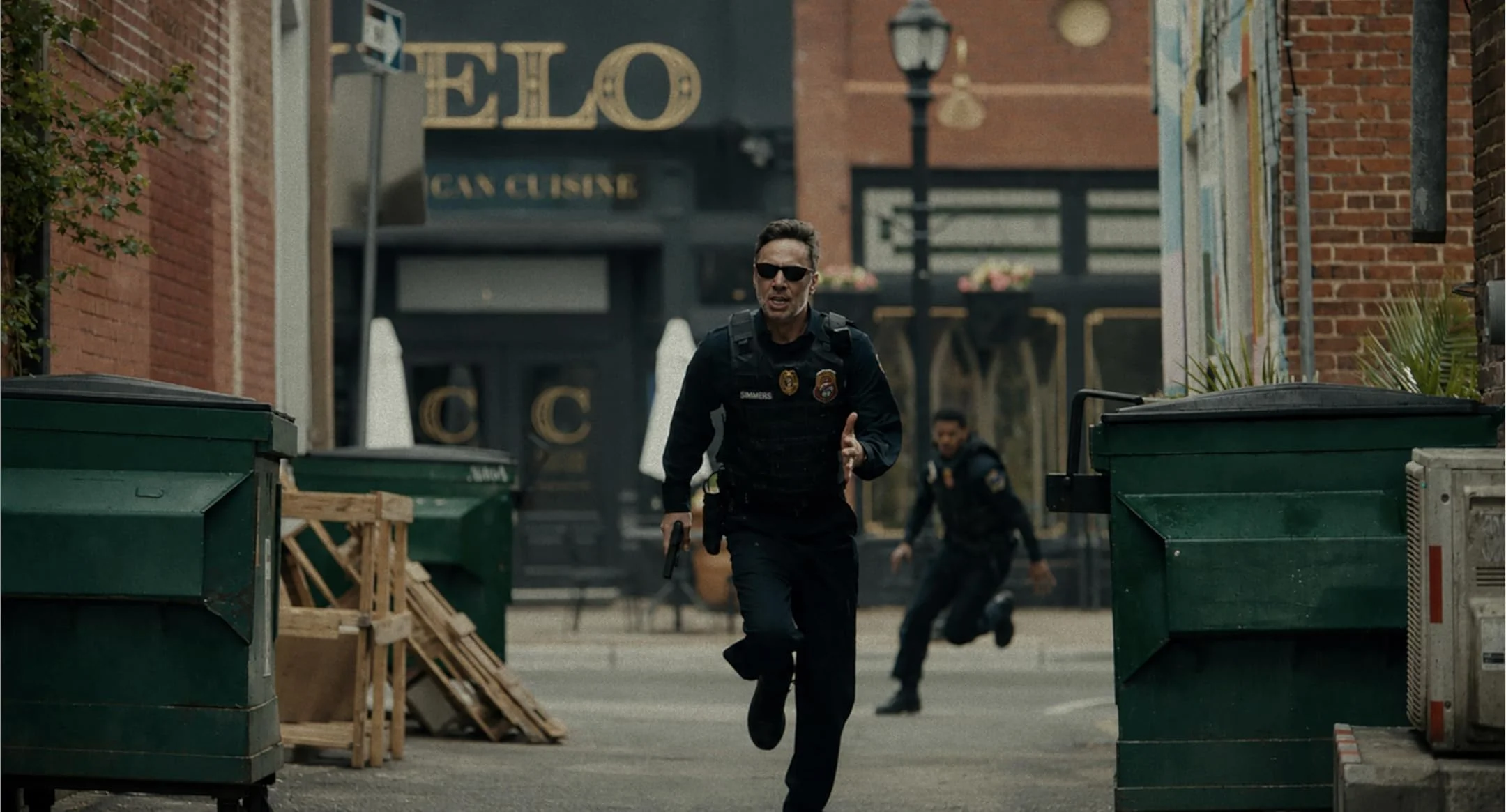

Police-radio chatter reaches us while the studio logos are still on screen, and the chase that follows feels underway before we have properly entered the film. Letting a scene’s sound precede its images is a simple way to pull an audience forward: we start listening for an event, then the picture catches up. Jake Allyn uses that handoff effectively in Clean Hands. Before we know much about the officer doing the pursuing, we understand the urgency of his working life.
That officer is Kevin Simmers, a Hagerstown, Maryland narcotics sergeant played by Zach Braff. Pursuit becomes the organizing activity of this dramatized true story, including Kevin’s response to his nineteen-year-old daughter Brooke’s opioid addiction. He seeks treatment, allows punishment, and goes after the people supplying her drugs. The chases and forceful interrogations, intensified by music from Those Who Ride With Giants, give those efforts a familiar thriller excitement. We are encouraged to want him to catch somebody. The harder question is what catching somebody can accomplish for Brooke.
Braff gives that question an emotional foundation. Kevin’s casual humor helps establish a man whose personality has survived difficult police work, while his anger reveals how poorly his professional confidence serves him at home. His devotion is easy to understand even when his decisions are painful to watch. Braff makes the repeated interventions feel like the actions of a frightened father who cannot bear inactivity. That is a useful distinction for a performance to preserve: Kevin’s need to do something remains believable even as the available evidence keeps challenging his choice of action.
Esther McGregor supplies the other half of that relationship, and the film needs her badly. As Brooke progresses from Percocet abuse to heroin, her distress could easily become a series of developments announced for her father’s benefit. McGregor gives it an immediate physical presence through her eyes and tears.
Her face asks us to stay with the person experiencing the crisis before the story moves toward Kevin’s next response. The affection between them feels sincere, which makes their encounters hurt without requiring us to accept every decision he makes. I found their connection persuasive enough to sustain interest through some familiar addiction-drama turns.
Dana, Kevin’s wife, introduces a complication that deserves attention. Played with grace by Abigail Spencer, she tells him that he and Brooke are addicted to each other. The observation puts pressure on a relationship the film otherwise uses as its emotional anchor. Kevin wants his daughter safe, but his attachment to being her rescuer can interfere with understanding what she needs. Spencer gives the household a perspective outside his urgency. Her quieter support helps us recognize the distance between loving someone and insisting on directing every attempt to help them.
The script builds its middle stretch from interventions that fail. Private rehabilitation proves difficult to secure; Kevin then lets Brooke be arrested in the hope that confinement will frighten her into stopping. When that approach fails too, he intensifies his pursuit of the people he holds responsible.
This is escalation, the process of making each new obstacle provoke a stronger response. It keeps the plot active, but Kevin’s methods develop faster than his understanding. We can anticipate another failed attempt without learning much about how he absorbs the previous failure. The performances keep those repetitions emotionally credible, though they cannot supply all the reflection the writing leaves out.

Brooke’s exposure to retaliation in jail makes the problem especially clear. Kevin antagonizes guards and inmates, and she bears the consequences. Here, his protective instinct produces a danger he cannot control. The film has the material to examine that failure seriously, yet its continuing appetite for forceful police action complicates the examination.
The musical intensity surrounding the crime sequences gives his pursuit an energy that sits uneasily beside the damage his confrontations cause. Allyn can make Kevin’s conduct exciting and show its cost, but the connection between those responses needs closer attention. Otherwise, the action keeps renewing our investment in a method the family drama is teaching us to doubt.
The treatment-access and insurance obstacles offer a valuable route out of that cycle. Kevin encounters problems that authority and persistence cannot readily solve, while exploitation by law-enforcement figures challenges his confidence in the institution he serves.
These encounters bring the opioid crisis into the story through specific barriers to care and abuses of power. They also suggest a different dramatic direction: Kevin could begin learning what help requires when arresting someone is ineffective or harmful. That transition is the most consequential part of his story, and it receives surprisingly little room once the film reaches its hopeful destination.
Braff is forceful in the late courtroom scene, where Kevin’s distress gives the aftermath of tragedy an emotional weight the familiar plotting cannot erase. His promise to build Brooke a house if she stops using drugs carries a similarly understandable parental longing.
Yet a realization and the work it inspires are separate stages of a character’s development. The founding of Brooke’s House, the recovery facility Kevin establishes, arrives late and moves quickly toward success. After so much time spent watching him try to control a crisis, the film abbreviates the process of learning to offer sustained support.
Promotional material for the real facility appears in the closing credits, extending that reassuring destination beyond the drama. It provides evidence that Kevin’s efforts led somewhere useful, but it cannot fill the gap in the storytelling. Building a place of recovery would give him a new set of responsibilities, with care measured through patience and repeated decisions rather than the capture of a suspect.
There is substantial drama in that work: securing resources, making room for people whose recovery is uncertain, and responding when progress falters. Between Kevin’s promise of a house and the presentation of its success, Clean Hands leaves little time for those responsibilities to become visible.
Clean Hands premiered at the Tribeca Film Festival on June 7, 2026, before receiving its nationwide release in theaters and on demand through Vertical on October 16, 2026. Directed by Jake Allyn, the biographical crime drama centers on a veteran narcotics officer whose perspective on the opioid epidemic shifts entirely when his own daughter struggles with addiction, prompting a powerful battle to save her.
Where to Watch Clean Hands (2026) Online
Full Credits
Title: Clean Hands
Distributor: Vertical
Release date: June 7, 2026 (Tribeca Film Festival), October 16, 2026 (United States)
Rating: R
Running time: 1 hour 48 minutes (108 minutes)
Director: Jake Allyn
Writers: Jake Allyn
Producers and Executive Producers: Jake Allyn, Conor Allyn, Brian Loschiavo, James Suttles, Jason Winn, JR Rappaport, Zach Braff, Kevin Simmers, Dana Simmers, Jim Gladden, Tony Herbert, Daniel Weaver, Jonathan Beaulieu, William Deasey, Scott Davis, Linda Davis
Cast: Zach Braff, Esther McGregor, Holt McCallany, Abigail Spencer, Lucas Till, E. Roger Mitchell, Kraig Dane, Ursula O. Robinson
Director of Photography (Cinematographer): Keith J. Leman
Editors: Owen Jackson
Composer: Those Who Ride With Giants
The Review
Clean Hands
Clean Hands earns its emotional weight through Zach Braff and Esther McGregor’s convincing father-daughter bond. Its police-thriller energy makes Kevin’s urgency easy to understand, though the excitement of his pursuits complicates the film’s criticism of his methods. Repeated interventions receive patient attention; his eventual commitment to sustained care receives too little. The performances keep us invested in a transformation the script rushes to complete.
PROS
- Braff makes Kevin’s frightened devotion believable.
- McGregor gives Brooke’s distress a powerful physical presence.
- Opening sound design draws us directly into Kevin’s working life.
CONS
- Repeated interventions develop action faster than understanding.
- Thriller excitement weakens scrutiny of Kevin’s harmful methods.
- Brooke’s House receives insufficient dramatic development.







