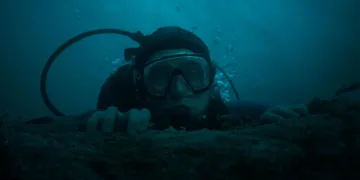






























Jay Gardiner goes looking for his father’s remains against the wishes of the man whose memory he hopes to honor. Mitt wanted his body to feed the ocean. Jay wants to bring it back. A year after his father’s death, he still cannot read the note Mitt left or visit the cemetery plot containing an empty casket. Searching the seabed gives him a task he can attempt with his hands, which may be easier than either of those apparently simpler obligations.
The search also allows Jay to continue arguing with someone who can no longer answer. Mitt, a veteran diver dying from mesothelioma, took his own life at sea. His son now disregards warnings and dives alone to retrieve him, violating the safety lessons Mitt spent years drilling into him. Obedience and rebellion have become difficult to distinguish. Even Jay’s attempt to do something for his father keeps turning into something done against him. Then a giant squid gets involved, and the family dispute acquires a digestive tract.
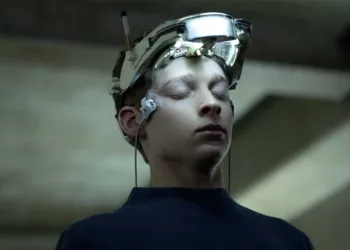
Brian Duffield’s Whalefall, adapted with Daniel Kraus from Kraus’s 2023 novel, traps Jay inside a sperm whale with roughly an hour of breathing air. The squid is the intended meal; Jay is an accidental supplement. Austin Abrams plays him with an absence of heroic composure that gives the premise its necessary human scale. Through his breathing apparatus, his cries sound obstructed and frighteningly private. His movements have the desperation of someone whose body keeps discovering dangers before his mind can organize them.
Duffield gives that body plenty to discover. Contracting flesh knocks Jay about, digestive acid threatens his skin, and the air outside his equipment cannot sustain him. When he briefly rests against the whale’s interior, the tissue moves around him. The interruption matters: even a surface that appears stable belongs to an organism conducting its own business. Jay cannot count on the room remaining the same shape.
The sound makes this instability physically persuasive. Open-water clicks and deep booms suggest distances Jay cannot survey; inside the whale, muffling shrinks the world around his breathing. During a rush toward the surface, Joseph Trapanese’s percussion lends the animal’s movement a force that seems to pass through Jay rather than carry him safely. The whale’s scale remains perceptible even when almost none of it can be seen.
This is where the film’s symbolism encounters something usefully uncooperative. The whale can stand for Mitt’s overwhelming presence, but it also has things to do that bear no relation to a young man’s grief. Feeding, swimming, digesting: a full schedule, apparently. That indifference prevents the setting from becoming a wholly obedient illustration of Jay’s feelings. A jellyfish he uses for illumination belongs to the same living world that is killing him. Survival requires finding temporary uses for things that were never put there to help.

The physical problem is less consistently clear. Jay coughs and then explains that the air is poisonous, supplying information his distress has already conveyed. Yet the route between internal spaces can remain vague enough that a movement’s purpose is difficult to anticipate. We understand the punishment immediately; the possible solution sometimes arrives without sufficient spatial preparation. This weakens a particular pleasure of survival stories: thinking alongside a frightened person as the available choices narrow.
Remembered lessons from Mitt fill some of that explanatory space. When panic drains Jay’s air, the past supplies instruction in conserving it. When swallowed debris becomes useful, his father’s teachings about the sea return with convenient relevance. The flashbacks make knowledge emotionally charged, but their timing can feel excessively accommodating. Memory begins behaving like technical support staffed by the person responsible for several of your other problems.
Mitt’s authority is the troubling part. Brolin gives his disapproval weight, and the insult “soft lungs” turns a bodily vulnerability into a judgment on his son’s character. His drinking and intimidation give Jay reasons to leave; the out-of-state scholarship offers a possible existence beyond that household. Inside the whale, however, breathing correctly becomes proof that the old man knew something. The screenplay repeatedly approaches the dangerous inference that a lesson’s usefulness vindicates the manner in which it was taught.
My first response was to resist that inference so strongly that I began resisting the flashbacks themselves. But that gives the past too simple a function. A person can need knowledge acquired through a damaging relationship. Jay should not have to forget how to breathe efficiently to establish that leaving home was justified.
Duffield finds a better way of expressing this entanglement when an assault on Jay’s sinuses gives way to remembered fireworks. The transition follows sensation into memory, allowing pain and recollection to share an instant without making the past deliver instructions. It also makes the tidier lesson-and-application passages feel restrictive. Jay’s mind can produce associations stranger and less helpful than the screenplay usually permits.
As his air dwindles and nitrogen narcosis takes hold, those associations expand into a mystical register. Mitt’s voice gains an immediate presence, and the distinction between human and animal consciousness becomes uncertain. Abrams’s continuing terror helps the shift: the performance has never suggested a man calmly administering a realistic experiment.
Duffield’s willingness to pursue this emotional extremity without embarrassed jokes deserves respect. Still, when reconciliation acquires so much influence over the survival drama, practical ingenuity begins to lose its place. Scuba equipment and recovered debris establish one kind of expectation; communion with a dead father asks for another kind of investment.
The title offers a way to think through that difficulty. A whalefall sustains other organisms after the animal’s death. Those organisms inherit nourishment without owing the dead creature agreement, affection, or a favorable account of its life. Perhaps I have been too quick to read Jay’s reliance on Mitt as the film demanding forgiveness. Using what remains can be an act of separation, too. The insistence of the father’s returning voice makes that reading harder to sustain, but Jay’s breathing lesson leaves room for it. He can practice something Mitt taught him while remembering why he wanted to leave, attending to the air he has available now.
Whalefall released in theaters nationwide on October 16, 2026, through 20th Century Studios. Directed by Brian Duffield and adapted from Daniel Kraus’s bestselling novel, the high-concept survival thriller follows a scuba diver who gets swallowed whole by an eighty-foot sperm whale while searching for his late father’s remains, forcing him to fight for survival inside the creature’s belly before his remaining oxygen runs out.
Where to Watch Whalefall (2026) Online
Full Credits
Title: Whalefall
Distributor: 20th Century Studios
Release date: October 16, 2026
Rating: PG-13
Running time: 1 hour 46 minutes (106 minutes)
Director: Brian Duffield
Writers: Brian Duffield, Daniel Kraus
Producers and Executive Producers: Brian Grazer, Brian Duffield, Jeb Brody, Allan Mandelbaum
Cast: Austin Abrams, Josh Brolin, Elisabeth Shue, Jane Levy, John Ortiz, Emily Rudd
Director of Photography (Cinematographer): Aaron Morton
Editors: Pietro Scalia
Composer: Joseph Trapanese
The Review
Whalefall
Whalefall makes dependence on a damaging parent painfully physical: Jay needs the knowledge of a man he needed to escape. Abrams’s frightened performance and the oppressive sound give that contradiction weight. The flashbacks supply answers too conveniently, and mystical reconciliation crowds out practical ingenuity. Still, the film leaves a difficult possibility alive: accepting an inheritance need not mean forgiving its source.
PROS
- Abrams’s vulnerable, physically committed performance.
- Sound that makes the whale’s scale and confinement palpable.
- Unsettling effects grounded in the animal’s bodily processes.
- Thoughtful tensions between inheritance, dependence, and forgiveness.
CONS
- Unclear internal geography weakens problem-solving suspense.
- Convenient flashbacks and redundant explanation overmanage the survival narrative.
- Mystical reconciliation diminishes the role of practical ingenuity.