
























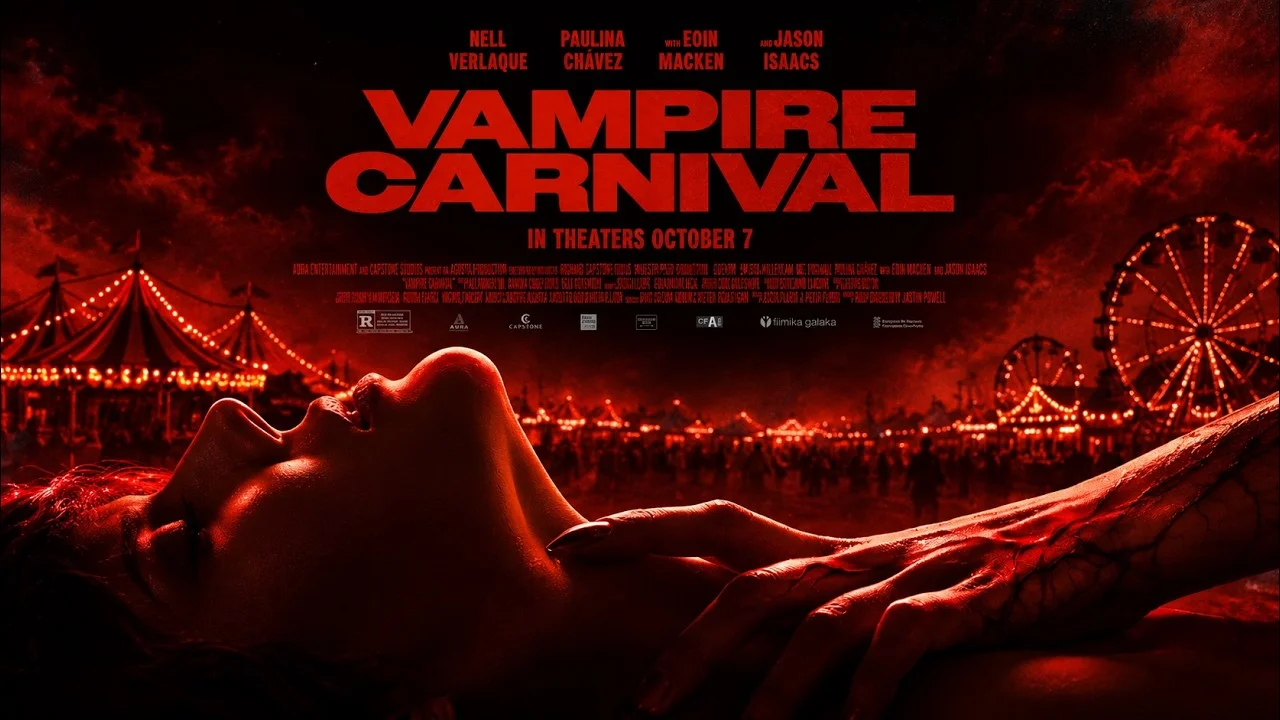

The vampires in Vampire Carnival have rules against killing, and Sebastian, one of their most persuasive recruiters, insists on consent. This is a useful complication for a film that spends so much time making its monsters attractive. If the invitation can be accepted safely, at least in principle, the suspense has to come from something beyond waiting for the teeth. Who respects the arrangement? Who resents it? What might a visitor agree to before understanding the community offering it?
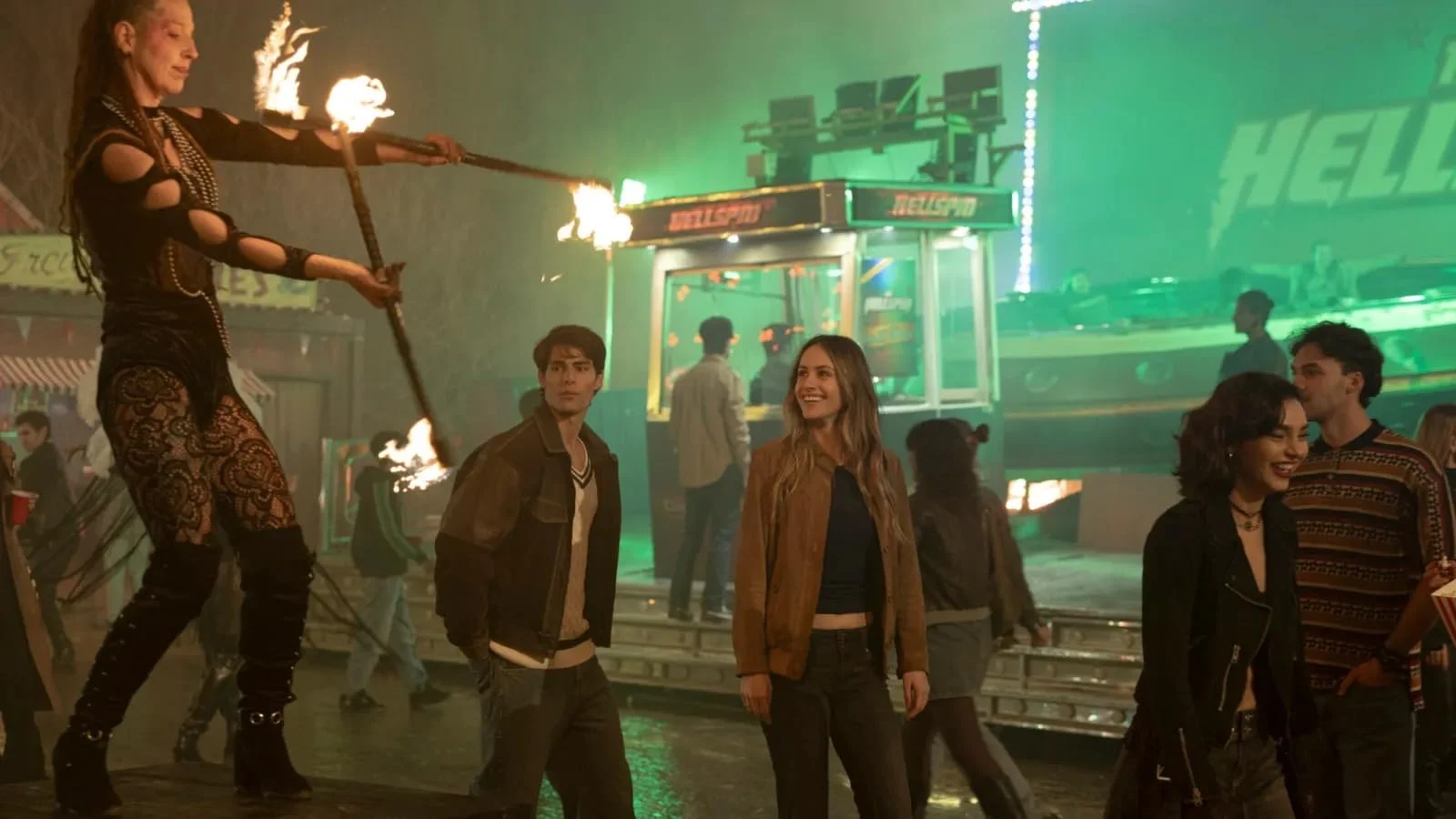
Directors David Charbonier and Justin Douglas Powell give that invitation a convincing public face. An extended tracking sequence moves through the carnival’s crowds, attractions, and performers, passing attention between people rather than fastening immediately onto a lurking threat.
The movement establishes a functioning entertainment business, complete with visitors enjoying themselves and a police officer among them. This matters to the story’s credibility. The carnival offers enough ordinary pleasure that entering its private spaces can feel like receiving special access, rather than ignoring an obvious evacuation notice.
For Gemma, played by Nell Verlaque, access to pleasure is already complicated. Her father’s suicide has left her with nightmares, while her mother withdraws into work and sleep. Friends Ryan and Olivia bring her to the carnival for an evening away from that household routine.
Verlaque establishes the distress clearly in the nightmare material, giving the subsequent attraction to Sebastian a reason beyond his considerable physical qualifications. Someone is paying attention to her without asking her to resume being the person she was before the death. The film has a credible emotional starting point here, and it does not need an elaborate supernatural explanation to connect grief with the appeal of escape.
Sebastian’s conversation about grief gives the flirtation an intimacy the private party alone could not provide. Alvise Rigo’s slightly stiff delivery has an unexpected benefit: his sympathetic remarks sound as though they come from someone whose relationship with ordinary human conversation has become distant. There is a suggestion of sadness beneath the model’s physique.
The writing, by Jason and Peter Filardi, gives that suggestion little room to develop, however. Sebastian recognizes Gemma’s suffering, but recognition does much of the work that a developing relationship should carry. His appeal is understandable before his character becomes particularly knowable, leaving the romance dependent on an imbalance the film never quite resolves.
Eric offers a potentially sharper connection between attraction and damage. Gemma’s former boyfriend has returned as the carnival’s Man Who Feels No Pain, performing self-inflicted injury for an audience. It is an efficient introduction to someone whose threatening behavior will eventually be complicated by an appeal for sympathy. His act makes pain public while concealing its significance.
Kieron Moore has enough presence to keep Eric interesting as he challenges the carnival’s discipline, but the screenplay moves uncertainly between treating him as a dangerous disruption and asking us to recognize a wounded person. Those readings can coexist. They need earlier contact with each other than the film supplies.
Toussaint, the ringmaster played by Jason Isaacs, should help define what Eric is rebelling against. His hypnosis act, ceremonial manner, and insistence on order establish someone accustomed to controlling both an audience and a household.
Isaacs commits to the theatricality, including the Latin and the eventual physical enforcement, without apologizing for the costume drama taking place around his head. His performance gives the carnival an authority figure with a distinct register. Yet the disagreement beneath that authority remains thinly developed. A prohibition on killing supplies a rule to break; it does not, by itself, establish a substantial conflict between different ways of living as a vampire.
That missing development becomes consequential when the film turns violent. Overt vampiric danger takes roughly an hour to emerge in a 98-minute film, with the first killing following shortly afterward. A long period of seduction is a legitimate choice, especially when the creatures are offering companionship rather than immediately pursuing victims. But the delayed escalation places extra responsibility on the relationships established beforehand. Ryan’s homemade drug disrupts the party and helps push the evening into crisis. The plot acquires an incident before the opposing interests within the carnival have acquired sufficient definition.
The directors remain capable of giving individual confrontations the clarity that the larger conflict lacks. The hall-of-mirrors encounter between Ryan and Eric puts a familiar attraction to practical dramatic use, bringing the carnival’s visual deception into a direct confrontation.
Elsewhere, the private party extends the setting’s invitation through bodies, movement, and implied sexual freedom. These sequences have different purposes, and the filmmakers can handle both. The difficulty lies in connecting their effects: the sensual interlude establishes an appealing alternative world, while the later violence exposes divisions that the intervening drama has only lightly explored.
Brief flashbacks to material already shown make the allocation of time harder to defend. They repeat information while Eric’s changing dramatic role still needs preparation. The screenplay is willing to remind us of the evidence it has supplied, but less willing to spend time developing the relationships that would give that evidence weight. This is where the grief story, romance, and horror begin competing for the same remaining minutes. Each depends on Gemma’s emotional involvement, yet the final act must accelerate the danger while introducing information needed to understand that involvement.
The late revelation involving Gemma and Eric’s histories carries the heaviest burden. Without disclosing its contents, it is intended to change how his behavior and their connection are understood. Moore’s performance gives the attempt some traction, and the self-harming stage act offers an earlier indication that pain belongs in his characterization.
What is missing is a sustained sense of how that pain has shaped this particular relationship. Gemma’s loss has been part of the film’s present tense from the nightmare onward. Eric’s history reaches us when there is little time left to sit with an altered understanding of someone we have spent much of the film watching as a threat.
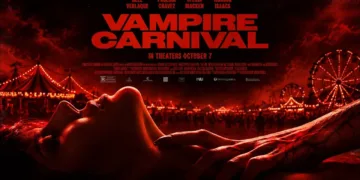
Vampire Carnival was released in theaters on October 7, 2026, and is scheduled for digital release on October 30, 2026. Directed by David Charbonier and Justin Douglas Powell, the supernatural horror-thriller follows a grieving young woman who is lured into an otherworldly traveling sideshow that feeds on despair, forcing her to confront past trauma before becoming its next permanent attraction.
Where to Watch Vampire Carnival (2026) Online
Full Credits
Title: Vampire Carnival
Distributor: Aura Entertainment, Signature Entertainment
Release date: October 7, 2026
Rating: R
Running time: 1 hour 34 minutes (94 minutes)
Director: David Charbonier, Justin Douglas Powell
Writers: Jason Filardi, Peter Filardi
Producers and Executive Producers: Not publicly specified
Cast: Nell Verlaque, Jason Isaacs, Kieron Moore, Paulina Chávez, Eoin Macken, Alicia Sanz, Cedrick Cooper
Director of Photography (Cinematographer): José Luis Bernal
Editors: Stephen Boyer
The Review
Vampire Carnival
Vampire Carnival makes its invitation convincing, then struggles to give the ensuing conflict equal definition. The tracking sequence, mirror confrontation, and Isaacs’s theatrical authority supply pleasures the screenplay cannot consistently connect. Delaying the bloodshed is defensible; leaving the relationships underdeveloped during that delay is harder to excuse. Eric’s late revelation asks for an emotional reassessment the preceding scenes have only partially prepared.
PROS
- Fluid staging of the carnival’s public spaces.
- Isaacs’s commanding theatrical performance.
- Effective hall-of-mirrors confrontation.
CONS
- Thinly developed romance with Sebastian.
- Underexplored divisions within the vampire community.
- Insufficient preparation for Eric’s late revelation.