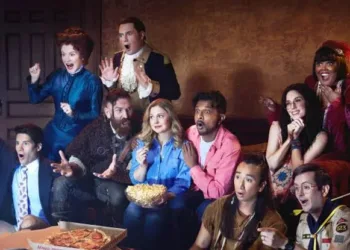





























Eugene Levy remembers keeping his head down during “The Recess Monkeys” because John Candy was making him laugh. The sketch casts Levy, Candy, and Rick Moranis as an awkward young band performing Chilliwack’s “My Girl (Gone, Gone, Gone),” with the performers’ comic assurance concealed beneath their characters’ musical inadequacy.
Watching it again in Jason Hehir’s SCTV: The Greatest Show You’ve Never Heard Of, Catherine O’Hara sings along and laughs at Levy. His recollection gives the footage an additional point of interest: the effort required to remain inside a performance while a colleague threatens to make that impossible.
The reunion footage preserves this relationship between individual skill and collective amusement. Levy, O’Hara, Andrea Martin, Dave Thomas, and Martin Short watch together, occasionally becoming commentators on their younger selves. Their responses reveal which choices still surprise them and which performances they remember struggling to withstand.
Moranis contributes separately, helping explain his own work. Across these encounters, Hehir has access to performers who can discuss the construction of a joke and remain susceptible to it. The roughly 90-minute film benefits whenever their recollections direct our attention back toward something happening in the sketch.
Its early history supplies a persuasive explanation for the series’ form. After Toronto performers including Dan Aykroyd and Gilda Radner left for Saturday Night Live, another group began making television in 1976 with a reported budget of $7,000 per episode.
The fictional station in Melonville provided an organizing device for advertisements, newscasts, talk shows, dramas, and activity behind the cameras. A station with inadequate resources could plausibly resemble the production making it. Visible wires and inexpensive sets acquired a comic function, while the framework accommodated performers whose sensibilities did not need to become identical.
The arrangement also gave the actors something to play beyond an impersonation’s surface. O’Hara’s Lola Heatherton interviewing Martin’s Mother Teresa turns on a celebrity’s inability to understand charitable work without locating a personal reward.
The encounter has a relationship, however absurd, and O’Hara’s insistence gives Martin’s presence a precise comic purpose. Hair, makeup, and costume help establish the transformation, but the writing supplies a reason for these people to occupy the same programme. Hehir’s clips make the station intelligible as a flexible storytelling structure. Its range came from the number of encounters it could plausibly broadcast.
The production history becomes harder to compress once survival and recognition begin pulling in different directions. Interruptions strained the cast’s enthusiasm, and the move to Edmonton in 1980 kept the operation going under changed circumstances. The NBC period brought additional resources and room for ambitious material.
Hehir communicates the instability surrounding the work, although the succession of production milestones moves faster than the account of how the performers adjusted to them. The early budget has a clearly demonstrated effect on the comedy. Later changes sometimes receive a date and a recollection where a fuller account of their practical consequences would help.
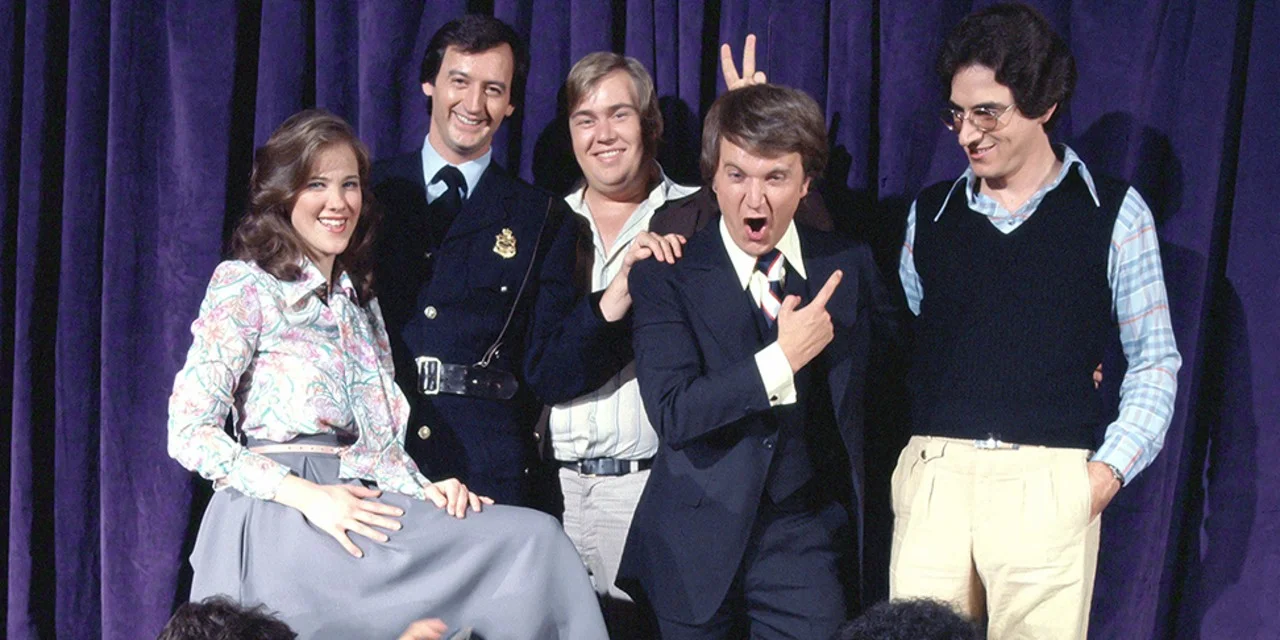
Bob and Doug McKenzie offer the strongest opportunity to connect those institutional changes to creative decisions. Moranis and Thomas devised the beer-drinking brothers after a request for more recognizably Canadian content. Material assembled as improvised filler became a popular attraction.
The documentary can trace an unusually clear sequence here: a broadcaster’s demand prompts a comic response, audiences embrace it, and its success alters the pressures within an ensemble. The characters complicate any easy account of an overlooked show finally receiving its reward. Recognition brings questions about whose contribution is being recognized and how that recognition is distributed.
The film acknowledges creative differences, pay disparities, and the friction accompanying the characters’ popularity. These admissions matter because they interrupt the assumption that affection and shared ability make collaboration self-sustaining.
Yet the account gives a firmer sense of the disagreements’ existence than of their development into departures. There is room between demanding an exposé and accepting conflict as a brief stop on the way back to the clips. The film’s early explanation of how a limitation became a creative advantage sets a standard of cause and consequence that its account of the group’s fragmentation only intermittently meets.
Its outside witnesses are similarly uneven in their contribution. Tom Hanks remembering the tapes he recorded and shared with colleagues on Bosom Buddies provides a tangible example of the comedy circulating among working actors. Bill Hader, Bob Odenkirk, Fred Armisen, Kathryn Hahn, and Conan O’Brien establish the depth of its following, but enthusiasm has diminishing explanatory value once the footage has demonstrated the appeal. Commentary identifying why a sketch is funny can interrupt the timing it means to celebrate. A joke occasionally acquires a panel of expert witnesses before it has finished making its case.
The concentration on famous American admirers also affects the history’s destination. Their testimony makes the show’s influence accessible to viewers who recognize its descendants before its original performers, but it places considerable weight on recognition south of the border.
Ending the historical account with NBC’s 1983 cancellation, while leaving the subsequent final season outside the narrative, reinforces that emphasis. An American network’s decision becomes the stopping point for a Canadian series whose life continued beyond it. The omission matters less as missing inventory than as a choice about which event is allowed to close the story.
A late exchange offers a different measure of the work’s reach. Thomas reflects that even a low-rated programme could make a million people laugh, and Hehir cuts to Short taking in the observation. The edit allows a familiar industry category, the small audience, to become a number of actual people receiving something the performers made. Short’s response gives the thought time to register without another admirer explaining its significance. After so much attention to the people who became famous watching SCTV, the film briefly makes room for the viewers who left no interview, career anecdote, or public record of having laughed.
SCTV: The Greatest Show You’Ve Never Heard Of premiered globally on Netflix on October 30, 2026. Directed by Jason Hehir, the documentary film explores the rise, legacy, and enduring influence of the legendary Canadian sketch comedy series through archival footage and intimate cast interviews.
Where to Watch SCTV: The Greatest Show You’ve Never Heard Of (2026) Online


Full Credits
Title: SCTV: The Greatest Show You’ve Never Heard Of
Distributor: Netflix
Release date: October 30, 2026
Running time: 1 hour 30 minutes (90 minutes)
Director: Jason Hehir
Producers and Executive Producers: Jason Hehir, Connor Schell, Cranston Valenzuela
Cast: Rick Moranis, Eugene Levy, Andrea Martin, Catherine O’Hara, Martin Short, Joe Flaherty, Dave Thomas, John Candy
The Review
SCTV The Greatest Show You've Never Heard Of
Hehir finds his best material where archival comedy meets the performers’ recollections: a suppressed laugh can explain the ensemble better than another declaration of greatness. The sketches demonstrate how limited resources encouraged invention, while the reunion preserves the pleasure of shared work. The historical account is less precise about the group’s fragmentation, and stopping at NBC’s cancellation leaves the story unfinished. An entertaining introduction with valuable firsthand insight, though its affection sometimes outpaces its explanation.
PROS
- Reunion footage illuminates ensemble timing.
- Sketches demonstrate the fictional station’s creative flexibility.
- Early production constraints receive clear comic context.
- Hanks provides concrete evidence of the show’s influence.
CONS
- Creative disagreements receive limited development.
- Commentary sometimes interrupts the comedy.
- The historical account omits the final season.