

















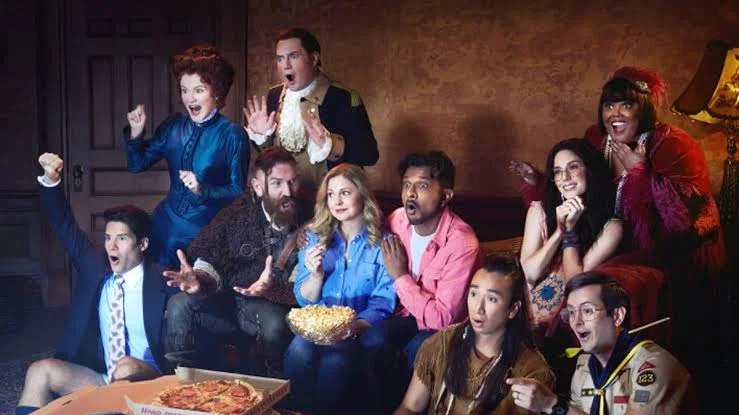

Kyle breaks a mirror playing basketball indoors, and Jay’s response is to find a replacement before Sam discovers the damage. Sensible enough, once you accept the indoor basketball. With Sam away in Australia filming her screenplay, Polar Opposites, Jay and Kyle have temporary responsibility for Woodstone’s supernatural household. Utkarsh Ambudkar and Ben Feldman make their partnership productively quarrelsome: Kyle can communicate with the ghosts, but that qualification doesn’t make the pair competent custodians. Their first repair job imports Hetty’s estranged sister.
The replacement mirror contains Margaret, who tricks Hetty into taking her place inside it. Then Jay and Mark break that mirror while moving it. “Halloween 6: The Mirror,” the two-part Ghosts Season 6 premiere, builds its complications through this pleasingly disastrous sequence of attempted solutions. Each intervention changes the problem instead of clearing it away. Sam’s absence gives the living characters room to cause trouble themselves, and the mirror makes their physical blundering consequential for people who usually have little to fear from dropped furniture.
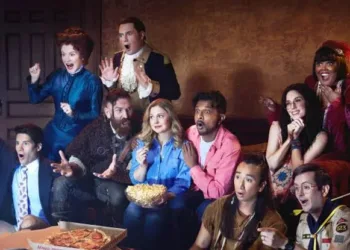
That connection supplies some excellent ensemble comedy. When Hetty ends up scattered among the fragments, Alberta announces that she has “sharded” herself, and Isaac expands the emergency to the whole Hudson Valley. Brandon Scott Jones delivers the absurdity with the conviction of someone issuing a public safety alert. The joke develops through his alarm: a childish verbal gag acquires the urgency of a regional catastrophe. A fragment leaving with a Halloween party guest also gives the party a useful role in the rescue plot. The gathering has become a distribution network for pieces of Hetty.
Bela’s romantic subplot makes less inventive use of the occasion. She hopes to attract Evan from her gym; he leaves with Amanda, one of Jay’s restaurant employees. The disappointment is easy to understand, but the reversal supplies little surprise beside the multiplying mirror problems. It is the hour’s most routine strand, useful for keeping living guests in circulation without generating much comic development of its own. The stronger material gives the party’s chaos a cost: beneath everyone’s extravagant reactions, Hetty’s predicament has become genuinely frightening.
Her relationship with Margaret gives that danger emotional substance. Hetty has spent years believing her sister betrayed her by telling their father about her forbidden involvement with a painter. The mirror’s access to memories exposes what this account leaves out: Margaret loved him first. The revelation forces Hetty to reconsider a grievance she has preserved so thoroughly that her sister’s experience barely figures in it. A supernatural device supplies the missing evidence, but the failure it exposes is recognizably Hetty’s. She has been an exceptionally diligent archivist of her own injuries.
Rebecca Wisocky makes the correction work because Hetty’s indignation has such force before it starts to give way. Her hauteur is funny, yet it also establishes the resistance an apology must overcome. Admitting that she failed Margaret requires her to surrender the position from which she has been conducting their argument. Maria Thayer gives Margaret enough hurt to complicate Hetty’s version without making her harmless. Tricking your sister into supernatural confinement remains a fairly aggressive opening bid for reconciliation. Understanding her resentment doesn’t require forgetting what she does with it.

The episode is less patient with the reconciliation once the sisters reach it. Flower’s entrance brings the comedy back before their exchange has quite finished settling. Sheila Carrasco’s ability to disrupt an emotional atmosphere is part of her appeal, but the placement makes the scene feel anxious about staying sincere. The interruption provides relief at the expense of a little breathing room. Wisocky and Thayer have earned enough trust here to hold the moment without immediate assistance from the household’s least reliable conversational participant.
Margaret’s departure gives the resolution a better balance of feeling and practical ingenuity. The mirror that imprisoned her can travel, so she chooses to remain attached to it and reaches Paris with Trevor’s daughter Abby. Its function changes again, from trap to transport. The connection between Paris and the sisters’ childhood also gives Hetty’s fascination with the city a personal history. Their repaired relationship permits a separation, with an uneven benefit: Margaret gets to go somewhere Hetty still cannot follow.
Pete’s absence runs beneath these events, and the proposed séance gives it an appropriately peculiar form. Alberta wants him back; Sasappis invokes his DNS, or “Do Not Séance,” request, alongside fears about punishment for revealing information about the afterlife. The acronym makes an excellent Pete joke, expressing supernatural anxiety through the language of contingency planning. It also creates an obstacle the household cannot responsibly solve by being louder. Alberta’s agreement to stop matters because bringing him home has been her priority. Respecting his wishes requires her to leave that desire unanswered.
The memorial on his death anniversary then appears to deliver what the abandoned séance could not: Pete returns. The premiere resolves his physical disappearance within its two episodes, avoiding the need to keep an empty space in the ensemble indefinitely. But Richie Moriarty’s character comes back without his memories of the afterlife, approaching the household as though he has only just died. The mechanism remains unexplained. The dramatic reversal is already clear, however, and its placement turns the anticipated reunion into a fresh disruption.
Hetty’s story has used recovered memories to make a relationship possible again. Pete’s return removes the history through which his friends know him, giving the two plots sharply different resolutions. That is a strong use of the double episode’s space: one reconciliation prepares us for another, then the second fails on entirely different grounds. The household has spent the premiere trying to recover someone it loves. Now its members must introduce themselves to a man for whom their affection arrives without explanation.
Ghosts returned for its sixth season with a special Halloween premiere episode on CBS on October 29, 2026. The hit comedy follows a young couple living in a country estate inhabited by a quirky group of spirits that only the wife can see and hear.
Where to Watch Ghosts Season 6 Premiere Online










Full Credits
Title: Ghosts (Season 6 Premiere: “Halloween 6: The Mirror”)
Distributor: CBS / Paramount+
Release date: October 29, 2026
Rating: TV-PG
Running time: 60 minutes
Writers: Joe Port, Joe Wiseman
Producers and Executive Producers: Joe Port, Joe Wiseman, Mathew Baynton, Jim Howick, Simon Farnaby, Laurence Rickard, Ben Willbond, Martha Howe-Douglas, Alison Carpenter, Debra Hayward, Alison Owen, Angie Stephenson
Cast: Rose McIver, Utkarsh Ambudkar, Brandon Scott Jones, Danielle Pinnock, Richie Moriarty, Asher Grodman, Rebecca Wisocky, Román Zaragoza
- Composer: Nami Melumad
The Review
Ghosts Season 6 Premiere
Woodstone’s temporary management turns a broken mirror into an excellent argument for adult supervision. The two-part premiere builds its farce through consequential mistakes, then gives Hetty and Margaret’s reconciliation enough substance to make the danger matter. Rebecca Wisocky and Maria Thayer carry its strongest scenes, while Pete’s return changes the household’s problem with admirable precision. Bela’s romantic disappointment feels routine, and Flower interrupts a moment that deserved longer to breathe. Still, this Halloween special finds fresh trouble inside familiar relationships.
PROS
- Mirror complications build through consequential mistakes.
- Wisocky and Thayer give the reconciliation emotional weight.
- Isaac’s alarm sharpens the ensemble comedy.
- Pete’s return delivers an effective structural reversal.
CONS
- Bela’s romantic subplot offers little surprise.
- Flower’s interruption rushes the reconciliation’s emotional aftermath.