
























Simone wants a child. Asked to explain that desire, however, he struggles to get past the answers that sound appropriate. In his sessions with Silvana Zappacosta, the sexologist played by Anna Bonaiuto, the prospective father begins to resemble a candidate preparing for an interview whose subject happens to be himself. Silvana notices his preference for saying what people expect. Daniele Luchetti’s You, Me, Us finds a productive discomfort here: a man can feel certain about his future while remaining remarkably incurious about the reasons he wants it.
His partner, Lucia, has been doing rather more visible negotiating. Initially opposed to marriage and motherhood, she agrees to marry him and enter the adoption process. Yet her wish to live farther from his family encounters resistance. Placed beside those concessions, Simone’s difficulty accommodating a change of address makes the language of mutual compromise sound suspiciously generous. The couple are both being asked to change, apparently. Some changes just happen to involve becoming a parent.
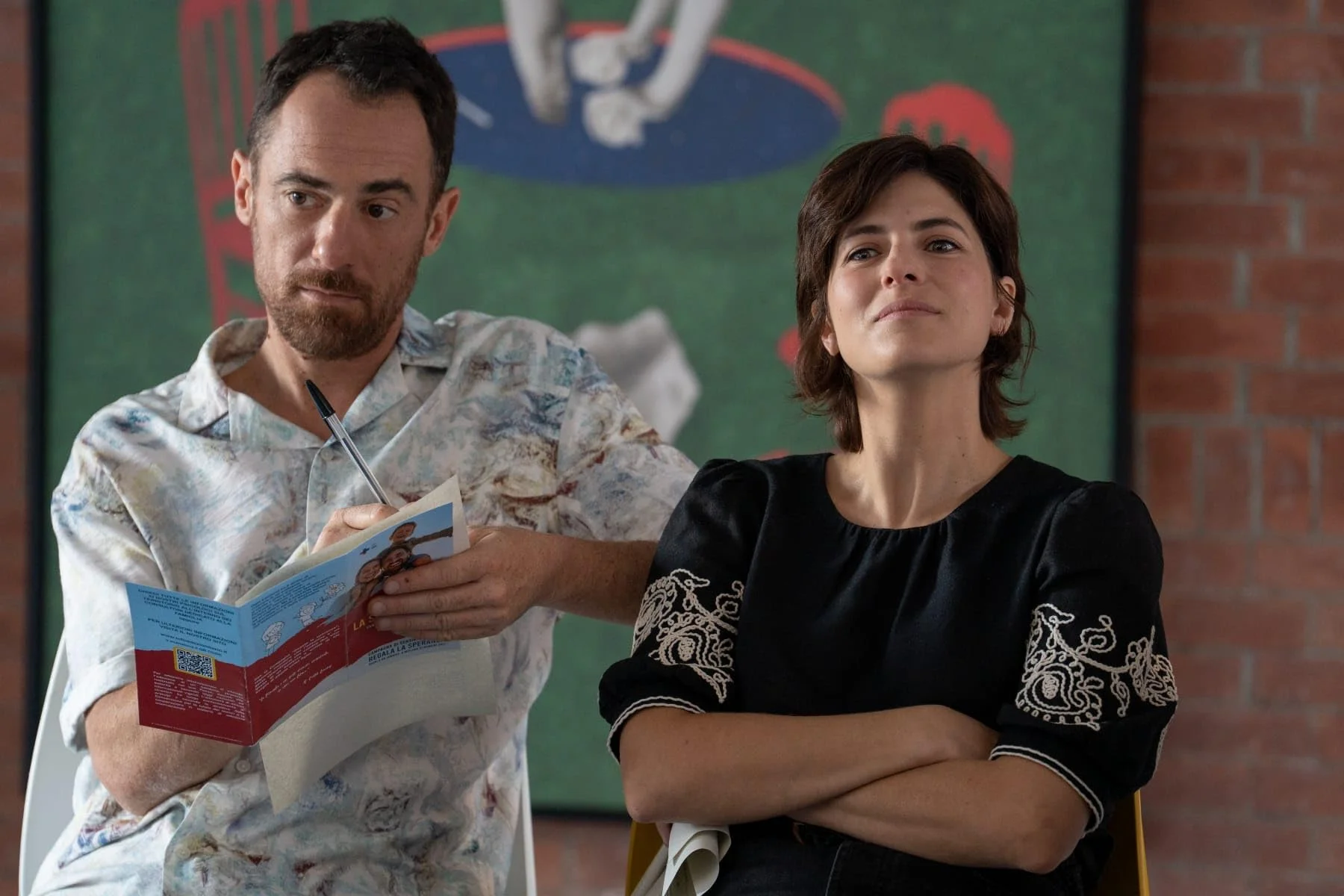
Elio Germano’s Simone is a firefighter whose attachment to family offers him a reassuring model of adulthood. Maria Chiara Giannetta’s Lucia has a less orderly personal history and a stronger investment in independence. They meet after a road accident, when he comes to her assistance; a four-year leap takes their attraction into an established relationship. Luchetti spends little time wondering if these opposites can fall in love. The difficult business concerns what their love entitles them to expect from each other.
But Lucia’s later desire to adopt complicates my objection. To read her changing mind solely as defeat would leave her trapped inside her first declaration. She would be allowed independence only on the condition that she never revise it. The film deserves credit for admitting a less convenient possibility: pressure and genuine desire can coexist, making the origin of a decision difficult to untangle. Giannetta gives this difficulty a concrete expression when Lucia holds a baby. Her discomfort remains visible while Simone sees a possible future. His hope arrives before she has had room to understand her own reaction.
That encounter also explains the value of the leads’ rapport. Affection does not make their perceptions converge. Through banter, small clashes and their persistence in returning to each other, Germano and Giannetta establish an attachment substantial enough to make separation costly. Lucia’s unease can therefore exist inside a loving relationship without automatically becoming evidence that the relationship is false. The harder question is how long tenderness can sustain an arrangement that keeps postponing its most consequential disagreement.
Luchetti builds that postponement into the screenplay. Conversations approach confrontation, then retreat; arguments remain unfinished, preserving a domestic peace that depends on leaving certain things unsaid. The repetition has psychological precision. These people have learned how to remain a couple, and part of that knowledge consists of recognizing the conversations that might stop them being one. Their everyday negotiations can be funny because each knows the other’s habits. They become uncomfortable when the same familiarity helps them avoid asking anything new.
The method also places a strain on the drama. Another arrested confrontation does not always deepen our understanding of avoidance. At times, it simply delays an exchange whose necessity is already clear. The eventual emotional eruption releases accumulated pressure, but its force cannot retroactively give every earlier postponement a distinct purpose. I wanted greater development between those interruptions, particularly around the distance between Lucia agreeing to a shared plan and coming to want it herself.
The sessions with Silvana offer a useful disruption. Her questioning interferes with the couple’s established means of getting along, especially Simone’s habit of presenting himself as reasonable. Bonaiuto’s comic function grows out of this encounter between an acceptable answer and an inconvenient follow-up. Simone has found someone for whom sounding ready requires further discussion (an unfortunate development for a man hoping readiness might be self-evident).
The adoption process makes that scrutiny necessary beyond the couple’s immediate happiness. Interviews and evaluations introduce people who cannot simply accept affection as sufficient preparation. Luchetti gives these institutional encounters a hopeful character: they can provide occasions for listening and disclosure, with questions that the lovers have learned to evade at home. The film’s warmth is useful here. Simone’s inability to explain himself can become material for examination without requiring him to be humiliated.
Still, the movement toward emotional reassurance leaves a difficult remainder. A couple reaching greater honesty is a meaningful achievement; preparing to take responsibility for a child raises another set of demands. The late release of withheld feeling gives the relationship a catharsis that the adoption question cannot automatically share. Luchetti’s generous treatment of his protagonists sometimes makes those two kinds of progress feel too closely aligned.
Silvana’s challenge to Simone points toward a less comfortable future beyond that release. He has to learn to recognize an answer he supplies for approval. Parenthood will bring occasions when no evaluator is present, Lucia wants something he cannot readily accommodate, and another person’s needs interrupt the family life he imagined. His newly examined desire will have to survive being lived with, including by people who never agreed to the version he had rehearsed.
You, Me, Us premiered globally on Netflix on October 29, 2026, following its screening at the Rome Film Festival. Directed by Daniele Luchetti, the Italian drama follows a mismatched couple whose strong relationship is tested when they decide to pursue adoption.
Where to Watch You, Me, Us (2026) Online


Full Credits
Title: You, Me, Us (Italian: Noi, un po’ meglio)
Distributor: Netflix
Release date: October 29, 2026
Rating: TV-MA
Running time: 1 hour 47 minutes (107 minutes)
Director: Daniele Luchetti
Writers: Enrico Audenino, Davide Lantieri, Serena Patrignanelli, Daniele Luchetti
Producers and Executive Producers: Andrea Occhipinti
Cast: Elio Germano, Maria Chiara Giannetta, Anna Bonaiuto, Ilaria Spada, Caterina Guzzanti, Dajana Roncione, Jacopo Olmo Antinori, Francesca Romana De Martini
Director of Photography (Cinematographer): Ivan Casalgrandi
Composer: Andrea Laszlo De Simone
The Review
You, Me, Us
You, Me, Us is sharpest when Simone discovers that wanting the expected things does not mean understanding himself. Germano and Giannetta make affection believable without pretending it settles the couple’s disagreement. I admire that generosity, though the stalled confrontations and Lucia’s unevenly developed change of heart leave the reassurance doing too much work. Love gets these people talking. The film is less persuasive about what their conversation resolves.
PROS
- Convincing affection between the leads.
- Incisive questioning of Simone’s unexamined certainty.
- Adoption evaluations give private assumptions useful scrutiny.
CONS
- Repeatedly deferred confrontations stall development.
- Lucia’s changing desire needs fuller exploration.
- Emotional reconciliation too readily suggests parental readiness.