



















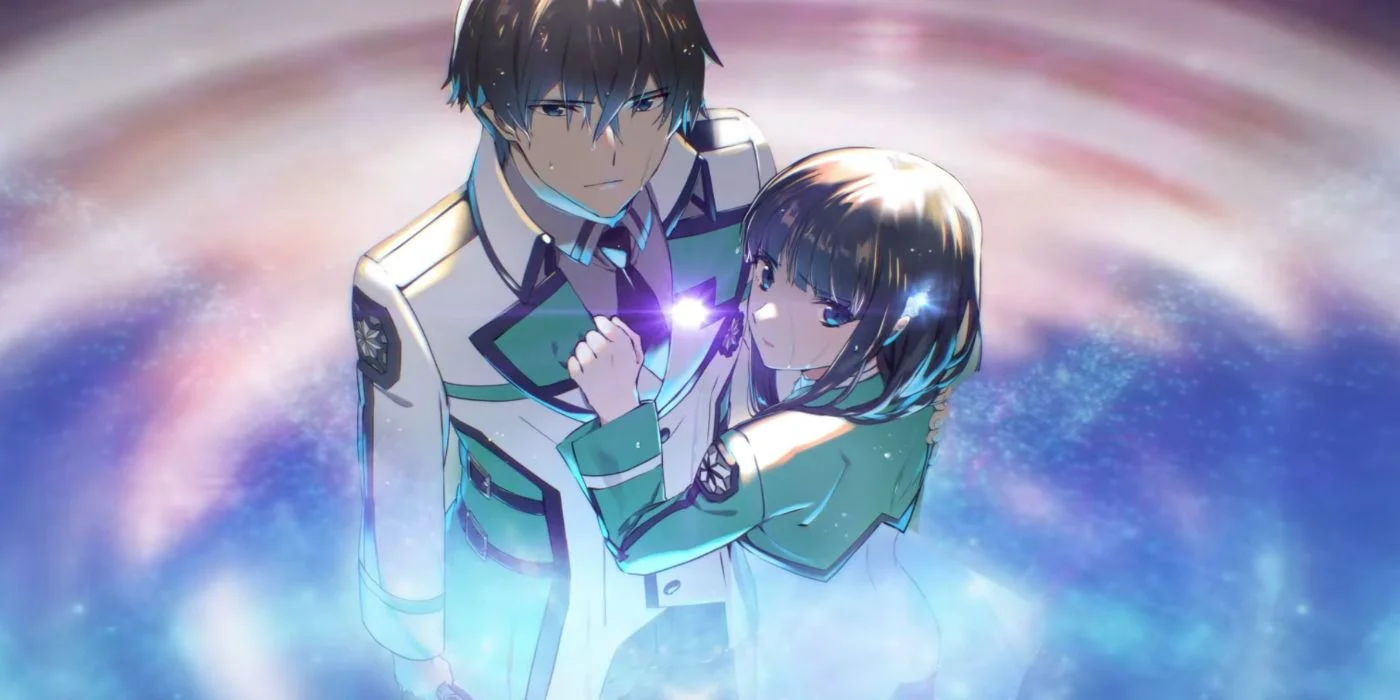

The Yotsuba family’s past is drained almost to monochrome, but its violence remains horribly legible. Maya’s abduction and abuse lead to a campaign of retaliation that establishes the clan’s capacity to punish anyone who harms its members. The restricted palette gives this history a separate visual register, removed from the polished surfaces of the present. Yet the family’s protective instinct already carries something frightening. Its response to an injured person becomes a demonstration of collective power, and the injured person must continue living within that power.
Tatsuya’s emotional conditioning brings this history of control into the intimate life of the family. His mind has been altered so that his attachment to Miyuki survives where other feelings have been curtailed. The clan’s intervention reaches beyond conduct into the capacity to feel. This is familiar psychological-thriller territory: identity shaped by forces whose authority predates any possibility of consent. Tatsuya’s formidable abilities cannot undo that original imbalance. He can overcome an opponent. Choosing the emotional terms of his own existence presents a different problem.
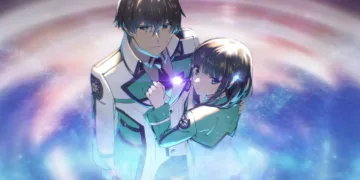
The Irregular at Magic High School THE MOVIE – Yotsuba Succession Arc places that problem inside a struggle over family leadership. Miyuki faces the prospect of a marriage chosen for her, with succession offering a possible means of controlling her future and protecting her place beside Tatsuya. The arrangement has a particularly cruel logic. To escape the clan’s decisions, she must acquire the power to make them. The film gives its theatrical scale to this negotiation, moving the dramatic emphasis away from Tatsuya’s combat superiority and toward the authority exercised over both siblings.
Miyuki’s collapse on the floor provides the necessary human scale. Her distress has specific objects: intimacy with a man she does not want, separation from the person she trusts, and the possibility that Tatsuya might find a romantic attachment elsewhere.
The film treats these fears seriously, allowing the sibling attraction to become a sustained source of pain rather than a recurring comic provocation. Her physical sickness matters. An arranged marriage ceases to be an abstract obligation when her body recoils from its implications. The scene earns sympathy without requiring us to accept her desired solution.
Her dependence also has a credible history. Within a family that has repeatedly subordinated the siblings to its interests, Tatsuya has been her reliable ally. Losing him would mean losing the relationship through which she has experienced security. Yet that security rests partly on an intervention inflicted upon him.
His devotion is real in its effects, even as its imposed origin troubles any easy celebration of it. Miyuki wants freedom from other people’s plans while hoping to preserve a bond that restricts Tatsuya’s emotional possibilities. The film becomes most interesting when both truths remain visible, without treating her suffering as an answer to his predicament.
The direction works hard to give these largely verbal conflicts a cinematic existence. Slow rotations shift our position around conversations; low-angle compositions interrupt the level exchange of talking faces; attention to background objects gives the eye somewhere to travel while explanations continue.
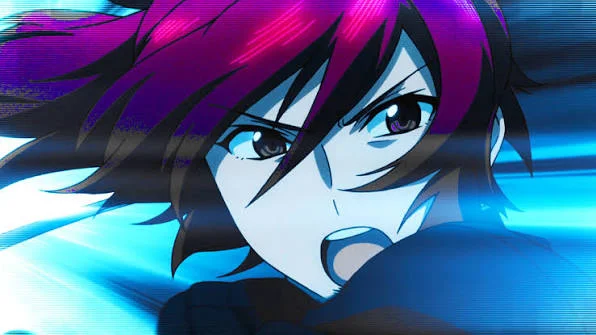
Surreal passages give private thought a visible form. These devices keep the image active without manufacturing a battle every time the dialogue grows dense. Their success is partly a matter of duration: the film makes room for uncomfortable emotional material by giving the viewer something to examine while listening.
The detailed character rendering contributes to that attentiveness. Hair continues to move, and highlights on faces and clothing take their color from nearby light sources. The figures feel situated within an environment, rather than pasted against decorative backgrounds.
This polish suits a story in which the family’s dignified appearance coexists with invasive control. There is pleasure in looking at the Yotsuba world, even while learning what it has done to its children. Still, the camera’s mobility has limits. Changing our position around an explanation cannot give the listener greater freedom to challenge it. Visual energy sustains these scenes; the distribution of knowledge remains firmly in adult hands.
That limitation becomes decisive when Maya supplies the revelations concerning the siblings’ origins and the terms of their relationship. Flashbacks and explanatory dialogue perform the work that a climactic confrontation might usually undertake. There is nothing inherently inadequate about this choice.
Information can be violent, especially when it changes a person’s understanding of the life already lived. Here, however, explanation also becomes a convenient instrument of reassurance. The film offers a route through the objections surrounding Miyuki’s desire, and the machinery of family authority begins authorizing an outcome it previously appeared to obstruct.
The sparse combat makes this dependence on disclosure unusually exposed. Three of the four fights are brief, and the longer encounter does not resolve the central emotional dispute. Anyone awaiting a sustained demonstration of Tatsuya’s overwhelming strength will find the release subdued.
The more relevant weakness is that the conversations must bear nearly all the weight of the payoff, including a burden they cannot fully discharge. Maya can explain the family history. The clan can revise its position. Neither act can produce a romantic feeling in Tatsuya simply because the story has made room for one.
His attachment to Miyuki remains familial, and this prevents the apparent resolution from becoming emotionally complete. His restraint should not be mistaken for an empty characterization: the distinction between what he feels and what others now permit is the substance of his role here. Miyuki’s feelings have gained an explicit place in their shared life, which leaves him with a new responsibility toward her expectations. Returning to school or continuing to live beside her will now involve knowing that familiar gestures of care may carry a meaning he does not share.
The Irregular at Magic High School THE MOVIE premiered theatrically in North America on November 1, 2026. Directed by Jimmy Stone, the anime feature film follows magical siblings Tatsuya and Miyuki Shiba as they face high-stakes political conspiracies and deadly threats involving the powerful Yotsuba clan.
Full Credits
Title: The Irregular at Magic High School THE MOVIE
Distributor: Crunchyroll / Sony Pictures
Release date: November 1, 2026 (United States and Canada)
Rating: Not Rated
Running time: 1 hour 43 minutes (103 minutes)
Director: Jimmy Stone
Writers: Tsutomu Satō
Cast: Yuichi Nakamura, Saori Hayami, Chiwa Saitô, Daisuke Ono, Ai Kayano
The Review
The Irregular at Magic High School THE MOVIE
Visually meticulous and psychologically uneasy, Yotsuba Succession Arc finds its strongest drama in the family’s control over the siblings’ emotional lives. Miyuki’s distress earns sympathy, while Tatsuya’s conditioning complicates the romance the clan begins to authorize. Slow camera rotations and finely rendered lighting sustain the conversations, but the explanatory climax offers reassurance faster than it resolves the problem of reciprocal desire. The subdued combat matters less than that unfinished emotional negotiation.
PROS
- Miyuki’s distress receives serious dramatic attention.
- Expressive camera movement and detailed lighting.
- Emotional conditioning gives the family conflict ethical weight.
CONS
- Heavy reliance on explanatory dialogue.
- Romantic reassurance outpaces emotional resolution.
- Limited physical catharsis from the brief fights.